When I told people I was off to visit Liège, for the most part the retort was ‘where?’.
This charming city in Wallonia, Belgium seems to be a well kept secret. I can’t imagine why as there’s plenty to explore in Liège.
Table of Contents
An Introduction to Liège:
Liège is in French speaking Wallonia, Belgium, set along the Meuse River in the mid-Eastern part of the country. The city was developed on large river islands at the confluence of the Meuse and Ourthe Rivers, originally settled on by nomadic tribes. It is Belgium’s third largest city after Brussels and Antwerp, with a population of about 195,000, and houses a large thriving university, which brings with it youth and vibrancy.
Liège has a long continuous history and has been an important Belgium city, growing up on the Meuse. Liège started some 7000 years ago. The first village of Liège was built around 500 BC in the upper area of the valley, it remained a small village for thousands of years, and during the Middle Ages, thanks to a bishop named Lambert, it started to grow. However Bishop Lambert was brutally murdered in 700 AD by a rival family for political reasons, his relics were buried in the place where he was murdered; a small chapel was erected in the what is now known as St Lamberts Square. Liège rapidly became a place of pilgrimage; it is said that many miracles occurred after his death.
Around 800 AD Liège became the capital of the diocese, which it remained until the French Revolution in 1789. The city grew after the revolution, and in the early 19th century it became an important industrial centre producing coal and steel, which led to the immigration of many Italians who now make up 5% of the population; now Liège is home to many different nationalities. Liège suffered terrible damage during the 2nd World War and so it went through a massive period of renovation and in the 70’s many houses were dismantled and reconstructed in order to move old buildings out of the slums.
Liège’s architecture is an eclectic mix of old and new, tradition and modernity meet to create a flourishing city, not always pretty but it provides some magnificent examples of medieval buildings and elegant 19th century houses set in wide boulevards through to the Brutalist architecture of the 60’s and 70’s and everything in-between. During the latter period the city became very impoverished and many of the middle classes left the city.
However, today’s Liège is prospering and finding its feet again, helped by its friendly populace. Known in French as the Citée Ardente (literally the ‘fiery city’), due to the warmth and enthusiasm of the local folk, it’s a genuinely welcoming place to visit. Period buildings are being renovated and converted into unusual museums, galleries, restaurants, and breweries, there are pretty parks to stroll in, interesting cultural venues, design shops, and boutiques and a thriving culinary scene along with a unique beer culture.
We were lucky enough to take a walking tour of the city on our first afternoon in the city with Anne who proved to be a wonderfully informative guide. It happened to be one of the hottest days of the year to walk the streets despite which Anne managed to give us a hugely pleasurable and interesting insight into the history of Liège and took us to see some of its most historic buildings and sights. Here are some of the places you shouldn’t miss in Liège:
The Place Saint-Lambert:
The Place Saint-Lambert is the main square in the centre of Liège and it is very much at the heart of the city. Until 1794 it was home to St Lambert’s Cathedral, a huge Gothic building that was dedicated to the martyr Saint Lambert and Our Lady, however it was completely destroyed after the Liège revolution in 1789. In October 1898, while installing a sewage system underneath the square, various artifacts from the Middle Ages and the Roman period were found, it was excavated a few years later in 1907. Today in the Archéoforum museum, which is located underneath the square, you are able to see the foundations of three successive cathedrals and many historical artifacts. A visit here in the underground tunnels gives a fascinating insight in to the history of the city.
Palace of the Prince-Bishops:
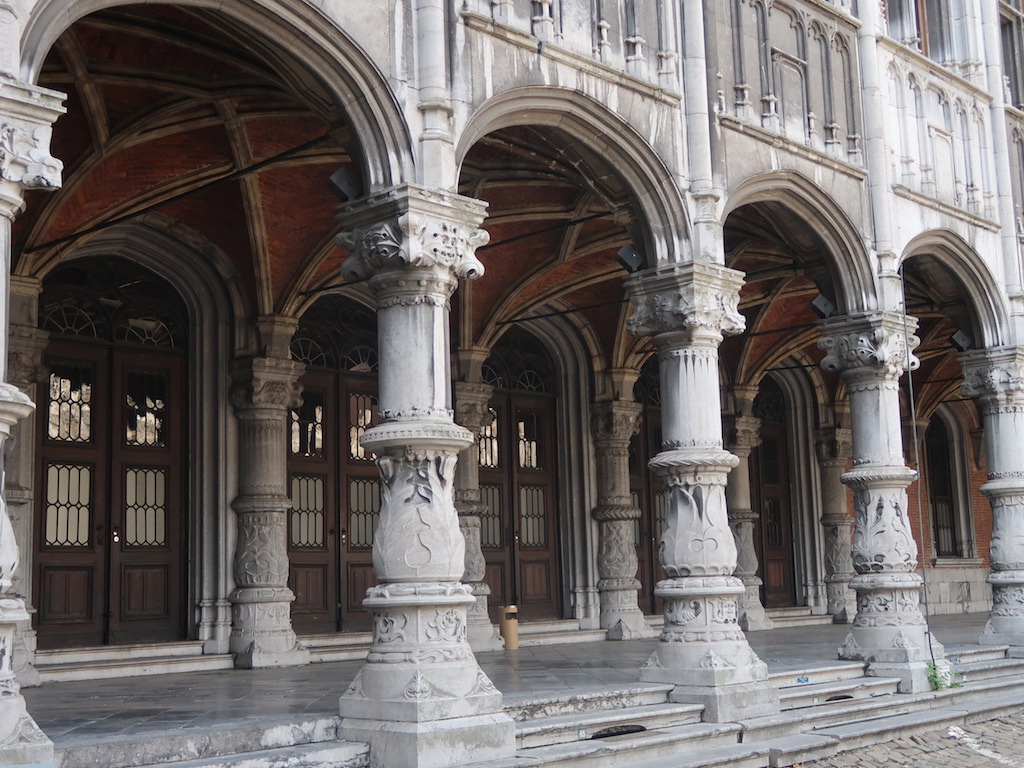
The present Palace of the Prince-Bishops was proceeded by two buildings, the first was built by Bishop Notger, but it was destroyed by fire in 1185, the second was also destroyed by a fire in 1505 and then reconstructed by Prince Erard de Marck, who commissioned the architect Arnold van Mulcken to do the work. This grand building is a remarkable mishmash of styles, with a mixture of Italian and French Renaissance architecture and remains of the Gothic style, all of which were influenced by the Prince-Bishop’s worldly travels.
The palace now houses the Courts of Justice on one side and the provisional government headquarters on the other, as a result, the public cannot visit the inside of the palace but I was suitably impressed by its stunning courtyard with its beautiful Renaissance columns.
The Citadel Hill:
The Citadel was the central fortification of Liège up until the end of the 19th century. Just a few minutes walk from the Place Saint-Lambert and very close to the Montagne de Bueren, you are able to walk up the to the wooded hills which are located within the Citadel. It’s a beautiful verdurous space, an unexpected natural haven so close to the city centre, and along with many iconic monuments, there are 90 hectares of lush greenery to explore. We walked along the paths and alleyways and up and down narrow stairways.
It’s perfect for a peaceful walk in the countryside and it provides spectacular views over the city. Because of its high position, it gets maximum sunlight which was ideal for growing fig trees, vines and lavender over the hillside.
I was amazed to discover that up to 8000 people still live in the houses up on the hillside today.
The Minimes’ terraces:
The hillside was once colonised by religious elders and you can still see the old convents and churches. The Friars Minimes appeared in the 15th century. They followed very strict rules. Penitence, humility and love were important to them. They believed in perpetual fasting. They cared for the poor and the sick. Their motto was “Charitas, humilitas”, charity and humility. Which can be seen on a stone marked with “Charitas”.
The Ursuline dead-end passage:
The Ursulines’s dead-end passage was first mentioned in the 17th century although it may be older; it is the largest dead-end passage of the hillside. It is made up of steep narrow paths and stairways; the stairs are incredibly well worn and very slippery as I found out!
Brewery Curtius in the former Beguinage:
We visited the Curtius Brewery for a tour and lunch (more on Brewery C in my next post)) in a beautiful building set on the hillside, which was once a beguinage. Much like a nunnery, a beguinage is a small religious community for women who didn’t want to marry. They lived supervised by a priest, caring for the poor and the sick, but unlike nuns didn’t have to make vows, so they could leave the community when they pleased.
The Montagne de Bueren:
The Montagne de Bueren is the most breathtaking set of steps I have ever seen and one of Liège’s must-see attractions. There are 374 of them at a 30% incline and unsurprisingly they are listed in the top 10 most memorable stairs in the world. The stairways were built in 1880 to enable the troops, who lived in barracks at the top of the hill at the Citadel to get quickly into the city if there was an invasion, riots or demonstrations, and rumour has it that the soldiers were forbidden to use the Rue Pierreuse, which led into the city because it was a street of disrepute; home to brothels and drinking houses.
Once a year, on the first Saturday in October, the stairs and the hillsides are covered with thousands of candles, and every two years in the spring, they are covered with thousands of flowers, it sounds enchanting I only wish I had been there to see it.
At the top of the steps is a school and the children regularly run up and down the steps to get to school on time, it’s certainly a great way to keep fit and get your daily exercise!
On the day of my visit, it was 39 degrees and I have to admit I didn’t have the energy or inclination to embrace the challenge.
The Collegiate Church of Saint Bartholomew:
Saint Bartholomew is one of the oldest churches in Liège and a rare Romanesque building. It boasts a characteristic Rheno-Mosan architecture, a regional form of Romanesque architecture from the valleys of the Meuse and Rhine Rivers with stone-framed windows, decorated architraves and alternating layers of brick
Saint Bartholomew church was erected in the second part of the 11th century outside the city walls. It took about a hundred years to finish the works in the western block, which was completed around 1180. Unlike other churches, it was not transformed into the Gothic style and has kept its Romanesque style.
Saint Bartholomew houses a unique piece of art, known to be one of the seven wonders of Belgium: a brass baptismal font created in the 12th century.
Dead End Passages in Hors Château:
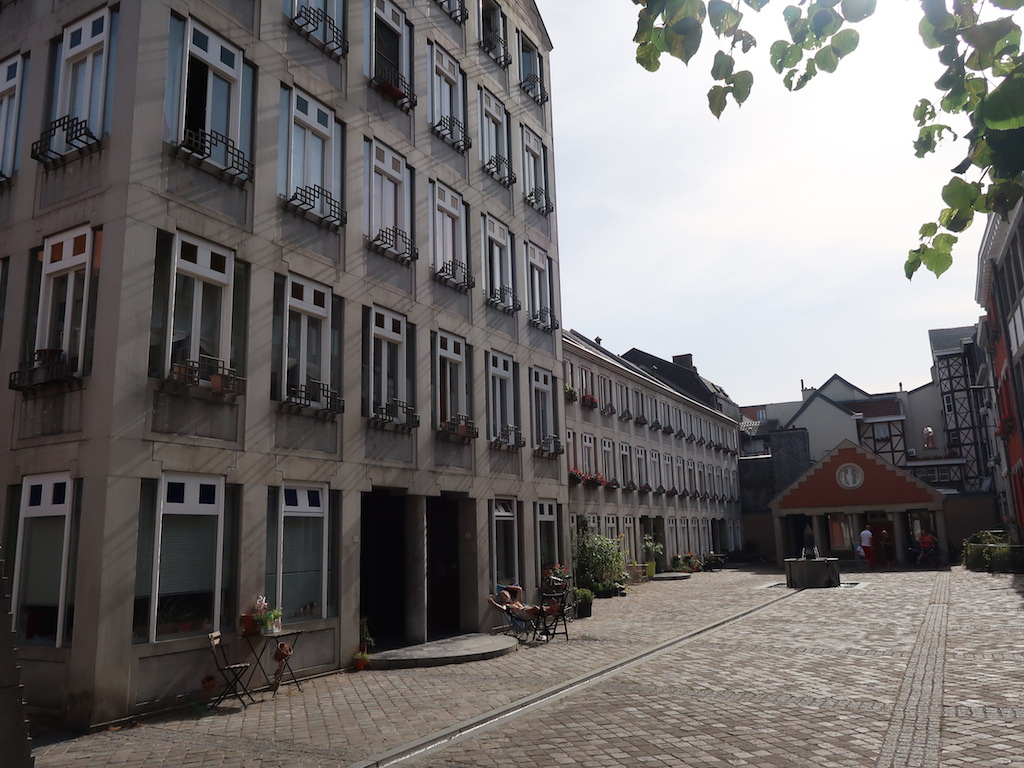
There are lots of wonderful little places to discover in Liège. These houses, for example, date back to the 17th and 18th centuries. During the 60’s and 70’s, most of them were in ruin and the local authority wanted to knock them down, but local people started to buy them and renovate them. It is now its a charming area full of beautiful well cared for houses, incredibly pretty and quintessentially Liégeois.
Saint Antony Court – Tikal Square:
This unique and elegant housing area in Tikal Square was designed by a famous Belgian architect called Charles Van den Hove; his Art Nouveau influenced designs were inspired by the Scottish architect Charles Mackintosh. At the end of the 1970’s, it was a far cry from what it is today. The old houses from the 17th and 18th centuries had become terrible slums and the area also housed an old brewery warehouse. In 1979 the Walloon Social Housing department decided to create a social housing complex here. In Liège it was more usual when housing became run down, to just to tear it down and build from scratch, but in this case the old houses got a bright and colourful new lease of life in what is now a lovely tranquil place to live.
Les principautaires :“the people living in the Principality of Liège”.
A Liège artist called Mady Andrien created this large metal sculpture which depicts two groups of people: the rulers, standing high above the population, looking down on the people below them, the people below are represented by happy and carefree children playing with their dog.
Liège-Guillemins Railway Station – Designed by Santiago Calatrava:
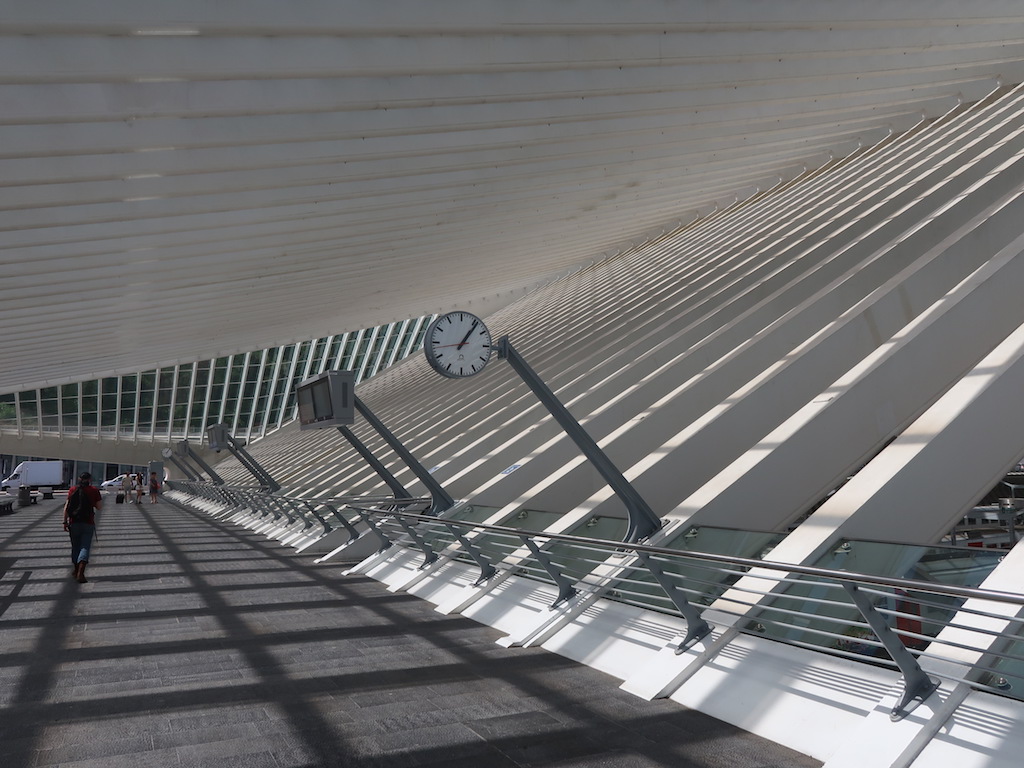
My first glimpse of Liège was the magnificent Liège-Guillemins railway station that was designed by Spanish architect Santiago Calatrava and opened in 2009.
Its impressive structure is a sight to behold and a photographer’s dream with its sweeping lines in hues of white and grey, overhung by a huge canopy of glass and steel, pouring in light and glimpses of colour as the trains draw into the station. A landmark for the city and definitely worth a trip even if you don’t arrive in Liège by train.
La Boverie Park and Museum:
La Boverie Park and Museum was about at 25-minute walk from our hotel, an enjoyable walk across the river in the direction of the Calatrava’s magnificently designed Guillemins Railway Station, which you can access directly by bridge from the park which is also flanked by the majestic new Paradise Tower and design centre.
The La Boverie Museum is a striking monumental building, which is housed in the 1905 World Fair’s Fine Art Palace. Renovated between 2013-16 it sits regally in the pretty park along the River Meuse, where the gently sloping lawns and duck ponds create an oasis of calm. If the weather is good this is the perfect spot for a picnic.
The Boverie’s current exhibition Viva Roma is brought to Liège in partnership with La Louvre and brings together a fabulous collection which depicts Rome through the expressions of European paintings of the Eternal City. It takes you on a Grand Tour of the followers, ancestors, collectors, artists and amateurs who travelled to refine their education from the 17th century until the present day.
For those looking for a more contemporary vision, the Fernand Flausch Retrospective is an exhibition by multi -disciplinary Belgium artist who was initially influenced by pop art, music, graffiti and American comics. Housed here at the Boverie, you’ll find an inspirational and colourful collection on show.
Finally, The small permanent collection in the basement of the building seems limited but does include some lesser-known works by artists Chagall, Ensor, Gauguin, Franz Marc and Magritte.
Museum of the Walloon Life:
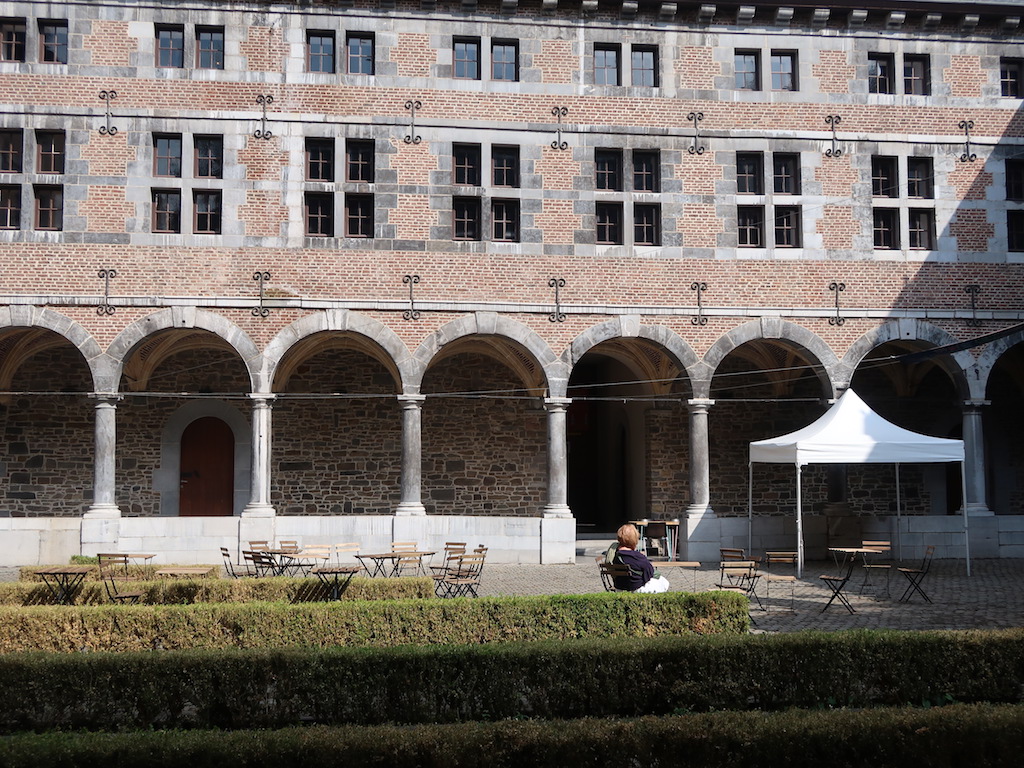
Walloon Life is a beautifully designed modern museum located in the heart of Liège, in the magnificent former monastery of the Liege Friars Minor. It gives a fascinating insight into life in Wallonia through the age, depicting its history and culture from the 19th century. And, the Museum of Walloon Life houses the most extensive exhibition of Belgium folklore, covering its festivals and religions and puppetry.
During my visit there was a fantastic exhibition called Super-Puppets, which I loved…they say it is designed for the young and the young at heart (they were right!). It creates an original and fun way to discover Wallonia ’s rich and diverse heritage.
Visiting Liège:
I travelled by to Liège by Eurostar from London’s Kings Cross St Pancras to Brussels where we changed and then took a one-hour train journey to Liège. The Eurostar has to be my favourite way of travelling it is both effortless and fast. This time I very much enjoyed the luxury of a Standard Premier ticket, which includes a pleasant light meal and drinks and helpful friendly service into the bargain.
Liège is a beautiful Belgian city, with so much to discover. Please look out for my next post where I will be writing about some of the wonderful places to eat and stay in the city centre.
I was invited to visit Liège by the WalloniaTourist Board. You can find out more about what to do and where to stay on their website.
Thinking of visiting yourself? Why not pin this post for later
16 thoughts on “Visit Liège – Discovering Belgium’s Secret City!”
This is the first time I have read about Liege and I am absolutely in love with it. There is plenty of things to see and admire there. It has amazing architecture marvels especially the Palace of the Bishop. The super puppets looks so quite and great that you could see them. Railway station too will be a photographers delight. Thanking for sharing the detailed post on Liege.
So many little places in Belgium that we have yet to explore. The architecture looks very appealing and I love all the pictures you have posted. The old houses are so pretty!
Liege looks a real offbeat place in Belgium. Meuse river in fact gives a distinct charm to this third largest city of Belgium. Good to know the history of this city and about Bishop Lambert. The Place Saint Lambert looks grand and beautiful. Would love to visit this place some day.
To be honest, if you would have told me that you were off to Liège, I would have said the same “Where?”. We cycled across Belgium and visited many unpopular places there, but we still didn’t know about Liège. the architecture looks wonderful. The rail station looks amazing.
I haven’t heard much about Liège; the architecture looks wonderful. Bummer that you can’t visit the Palace of the Prince-Bishops. Would love to see the Montagne de Bueren and explore the passages
What a fascinating overview of Liege. I’ve spent time in Brussels and wish I had known about Liege. I love the architecture. From Place Saint-Lambert to the incredible stairs at Montagne de Bueren. What a great mix. How was the food? Looking forward to your brewery post to see more about the cuisine. The next time we go back to Belgium, we’ll be sure to visit Liege.
Almost makes me want to go back to Belgium. Didn’t see this area. Love the architecture. It’s great that a 25 min walk lead you to some beautiful sights.
FYI, you can commute quite easily from Brussels to Liège. The IC train goes from 3 stations in Brussels (Midi, Central and Nord) to Liège-Guillemins station. It takes less than 1 hour and it shouldn’t be more than 30€ (round-trip). Enjoy the Cité Ardente! PS: You’ll find one of the biggest fairground in Belgium which stands in Liège for the whole month of October.
A very enthusiastic description of our ” Cité Ardente”. A few important topics to add: – the river ferry ( ) – Liège is European Capital of Christmas in 2018 ( We’ll be happy to accommodate your readers in our guesthouse and give them more practical informations. Michel http://www.redandbreakfast.be
To provide the best experiences, we use technologies like cookies to store and/or access device information. Consenting to these technologies will allow us to process data such as browsing behaviour or unique IDs on this site. Not consenting or withdrawing consent, may adversely affect certain features and functions.
Functional
Always active
The technical storage or access is strictly necessary for the legitimate purpose of enabling the use of a specific service explicitly requested by the subscriber or user, or for the sole purpose of carrying out the transmission of a communication over an electronic communications network.
Preferences
The technical storage or access is necessary for the legitimate purpose of storing preferences that are not requested by the subscriber or user.
Statistics
The technical storage or access that is used exclusively for statistical purposes.The technical storage or access that is used exclusively for anonymous statistical purposes. Without a subpoena, voluntary compliance on the part of your Internet Service Provider, or additional records from a third party, information stored or retrieved for this purpose alone cannot usually be used to identify you.
Marketing
The technical storage or access is required to create user profiles to send advertising, or to track the user on a website or across several websites for similar marketing purposes.
To provide the best experiences, we use technologies like cookies to store and/or access device information. Consenting to these technologies will allow us to process data such as browsing behaviour or unique IDs on this site. Not consenting or withdrawing consent, may adversely affect certain features and functions.
Functional
Always active
The technical storage or access is strictly necessary for the legitimate purpose of enabling the use of a specific service explicitly requested by the subscriber or user, or for the sole purpose of carrying out the transmission of a communication over an electronic communications network.
Preferences
The technical storage or access is necessary for the legitimate purpose of storing preferences that are not requested by the subscriber or user.
Statistics
The technical storage or access that is used exclusively for statistical purposes.The technical storage or access that is used exclusively for anonymous statistical purposes. Without a subpoena, voluntary compliance on the part of your Internet Service Provider, or additional records from a third party, information stored or retrieved for this purpose alone cannot usually be used to identify you.
Marketing
The technical storage or access is required to create user profiles to send advertising, or to track the user on a website or across several websites for similar marketing purposes.




 There are lots of wonderful little places to discover in Liège. These houses, for example, date back to the 17th and 18th centuries. During the 60’s and 70’s, most of them were in ruin and the local authority wanted to knock them down, but local people started to buy them and renovate them. It is now its a charming area full of beautiful well cared for houses, incredibly pretty and quintessentially Liégeois.



 A Liège artist called Mady Andrien created this large metal sculpture which depicts two groups of people: the rulers, standing high above the population, looking down on the people below them, the people below are represented by happy and carefree children playing with their dog.


 La Boverie Park and Museum was about at 25-minute walk from our hotel, an enjoyable walk across the river in the direction of the Calatrava’s magnificently designed Guillemins Railway Station, which you can access directly by bridge from the park which is also flanked by the majestic new Paradise Tower and design centre.





This is the first time I have read about Liege and I am absolutely in love with it. There is plenty of things to see and admire there. It has amazing architecture marvels especially the Palace of the Bishop. The super puppets looks so quite and great that you could see them. Railway station too will be a photographers delight. Thanking for sharing the detailed post on Liege.
I hope you manage to pay it a visit one day. The railway station is really quite awesome!
So many little places in Belgium that we have yet to explore. The architecture looks very appealing and I love all the pictures you have posted. The old houses are so pretty!
Yes, so much to explore, I loved the old houses in the pretty courtyards they were quite a find.
Liege looks a real offbeat place in Belgium. Meuse river in fact gives a distinct charm to this third largest city of Belgium. Good to know the history of this city and about Bishop Lambert. The Place Saint Lambert looks grand and beautiful. Would love to visit this place some day.
To be honest, if you would have told me that you were off to Liège, I would have said the same “Where?”. We cycled across Belgium and visited many unpopular places there, but we still didn’t know about Liège. the architecture looks wonderful. The rail station looks amazing.
As a person living in Liège, I really enjoyed your article about our fiery city. Thanks a lot!
I haven’t heard much about Liège; the architecture looks wonderful. Bummer that you can’t visit the Palace of the Prince-Bishops. Would love to see the Montagne de Bueren and explore the passages
What a fascinating overview of Liege. I’ve spent time in Brussels and wish I had known about Liege. I love the architecture. From Place Saint-Lambert to the incredible stairs at Montagne de Bueren. What a great mix. How was the food? Looking forward to your brewery post to see more about the cuisine. The next time we go back to Belgium, we’ll be sure to visit Liege.
Thank you I’m glad you enjoyed the post, I hope you get to get to Liège on your next visit.
Almost makes me want to go back to Belgium. Didn’t see this area. Love the architecture. It’s great that a 25 min walk lead you to some beautiful sights.
It is wonderful to be able to walk everywhere, it made our stay all the more pleasurable.
We will be in Brussels this October. It is only an hour away! I may get to see the Montagne and witness the architecture in the remake of a city.
FYI, you can commute quite easily from Brussels to Liège. The IC train goes from 3 stations in Brussels (Midi, Central and Nord) to Liège-Guillemins station.
It takes less than 1 hour and it shouldn’t be more than 30€ (round-trip).
Enjoy the Cité Ardente!
PS: You’ll find one of the biggest fairground in Belgium which stands in Liège for the whole month of October.
Liege, la cite ardente!
I love it, that’s where I’m from and don’t understand why the travel agencies don’t advertise it?
A very enthusiastic description of our ” Cité Ardente”.
A few important topics to add:
– the river ferry ( )
– Liège is European Capital of Christmas in 2018 (
We’ll be happy to accommodate your readers in our guesthouse and give them more practical informations.
Michel
http://www.redandbreakfast.be