

Last Updated on November 8, 2026
The art of Relaxation in Northern Portugal
I wasn’t sure slow travel was for me. I tend to travel intensely, packing in as many sights, museums and restaurants as I can in a day, intent on experiencing as much of a city as possible before moving on. After a three-week road trip through Portugal, travelling from the Algarve in the south to the Douro Valley in the north, I had visited so many towns and cities that even I felt ready to slow down. The Minho region proved to be the ideal area in which to do so. Slow travel is not just an attitude; it is more easily achieved in surroundings that are so peaceful and hospitable that you want to take your time to dig deeper.

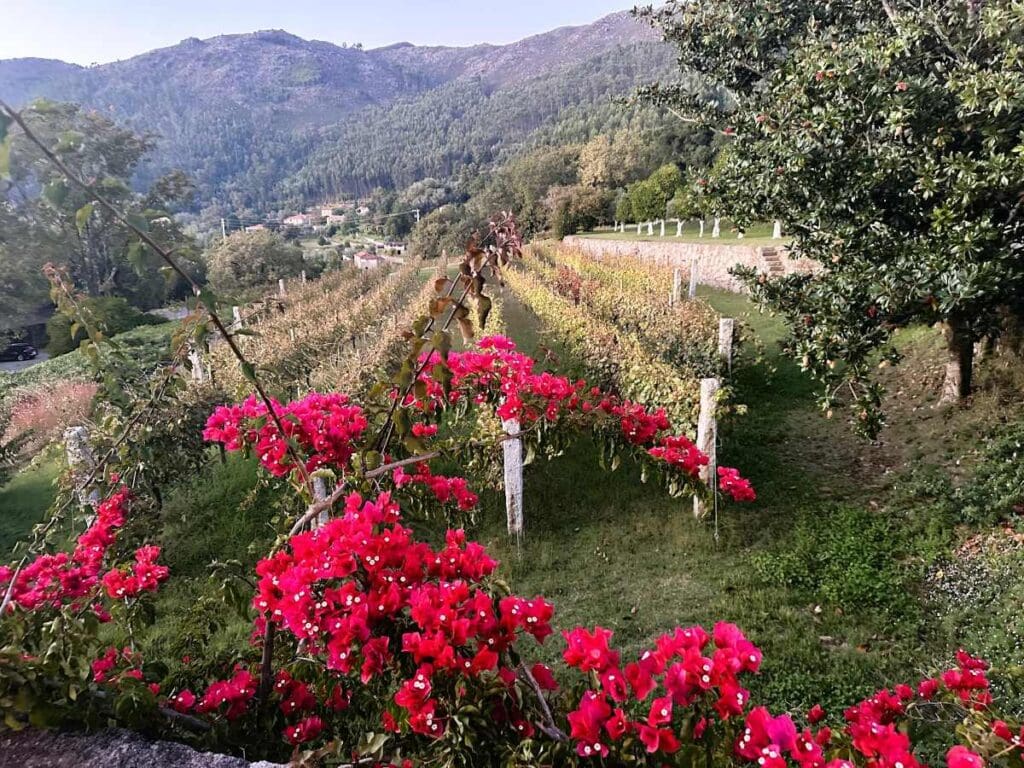
Table of Contents
Where is the Minho?
The Minho is located less than an hour north of Porto and lies south of the Portuguese border with Spain. The province is named after the River Minho that flows along the northern border with Spain. While it is one of Portugal’s less frequented tourist regions, wine lovers will recognise its most famous export – Vinho Verde. The Minho, with its expanse of vineyards, is a verdant region dotted with charming towns through which rivers flow to its coastline. Life in these towns has a totally different rhythm than the major cities, and the change in tempo from Porto to Ponte de Lima is like that between a fast-paced tarantella and a slow waltz.
Slow Travel in the Minho: Where to go?
Portugal has its origins in the Minho, with the nation’s birthplace at Guimarães, an important town for history buffs located in the inland part of the region. Nearby, Braga is known as ‘little Rome’ and is a must-see for its Roman ruins. Keeping to the spirit of slow travel, I restricted myself to visiting two charming towns located on the Lima River.
Ponte de Lima
Ponte de Lima is said to be the oldest town in Portugal, dating back to 1125. It is known for its Roman bridge, Ponte Romana, once part of the Roman military road, and its Medieval extension, Ponte Medieval. The bridge continues to play an important part in the town’s daily life as it forms part of the crossing on the Camino Português de Santiago. Many pilgrims pass over its ancient stones.

We took to the water, puttering along the River Lima in a replica água-arriba, a traditional, wooden, flat-bottomed boat once used to transport goods, animals, and people to towns along the river. In antiquity, this river was known as the River Lethe, and it was associated with a legend from classical mythology – Romans believed it to be the river of oblivion; whoever crossed these waters would lose their memory. When a legion of Roman soldiers reached the river in 2BC, during an expedition to the north of Portugal and Galicia, they refused to cross. The leader of the expedition, Decimus Junius Brutus, had to cross the river alone, and when he arrived at the opposite bank, he began to call his soldiers by name, thereby disproving the myth. Nowadays there is a sculpture of Junius Brutus on horseback on one bank and on the other a group of riders hesitating to cross.

Ponte de Lima is a small town, yet there is plenty to fill a day in this picturesque spot. There are historic churches to visit, along with the Sacred Art Museum. It is a perfect location to learn about Vinho Verde, and we enjoyed a tour and wine tasting at the Interpretation and Promotion Centre of Vinho Verde. Afterwards, pull up a chair at a pavement café, order a glass or two of Vinho Verde from one of the local wineries, and watch the river flow.

If you have a car – or you can hail a cab – don’t miss an excellent restaurant located on a Quinta (estate) outside the town. A Carvalheira is recommended in the Michelin Guide and serves high-quality Portuguese cuisine. It is housed in a traditional stone building in a beautifully landscaped garden. We enjoyed a wide range of traditional starters – excellent charcuterie, cod fritters, beans with smoked sausage, and sautéed local mushrooms.

The restaurant is renowned for its roasted kid goat, but we also enjoyed enormous portions of roast pork shank, a memorable roast veal cut into thick pink slices which were garlicky and aromatic, roast octopus and a local speciality, duck rice. Arrive hungry, and you will leave very satisfied.
Viana do Castelo
Viana do Castelo was my favourite Minho town, well worth a day trip or even an overnight stay. It is located at the estuary of the Lima River and has a significant port dating back to Medieval times. Being on the Atlantic coast, it is popular with surfers and also boasts long cycling routes. It has excellent seafood too.

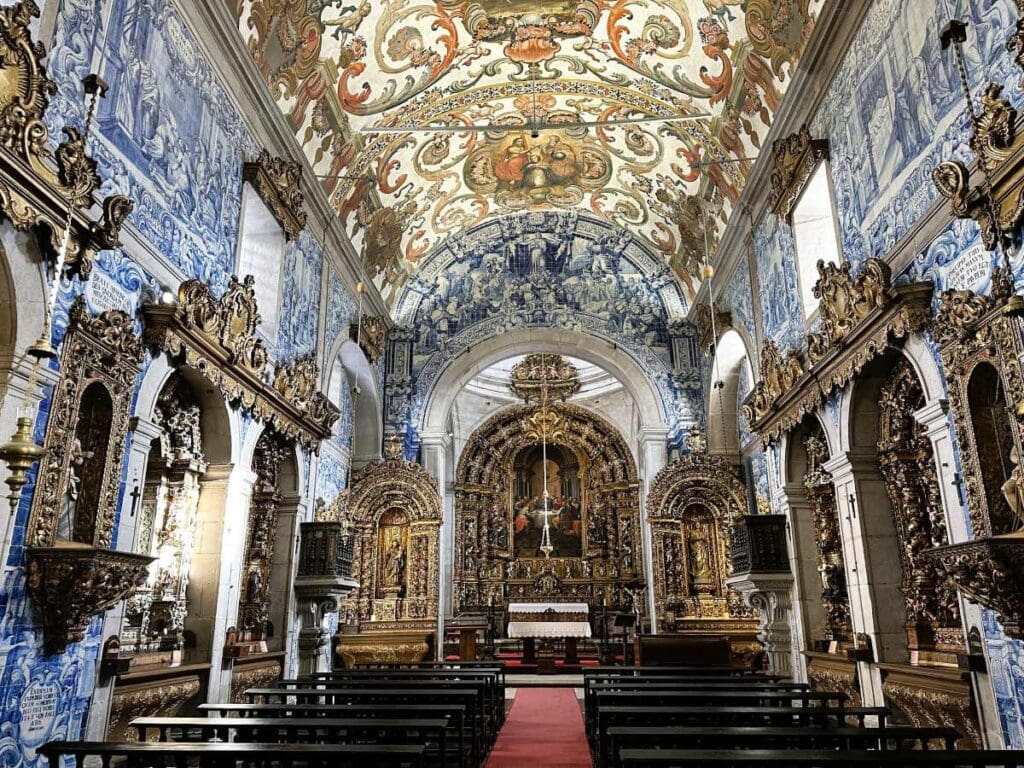
In the city centre, Praça da República, we found numerous 16th-century buildings, giving us a view into the past. Exploring further, the archaeological museum housed in the 15th-century Casa de Nichos, took us back to the prehistoric age of the region. There are many museums and churches to enjoy in Viana do Castelo. My favourite church was Igreja de Misericordia, a magnificent church adorned with huge blue-and-white azulejo-tiled panels depicting biblical scenes, remarkable gilded carvings and ornate Baroque ceiling frescoes.
The Decorative Arts Museum, situated in an 18th-century palace, also boasts impressive large tiled panels along its corridors. We enjoyed viewing a superb collection of faience pottery from the 17th and 18th centuries, some of it produced in Viana do Castelo.

Later, we visited a Rococo masterpiece, the São Domingos Church, with its stunning gilded carvings of leaves, grapes and putti cascading down pillars. After this visit, it seemed appropriate to pop in for a Jesuitas pastry at nearby Pastelaria Dantas, which has been serving the town since 1915.
Slow travel means taking time to discover not only museums but the feel of a place. We enjoyed several hours of meandering through the small, atmospheric cobbled streets of Viana do Castelo with its old buildings, many with exterior tiling.
Slow travel in the Minho: What to Do
Slow travel allows time to engage in local traditions. The Minho is where we learned to bake traditional cornbread in the small village of Montaria, where Carmen welcomed us into her kitchen with its wood-burning oven. She taught us to sieve cornflour, knead and shape the dough, wrap it in an enormous cabbage leaf to protect it from burning, and, once the bread was safely in the oven, seal the door with clay. While it baked, we went on an hour-long hike along the levada (stone irrigation channels) dating back to Medieval times, by which water was diverted from the spring up in the mountain to the still extant community watermill in the village.

Back at Carmen’s home, we removed the bread, now deep brown and crusty, and sat under the trees in her garden where the table was laid with local cheese and outstanding charcuterie from the hams smoking in her kitchen fireplace, homegrown salad, orange juice from her trees, extra virgin olive oil from her olives, and eggs from the chickens who watched from their coop as we ate. This was a zero-air-miles meal and one of the most memorable lunches of the trip. And the bread? It was the best loaf we had tasted in weeks.

Friends spent a morning horse riding and wild swimming in the Lima River and returned invigorated. I chose the more sedate option of a long walk in the Protected Area of Lagoa de Bertiandos S. Pedro de Arcos – a rare example of continental wetlands where some 508 species of flora can be found, 80 of which are considered rare or close to extinction. We strolled along a boardwalk which is dotted with hives to spot some of the144 species of birds that live in the forest, along with 41 species of mammals.
Slow Travel in the Minho: Where to stay
Vinte-Quinta da Boavista
I had been invited to join a small group on a wine estate outside Ponte de Lima. Vinte-Quinta da Boavista turned out to be one of those magical places that, as the gates open and shut behind you, envelop and cosset, pre-empt your every need and excel in the sort of rural luxury you read about in magazines and hope to experience.

The first thing I noticed about Vinte-Quinta da Boavista was the peace. Up in the hills of Moreira do Lima – a small Minho village, a half hour from the town of Ponte de Lima – all I could hear were roosters crowing. We checked in at the beautiful manor house, which dates back to the 15th century, with an impressive panel of blue and white tiles and a tastefully appointed breakfast room full of period furniture and artworks.

We were transported by buggy up the hill to our accommodation. These are not hotel rooms, but rather six self-catering, sustainable apartments and houses with large bedrooms, tasteful furnishings, Portuguese linens and artworks, contemporary bathrooms and fully fitted kitchens. Two houses are interconnected, which is perfect for intergenerational travel. Each house has a private terrace with a wide wooden bench on which to bask in the sun. At night, we sat out and stargazed, undisturbed by light pollution. In the morning, mountain light streamed into our room through French doors that open onto the terrace. Ahead of us lay a small vineyard which produces the grapes for the Pinot Noir we drank at dinner. Beyond was the fruit orchard and the olive grove. Behind, a dense eucalyptus forest rose up to cover the mountain top.
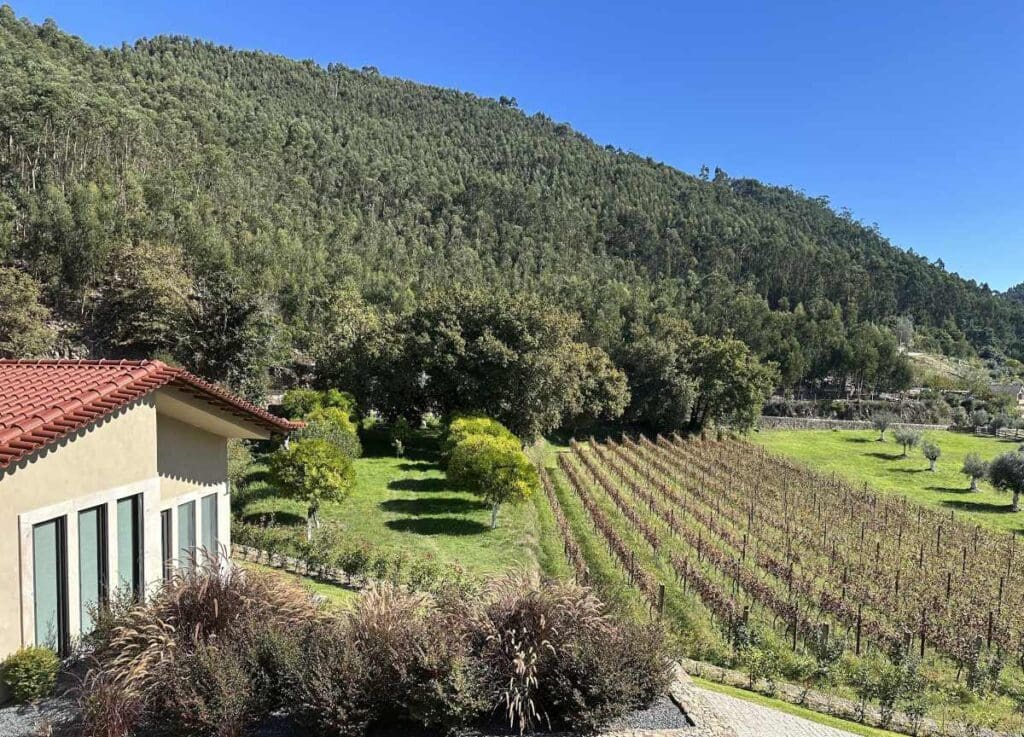
Vinte Quinta da Boavista is designed for slow travel, and everything you need is on site. You need not leave the property in order to have a fabulous holiday. While you could stay for a couple of nights, it is designed for families to visit for a week or more. Don’t feel like self-catering, or want a break from cooking? There is a restaurant overlooking the kitchen garden where healthy and creative meals are served, with fruit and vegetables grown in Vinte-Quinta da Boavista’s orchard, kitchen garden and greenhouse. Our first dinner brought persimmon and fennel salad, sea bass with leeks on fennel puree, and lavender panna cotta.

The Vinho Verde wines are produced from the grapes on the estate, and we sampled the Pinot Noir, a white wine, and a terrific sparkling made with 100% Alvarinho grapes. It was a gorgeous aperitif and paired beautifully with an impressive array of starter dishes – vitello tonnato, cod balls with aioli, leek wrapped in nori with seared tuna, and shrimp croquettes with citrus mayo.

Later we moved on to fish, prawn and mussel curry with millefeuille cake for dessert. The talented Chef Yhor is Ukrainian and prepares both Portuguese and European-focused dishes.

We breakfasted each morning on a long wooden table, a masterpiece of carving, and were treated to fresh eggs from the farm’s hens, homemade preserves, smoked salmon, charcuterie and cheese, an array of breads and pastries, cereals, yoghurt and fruit.
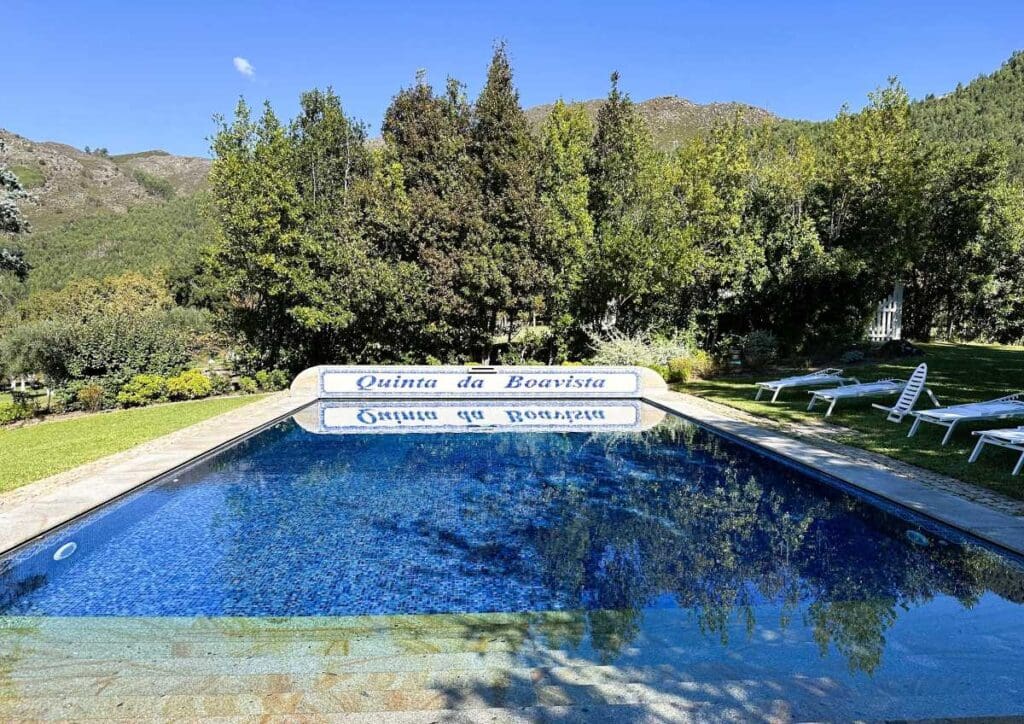
Want the kids entertained while you relax at the pool or in the sauna? The children’s house is so stunning that children will not want to leave. The inside of the two-storey building is a kid’s paradise, with soft play downstairs and upstairs, a huge bed on which children can relax, and a library of books in a range of languages and games (no screens). Outside, there is a table tennis table, climbing frame and trampoline. In the season, childminders can be arranged who will not only entertain your kids but even teach them some Portuguese. Children are taken to collect eggs from the chicken coop and then have a cooking class in the restaurant kitchen where they learn to bake Pão de Ló – a large sponge cake made in a clay mould. This is truly a space where parents can take a few hours off to totally chill.

For those wanting to be more active, there is a tennis court and electric bikes. The property is set in a huge area, much of it forested, and there are several hikes that can be taken from within the grounds. The property has a fully resourced massage and beauty studio, and I can vouch for the quality of the treatment here, having enjoyed an hour-long relaxation massage. A Zen studio – all wood and glass – is located in a eucalyptus forest and overlooks the village in the distance. Here, twice-weekly yoga sessions are held, and guests can use the space for meditation.

Vinte-Quinta da Boavista is an environment that soothes the soul and offers total relaxation whether travelling alone or with family and friends. The mountain air, the forests, the views, the sunsets and the stars- I’ve no doubt that spending a week here brings tangible health benefits. This is true slow travel, luxurious too, yet in keeping with the local environment.
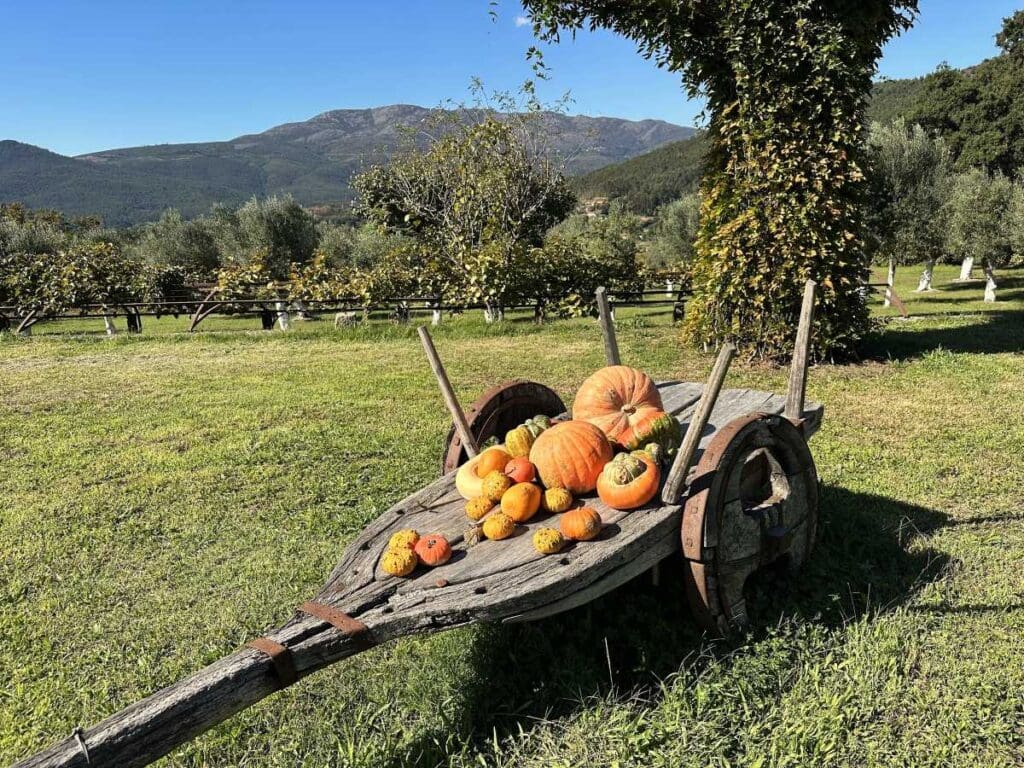
Having waxed lyrical each breakfast about the outstanding orange jam, I was delighted and touched when the owners, Ella and Sergey, waved us off at the end of the stay, having gifted me a bottle. Waking in my own home a few days later, rain cascading down and the heating turned on, I ate a slice of sourdough with orange jam and felt transported back not only to the elegant dining table, but to the peace and beauty of Vinte-Quinta da Boavista and the Minho beyond.
Vinte-Quinta da Boavista, Rua de Parada 20, Moreira do Lima, Portugal
Terra Rosa Country House & Vineyards
In the parish of Calvelo, not far from the town of Ponte de Lima, we found Terra Rosa Country House and Vineyards. This slow-living agritourism hotel, where we spent a night, is located on a wine farm that has belonged to the Rosa family since 1948. Francisco Rosa has developed 50 hectares of vineyards and is the major contributor of grapes to the Ponte de Lima cooperative that produces Vinho Verde. Since 2021, his daughter, Eliana Rosa, has transformed some of the farm’s beautiful old buildings, some of which were once used to house workers and their families, which explains the lovely old chapel on the grounds, which was used by workers on Sundays.

Two of the old stone buildings have been renovated and repurposed. One houses the seven-roomed boutique hotel, with large black steel-framed windows that overlook the garden. Our room had a terrace with comfy chairs and blankets to keep the evening chill at bay. The hotel’s palette is taupe and browns, earthy shades that are calming. Baskets and Balinese artefacts are distributed throughout the property, making it feel akin to a luxury beach resort transported to the Portuguese countryside. Wood and cane furnishings have an Asian/African aesthetic with many items sourced during Eliana’s travels. Some of these can be purchased in the cosiest hotel shop you could wish to find, housed in a small stone building and packed with desirable linens, ceramics, and artworks.

A second large stone building contains a games room with a pool table and space for massage, which can be booked with a local masseuse. A large dining space with huge glass doors overlooking the vineyard would make a spectacular venue for one of those large gatherings of family and friends for a special birthday or celebration. I began to make a list of friends to share the seven bedrooms and imagined the fun that would be had here, taking over the property for a couple of nights.

In the communal space, there are comfy sofas, board games and an invitation to slow down and appreciate the natural beauty of the surroundings. Outdoors, there is a beautiful old granary store and the erstwhile stone threshing floor is now an outdoor terrace with welcoming umbrellas, tables and sofas for al fresco relaxing. The farm has the Neiva River running through it, and guests are encouraged to walk in the peaceful and verdant grounds.
We arrived at Terra Rosa in the mid-afternoon as the late October sun bathed the vineyards in soft early autumn light. No sooner had we checked in than we headed for the heated pool where we luxuriated in the warm water; then, wrapped up in fluffy gowns, we lazed on pool loungers with cups of jasmine tea and slices of marble cake, provided to guests at tea time. I felt as if I was an extra on a movie set; the surroundings were picture-perfect, vineyards as far as the eye could see, and mature olive trees dotted about the property.

At breakfast and dinner, guests are invited to eat at a long wooden communal table where we enjoyed an early evening meal of charcuterie and cheese, salads and a dessert of fruit salad and orange cake. We sampled the wines that the farm produces – a white and a rosé, both with the distinctive soft bubbles of a Vinho Verde. We returned to the table for breakfast, where we were offered eggs to order along with fresh bread, preserves, charcuterie, cheese, fruit, yoghurt and cereals.

Terra Rosa is a retreat from the pace of the outside world, a space to decompress, stroll in the grounds, read a book, and play Scrabble in the evening. While our visit was too brief to experience the relaxing activities on offer at Terra Rosa, guests can ride the hotel’s bikes, order picnics to eat alongside the river, enjoy wild swimming, walk in the vineyards, have a massage surrounded by thousand-year-old olive trees, take cooking classes, and participate in olive and grape harvesting.
Terra Rosa Country House & Vineyards, Rua São Pedro de Calvelo, 195. Ponte de Lima, Portugal
In the hills and vineyards of the Minho, I discovered what slow travel truly means. I found soulful and meditative environments where the demands of the outside world could be put aside while focusing on my physical and emotional well-being. The wine estates I visited in the Minho are working farms that offer luxury accommodation with many opportunities to explore the surrounding region or to simply stay put and read at the pool. These are naturally farm-to-table establishments, where not only much of the food, but also the delightful Vinho Verde, is grown before your eyes in the gardens and vines. Some of these estates have been in families for generations, their roots deep in the soil. The warmth of Portuguese hospitality is renowned, and once experienced in the Minho, you will, like me, yearn to return.
Fact Box
I was hosted from Porto to London on TAP Air Portugal, which makes exploring Northern Portugal easy, with direct flights from London to Porto and a Portugal Stopover programme that lets travellers add up to five nights in Porto or Lisbon. It is a convenient way to combine Porto’s food and wine scene with the vineyards, traditional cuisine and rural experiences of the Minho region.
Many flights to Portugal leave from London Gatwick. I had an early morning departure, which would have required leaving home in the small hours. Far more convenient was an overnight stay at Hilton at Gatwick Airport, a short 10-minute walk from the terminal. The next morning I checked in my luggage and arrived for an early breakfast in the Clubrooms South lounge at Gatwick just as it opened at 6 am. Entry is available for £46. By the time I boarded my flight, I was relaxed and well-fed.
I was hosted by Holiday Extras, which is the market leader in UK airport parking, hotels, lounges, and transfers. A double room at Hilton at Gatwick Airport is available for £113.90 based on arrival on 24/11/2026. Plus, with Flextras, if you need to cancel or amend your booking, you can do so without charges.
Looking for more slow travel ideas in Portugal? Read our article on Madeira wine here


