
Last Updated on November 30, 2021
History of Salisbury – the oldest ‘New Town’ in England – Things to Do in Salisbury
Despite living in Wiltshire a few years ago, I haven’t visited Salisbury for a lot longer. In fact, it was half a century ago. We lived in the area when I was a kid so I remember trips to Salisbury for shopping and (more probably) just because my mum liked the Cathedral. It’s a historic city with an amazing heritage – and there’s a lot more to see besides Salisbury Cathedral and plenty of things to do in Salisbury

That said, the new City of Salisbury or ‘New Sarum’ is considerably older than me and less than two hours from London by train. Unlike many cathedral cities, it’s also mostly flat and easy to explore on foot. Read on to discover what makes it so special and learn what you shouldn’t miss and what things to do in and around the City of Salisbury
Table of Contents
Old Sarum, near Salisbury:
While Salisbury is easy to explore, the story starts with a settlement called Sarum, built on high ground a few miles from today’s city, which dates back to prehistoric England, then to the Romans, the Saxons and then the Normans. It was the Normans who built what remains of a Mott and Bailey Castle and a Cathedral. Just five days after the original Cathedral was built, it was struck by lightning and suffered extensive damage.

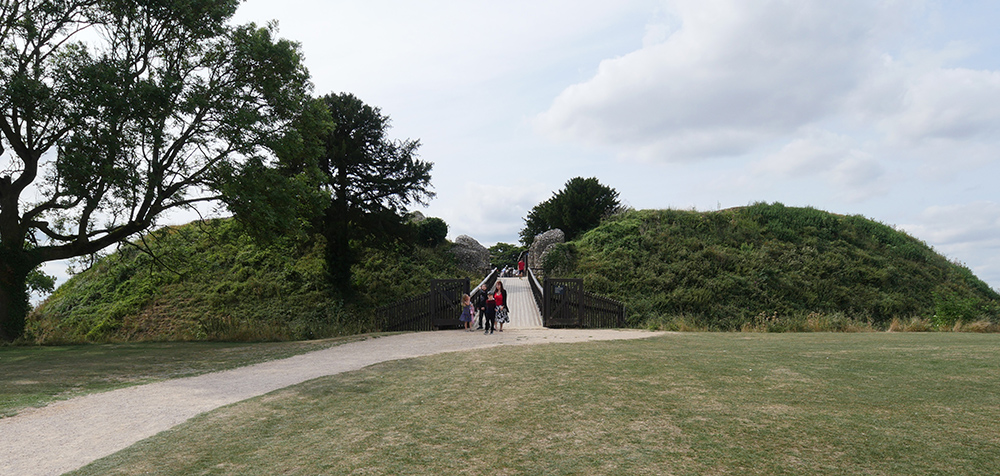
Refurbished and expanded by Roger of Salisbury, the Bishop and also the Lord Chancellor and Lord Keeper of England during the reign of Henry I, the cathedral at Sarum was doubled in size and work even started on a Royal Palace during the 1130s. But, once Henry I died, Roger was arrested by the new King, Stephen of England, who was uncomfortable with the power Roger had gained during Henry’s frequent absences in France and thought of him as something of a threat to his own Sovereignty.
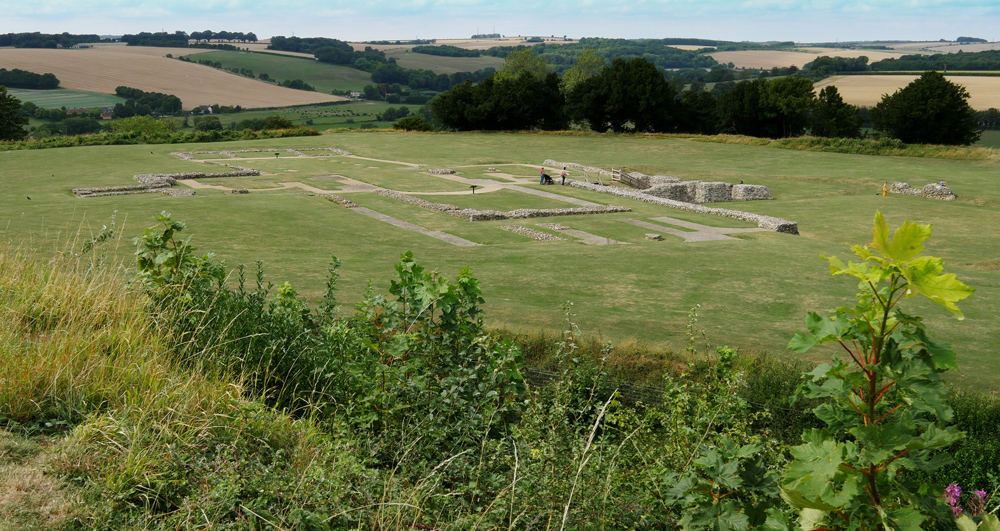
And, without Roger championing the site, Old Sarum became less and less popular. High on a hill, it was windswept and cold. The petition was made to move the Cathedral to a site where water would be plentiful and easier to access. Permission was given to relocate the cathedral in 1218 and the foundation of the new cathedral was begun on April 28th 1220 and completed 38 years later.
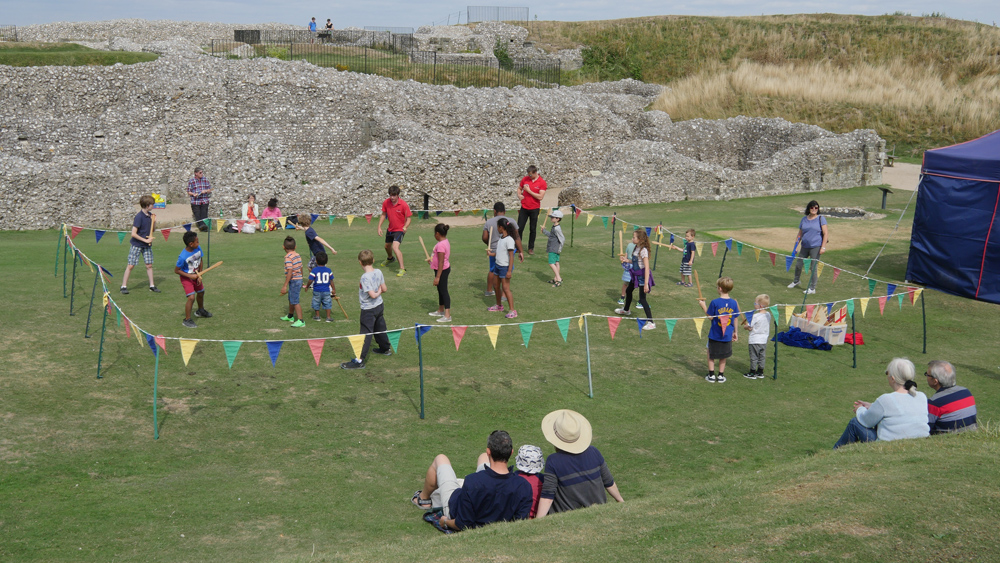
Now run by English Heritage, you can visit Old Sarum throughout the year to get an understanding of the ‘windswept and cold’ site (it was actually quite warm and sunny when I was there!). There are ‘living history’ activities for children too learning all about life at Sarum in the Middle Ages which seemed very popular – what self-respecting eight-year-old wouldn’t want to have a go at sword fighting and learning how to be a knight?
Visiting Salisbury Cathedral
What makes Salisbury as it is today so special is that much the city was built around the cathedral at or around the same time over a relatively short period. The Cathedral itself was constructed at what must have been breakneck speed in its day. And, the original city remains today – and even when it has been ‘modernised’, the infrastructure can be seen if you look closely.

Starting your trip to Salisbury, as most people do, with the Cathedral, you’ll find it is equally stunning on the inside and the outside. It took just 38 years to complete and the entire building is in the Early English Gothic style. I learnt from my guide that the early Gothic style was the first time that pointed arches were used rather than the rounded arches of Norman style. That resulted in a more efficient way of building, making it possible to build higher with narrower columns. The result is stunning. The tall, narrow nave has walls built from light grey Chilmark stone and columns from dark polished Purbeck marble (which is not actually marble at all but a local limestone from Dorset).

Perhaps the best way to really appreciate the architecture is to do as I did and take a spire tour. You’ll need a head for heights – and to be willing to climb 332 steps up. But, these guided tours provide a unique insight into the building.

As you go further up into the roof, you learn more about the stunning construction of the roof. The timbers would have been made from unseasoned oak. Each pair is generally hewn from the same tree, so if you look carefully you’ll spot a natural symmetry. And, no nails were used at all. Iron would have degraded and caused the roof to fall apart. Instead, the wood is pegged and jointed. As the oak dried, the pegging adjusted. You might worry about the possibility of woodworm, but we learnt that although the young oak could be attacked, once it was fully seasoned, it would be too hard for beetle infestations.

The tour takes you as far up in the spire as it is possible to go without being on a ladder (though the narrow wooden staircase has something of a ladder-like feel to it). I was fascinated to learn of the restoration work that had taken part in the late 1970s and 1980s. There was a massive appeal, with Prince Charles as president. I noticed that each diamond pane of glass in the spire was engraved with a personal message. Apparently, that was just one of the ways that the £6.5m needed for repairs to the Spire, Tower and West Front was raised.

If you look down, you can see metal supports added to ensure the spire’s stability

Once you are as far up as is possible to go on the inside, there are magic doors which lead you out onto balconies around the spire. You really do get a bird’s eye view and you can also take a look at the complex restoration work currently taking place. After everyone has taken in the magnificent 360 degree view, it’s time to clamber down – something which seems a lot quicker and easier!

Back down to earth, take time to visit the Magna Carta – the best preserved of the three on show in England. The copy at Salisbury originates from the involvement of Elias of Dereham, steward to the Archbishop of Canterbury, Stephen Langton and a negotiator involved in the discussions between King and barons. Elias was charged with delivering ten of the original thirteen copies – and one of those was given to the Cathedral at Old Sarum. Elias went on to mastermind the building of the new Cathedral and the Magna Carta has had a home there ever since. Although you can’t take photos, it is a chance to see the Magna Carta up close – unlike York, the display here is relatively simple and the historic document is behind a simple glass cabinet.

Salisbury Cathedral is one of those buildings that has a list of ‘mosts’. It has the largest Cathedral Close of any in the UK and the tallest spire. In fact, until the BT Tower and Milbank Tower were built in the early 1960s, it was the tallest building in Britain – remarkable for something built in 1258. It also has the largest cloisters in Britain and the oldest working modern clock in the world! It’s still the tallest solid stone spire in Europe (there’s one in Germany which is taller but has a pierced stone construction.

More than anything though, it is a building to take your breath away.
Arundells, Montpesson House and Salisbury Cathedral Close:
Apart from the Cathedral itself, there are plenty of things to see and do in and around the Close.
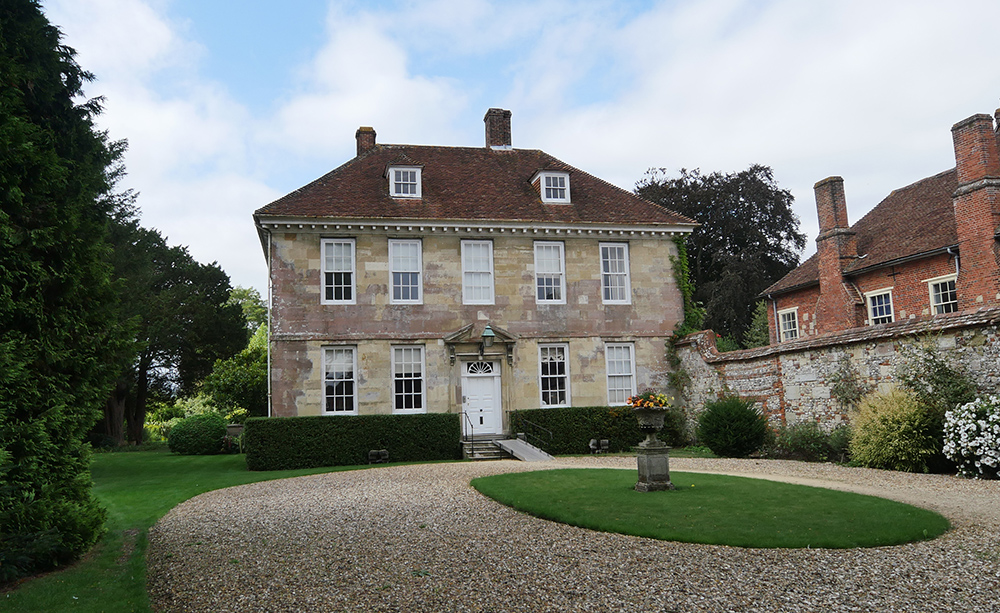
Arundells is the former home of Sir Edward Heath, former Prime Minister and a renowned sailor and musician too. Only open on Wednesdays, the house was bequeathed to the Nation by Sir Edward and has been kept ‘just as it was’.

Sir Edward grew up with a love of music. His parents encouraged him to practice and it paid dividends as he won an organ scholarship to Oxford.
His love of music never left and he conducted the Christmas carol concert in Broadstairs every year from his teens until he was too old to do so. He conducted various orchestras in the UK, Europe and the United States and he was a close friend of many eminent classical including Isaac Stern Moura Lympany and Yehudi Menuhin. The living room at Arundells is dominated by a beautiful grand piano too.

In fact, the house is a real testament to Sir Edward’s interests and hobbies. A through the keyhole would be so easy to guess. You’ll find models of many of his yachts, along with some of the trophies he won. Apparently, he took up sailing as a way of relaxing when he became Prime Minister – and was extremely successful.

He was also a keen ‘personal’ art collector. What you see on display at Arundells is very much a collection of paintings and drawing he loved. There are works by William Wyllie, LS Lowry, John Singer-Sargent, John Nash, John Piper, Walter Sickert, Augustus and Gwen John and even Winston Churchill, along with a fine display of political cartoons and a stunning hand painted Chinese wallpaper lining the stairwell.

And there are treasures from all around the world, given to him by local dignitaries.
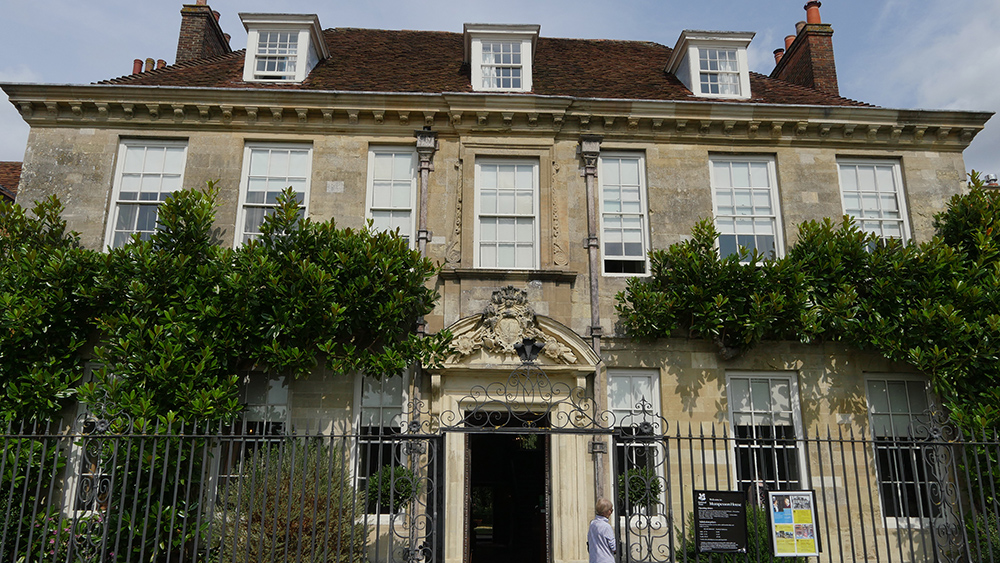
Just around the corner, Mompesson House, owned and run by the National Trust, is set up as a tribute to Georgian everyday life. From the empty house that was left to the trust by its last resident Denis Martineau, apparently decorated very much in the style of the 1960s, The National Trust chose to refurbish the house in the Georgian style, using donations of paintings, ornaments and furniture to fill the rooms. The result is a stunning space, the kind of townhouse I’d like to have lived in. A far cry from the shell that was left to the National Trust which was, by all accounts, decorated in a somewhat psychedelic style.

You’ll also find the rifles museum, housed in a listed building called ‘the wardrobe’ which dates back to the 15th Century. It’s now a small military museum housing regimental collections and telling the history of the County Regiments of Berkshire and Wiltshire and their more recent successors. And, The Salisbury Museum where you can learn more about the history of Salisbury and the surrounding countryside.
The medieval centre of Salisbury:
Getting a real understanding of Salisbury is best done on foot, walking around the City, preferably as I did, with a guide. The central part of Salisbury, like the ‘new towns’ in Edinburgh and America, was largely constructed during one period simultaneously with the construction of the Cathedral, starting in 1220. So, instead of a hotch-potch of alleyways and passages, Salisbury was built as a consciously planned city, with the central parts based on a grid pattern known locally as ‘Chequers’. The planning included water channels fed by the river Avon which were initially used for drinking water, then later as waste channels. The city grew rapidly so that by the second half of the 14th century it was one of the largest in the country, important for the production of cloth.

Walking through the city, there are plenty of medieval buildings to see. Poultry Cross, for example, is the only remaining one of four original market crosses in Salisbury. Built around 1307, the ornate canopy and buttresses were added much later when the cross was restored between 1852-5. It’s a Grade I listed structure and you’ll find it on the junction of Silver Street and Minster Street.
Behind Poultry Cross is the Haunch of Venison which is probably the oldest hostelry in Salisbury and was built to accommodate cathedral workers. The rooms downstairs date from 1320 and halfway upstairs you’ll find a mummified hand of an 18th-century card sharp who is said to still haunt the building. Sup a pint of ale and imagine the original workers building the cathedral without the help of any cranes or drills.

You can even sleep in one of the inns that were built to accommodate the cathedral workers. The Red Lion originally housed the draughtsmen working on the new Cathedral. When the cathedral was finished, the White Bear as it was then known, continued to house visitors to the Cathedral. It’s believed to be the longest running purpose-built hotel in the country.

I was fascinated to learn that behind the apparently Georgian facades of some of the houses you can still see the original medieval buildings. Rather than rebuilding, as fashion changed, the houses were ‘clad’. And, since there was a tax on bricks, this was done using brick tiles. Walk in through the door of what looks like a 19th-century shop and you’ll find the timber infrastructure of the original building.

Once you know, it’s tempting to walk around Salisbury looking for more!

In fact, many of the buildings come with fascinating stories. Trinity Hospital, for example, one of Salisbury’s medieval almshouses was founded by Agnes Bottenham. She was the landlady of the Rai d’Or which was a house of ill repute, originally built to cater for the needs of the workmen building the Cathedral. There’s still a tavern on the site of the original Rai d’Or, though it dates from the 16th Century. Trinity Hospital was an act of penance by Agnes, originally to provide accommodation for retired prostitutes. The current building is Grade I listed and was rebuilt in 1702. It’s still used as an almshouse – one of eleven sites in and around the City, many of which have a long heritage, though perhaps none so colourful as Trinity Hospital.

I wondered if perhaps Agnes had seen the Doom Painting in St Thomas’s Church, which was the main Parish Church for Salisbury at the time. But the timeline doesn’t work as the painting is thought to have been commissioned sometime between 1470 and 1500. Perhaps one of the reasons the painting is so stunning though is that it was covered over with limewash during the reformation and it remained that way until 1819 when faint traces of the work started to show through. St Thomas’s has always been the church of the City, and the painted badges of the guilds are still visible in the medieval wall paintings of the Lady Chapel. And don’t forget to look up. As befitted the church of a wealthy city, the timber roof is decorated with nearly 100 carved angels dating back to the 15th century. Although some of the angels have lost their wings, it’s still a splendid sight.
Things to do in Salisbury – a Salisbury Guide.
I thoroughly enjoyed visiting Salisbury. There were plenty of places to explore and a range of hotels and restaurants to enjoy.
I stayed at Milford Hall Hotel and Spa

On the outskirts of the town, this would be a great choice for anyone looking for modern styled rooms, good parking and the option of a rather delicious a la carte breakfast. If you prefer to stay more centrally, there are options closer to the Cathedral, including The Red Lion mentioned earlier in this feature. And Wiltshire is home to a range of wonderful country pubs and hotels, like The Lamb at Hindon, a few miles down the road which we visited a month or so ago.

I enjoyed lunch at Fisherton Mill a quirky restored mill with a range of craft workshops and shops to explore together with ultra-fresh tasty food and at Ox Row Inn, a Fuller’s Pub serving a good range of gastropub food at a reasonable price. My dinner was at the Old Ale and Coffee House – a quirky pub with a fun alfresco garden serving excellent food and a wide range of cocktails at sensible prices, just a few minutes from the Cathedral.

My walking tour was with Salisbury City Guides who offer a range of walking tours in and around Salisbury including a daily city centre tour similar to the one I enjoyed for a fee of £6.00 per person.
I was a guest of Visit Wiltshire
Thinking of visiting yourself? Why not pin this post for later



I love Salisbury!
My husband’s family lives in The New Forest and we often visit as I love it there so much!
A trip to Salisbury is really exceptional. This is first time i heard about the place but your blog made me curious and i am definitely going to visit this place. Thanks for sharing.
Interesting reading I have always wanted to visit Salisbury
I never knew Salisbury had that many cool things to do in it. I thought it was a bit off an old so never visited but this guide has opened my opens to visiting this interesting place, plus it’s not far from London.
This is such a cool offbeat destination from London, so full of history too. The stories associated are interesting.
I see the framed pic of our ex Prime Minister Late Smt Indira Gandhi’s photo on the piano of Sir Edward Heath. Very impressive.
That cathedral and roof are incredible! The fact that they used no nails is just amazing. I think it’s pretty awesome how they were able to build this way so long ago. I hope I’m able to visit one day. Honestly, I wouldn’t mind trying my hand at sword fighting too. 😉
I didn’t realize that Salisbury is less than two hours from London by train. My kids would enjoy the ‘living history’ activities and learning all about life at Sarum in the Middle Ages – sword fighting and practicing becoming a knight would be awesome! Thanks for recommending the Red Lion Inn. As I was reading through your post, I was thinking it would make sense to spend a few days exploring Salisbury.
I love England! I have not visited Salisbury yet ad would love to check out the Cathedral. I didn’t know you could climb up for a view, was that tiny circular wooden contraption the staircase? That’s an adventure in itself!
You are right there is a lot to do in Salisbury other than the cathedral – but wow It is pretty spectacular – and the ceiling made entirely of wood with no nails? and this thing has definitely held up throughout time. Milford hall looks like a beautiful place to stay. I’ll add this to my list of places to visit next time I’m in the UK
Honestly I’d never heard of Salisbury before reading this post, but it seems like a fascinating place to visit — with the added bonus of getting to see a beautiful cathedral. That wooden “staircase” to climb the spire though…yikes. Seems like it was worth it, but I totally see what you mean about being like a ladder!
I”m itching to do a driving tour around the UK. I didn’t know about Salisbury and although Old Sarum does look rather “windswept and cold”, Salisbury looks delightful! It’s just the kind of place I’d enjoy exploring.
You surely seem to have done your research on this one! For a structure struck by lightning, it sure seems sturdy and stunning at the same time! Would love to visit someday!
I must admit that the only two words I can associate with Salisbury are cathedral and steak. (in that order). Even being on the tip of my tongue, I couldn’t recall a mental image of the famous cathedral. Thank you for the tour today. I am a huge fan of the Manga Carta and would love to see it in person. Challenging the absolute authority of the King is one of the bravest acts in the history of Western Civilization.
Had no idea where Salisbury was, but knowing it’s only 2hr away by train makes it very convenient. Hope to go someday! Cannot believe you can go up top the cathedral and checkout the roof and architecture! With it being so tall, it must have been scary but gorgeous views. We also love doing walking tours in new cities so will keep this one in mind