Last Updated on February 21, 2024
Slow Travel Through The Oise Valley, France with CroisiEurope.
“Believe me, my young friend, there is nothing–absolutely nothing–half so much worth doing as simply messing about in boats.”

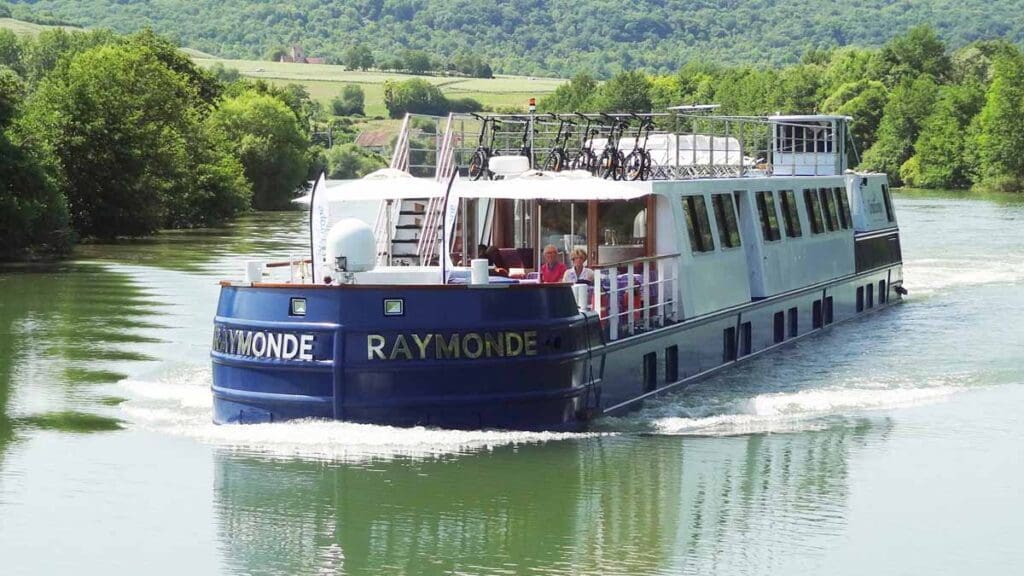
In the nostalgic realm of barge travel, a childhood adventure along the canals and waterways of the fens left a lasting impression on me. Fast forward several decades to a sophisticated journey with CroisiEurope, where the rustic charm of rickety barges is transformed into a boutique hotel experience. Picture gourmet meals served, daily room cleaning, and evenings commencing with cocktails on deck. Our diverse group, comprised French Canadians, Britons, and Americans, but evolved into a close-knit community by the trip’s end. The intimate MS Raymonde, a CroisiEurope barge hotel, housing a mere 12 cabins for guests, ensured a personalized touch with a crew of 6 attending to every need. Perfect for a slow meander through the Oise Valley from Noyon to Paris.
Table of Contents
Accommodation on MS Raymonde
Each cabin has 2 berths that can be pushed together to make a double bed. There’s a surprisingly spacious and well-designed bathroom with a shower and there are a multitude of hidden storage spaces so you can tuck your possessions away. There’s a small desk/dressing table and plenty of sockets to charge phones, laptops etc. Windows along one wall generally don’t have much of a view because the bedrooms are often almost at water level. But there’s plenty of space upstairs either on deck or in the comfy lounge where you can watch the world go by at a pace that would relax even the most stressed guest.

The lounge area with panoramic views is a great place to curl up with a book. On deck, there are enough tables and chairs for everyone on board, with parasols available if the weather is clement. The bar is well stocked and there’s a coffee machine for that all-important espresso!

Food and Drink on CroisiEurope MS Raymonde
We ate at one large table in the dining room. The crew will configure the room based on whether the guests seem happy to dine together – and in our case we voted unanimously for one large table.

Breakfast was continental with eggs if you wanted something more substantial. In addition to the normal cold meats, cheeses, breads and pastries we often had the remainder of the fine cheeses served the day before which was quite enough for me. In any case, the croissants were the proper French sort – melting and moreish. Perfect

Lunch, a four-course affair, involved a decadent and addictive cheese course with two local cheeses presented by Suzie, the ship’s purser. The sort of specialist cheeses you might hesitate to order in a restaurant, the selection included Morbier, Cantal Entre Deux, Valencay, Comte, Brillat-Savarin and Epoisses. It was a lovely and delicious way to get to know more about the regional food – and of course, the perfect excuse for a glass of wine or two.

It was hard to resist feasting on all four courses, but by the second lunch, I was doing just that and skipping dessert. Dinner, a mere three courses, was my opportunity to indulge in a sweet ending – Grand Marnier Mousse or Coupe Raymonde with praline ice cream, fresh blueberries and a violet macaron for example!

It’s a real achievement to produce such stunning food, freshly cooked daily, in the tiniest kitchens. We had dishes ranging from roast guinea fowl stuffed with dried fruits and a Moroccan-style sauce to a classic ‘Grandma-styled beef bourguignon’. Food for each barge is prepared by an onboard chef and is a real differentiator, although our trip was not specifically a gastronomy one.
To complement the meals, we were offered liberal quantities of paired wines (usually a choice of red, white and rose). And, throughout the day there were cocktails, soft drinks, teas and coffees available on request. It’s not somewhere you’ll go hungry or thirsty!
Excursions on the Oise Valley cruise
An essential feature of the CroisiEurope Barge Hotel cruises, the comprehensive programme of guided excursions is included in the cruise cost, although you can opt not to take part if you prefer and borrow a bike from the barge to explore by yourself.

We started on the first evening we arrived with a trip to the 12th Century Noyons Cathedral for a private, nighttime guided tour. The stillness of the night in this early Gothic masterpiece, which was built between the 12th and 13th centuries offered a transcendental start to our journey. Intricate sculptures and stained-glass windows lined the walls while the Chapter House could have come straight out of a Harry Potter film.

From then on, the days followed a regular pattern, cruising gently along the canals and rivers in the morning, trying hard to resist the 11 am cocktail hour before arriving in time for lunch on board the barge before an afternoon excursion.

Our second day took us on a walking tour of the pretty town of Compiegne followed by a visit to the Armistice memorial and museum. The Armistice Memorial and Museum in Compiègne, France, stands as a poignant tribute to the end of World War I. The memorial is located at the historic site where the armistice was signed on November 11, 1918, in a railway carriage, marking the cessation of hostilities. The museum and memorial complex, set amidst tranquil forests, offer a profound and reflective experience. At the heart of the site is a replica of the original railway carriage, encapsulating the solemnity of the historic moment.

The museum, adjacent to the memorial, meticulously chronicles the Great War’s events, providing a comprehensive understanding of the conflict’s impact. Exhibits feature artefacts, photographs, and personal narratives, immersing visitors in the wartime experience. Interactive displays convey the geopolitical complexities that led to the armistice and its aftermath.


Rather chillingly, the Armistice Memorial at Compiègne holds historical significance not only for marking the end of World War I but also for its association with Adolf Hitler and a symbolic event during World War II. On June 22, 1940, Hitler chose the same railway carriage where the 1918 armistice was signed as the site for the signing of the armistice with France, effectively ending the Battle of France. The choice of location was intentional, meant to humiliate the French and avenge the German defeat in World War I. Hitler aimed to symbolically reverse the historical outcome and impose his vision of triumph. The signing took place in the exact spot where the 1918 armistice had been signed, emphasizing the notion of German victory over France.

Then, for a little contrast, a visit to the Chateau de Compiegne, built for Louis XV a historic masterpiece constructed in the 18th century, underwent transformative expansions and renovations during Napoleon Bonaparte’s reign in the 19th century. This magnificent palace, surrounded by picturesque gardens, served as a favoured retreat for French monarchs and later became a symbol of imperial splendour. We were fascinated by Napoleon’s bedroom with its vibrant red decor and four-poster bed that seemed bizarrely out of proportion to the rest of the room. The opulent interiors of the Chateau showcase exquisite craftsmanship and house significant art collections together with a large transport museum.

By the end of the afternoon, on our return to MS Raymonde, cocktails were very much appreciated!

Chateau de Chantilly, our excursion on the second day, is a picture-perfect French chateau. A sweeping driveway and extensive parkland lead you to a moated castle, which dates back to the 16th Century. What we see today is largely due to the work of Henri d’Orleans, Duke of Aumale who inherited the estate in the 19th Century. He was responsible for an extensive restoration and expansion. And, on his death, he bequeathed the castle to the Institut de France, on condition that the layout of the treasures he’d collected remained unchanged.

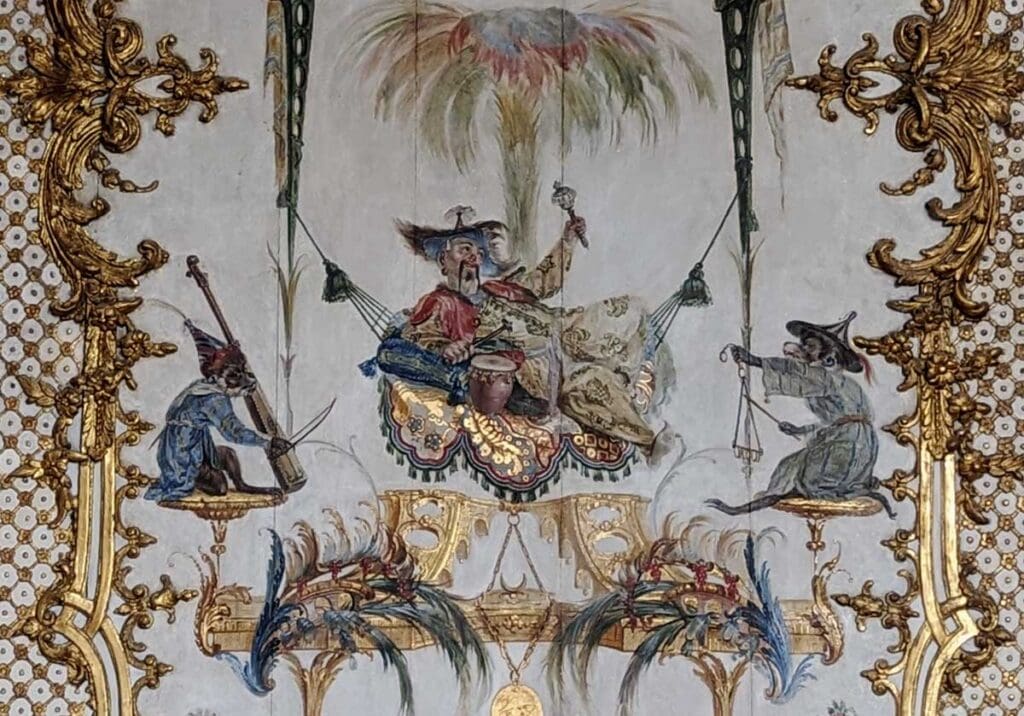
It’s a remarkable building, packed with treasures and somewhere I could easily (and deliberately) get lost in for a few days. We all loved the Grande Singerie, a Chinoiserie-style room that at first glance is beautiful and elegant. A closer look reveals monkeys (singes) dressed and behaving as men, in the company of sophisticated ladies. The room dates from 1737 when the chateau belonged to Louis-Henri, Duc de Bourbon and Prince de Condé, the paintings cover the entire room – the wall panels, doors and ceiling.
Astonishingly, the Duke’s art collection is the second largest collection of antique paintings in France, after the Louvre Museum. Memorable for me, as a real demonstration of the Duke’s breadth of interest was the Tribuna, one of the smaller rooms in the gallery, with a panorama of art history – works by Fra Angelico, Botticelli and Titian on two walls, examples of the French and Dutch schools of the 17th and 18th centuries, Poussin, Van Dyck and Watteau, on a third wall and two more walls devoted to the works of 19th century France – Ingres and Delacroix.

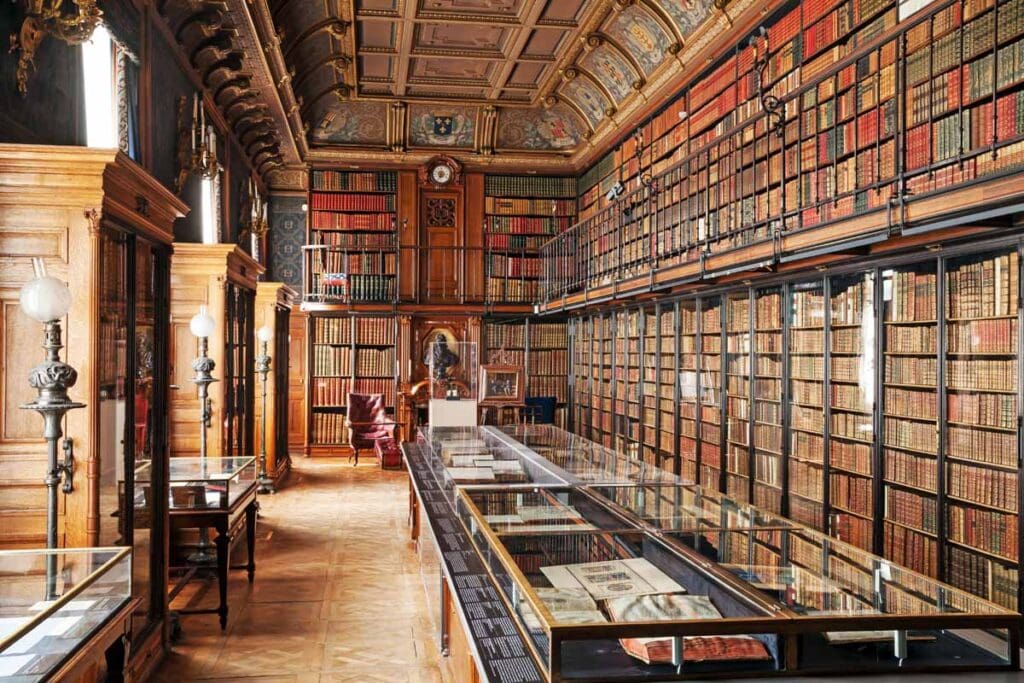
The library, with books neatly arranged by size and shape, has priceless manuscripts, some on display in carefully dimmed central cabinets.
Of course, the Chateau comes with stories of which the best known is of the pink diamond which Louis XIV gave to his cousin Louis de Bourbon, Prince of Conde, after his victory in the Battle of Rocroi in 1643. He had the diamond mounted on the pommel of his walking stick and it remained the property of the Conde family until it was bequeathed by the Duke to the Institut de France. The Pink Diamond was stolen from the Chateau in 1926, but thanks to some distinctive markings was unsaleable. It was recovered by the maid of a small hotel, near the Eastern Railway Station in Paris, while crunching an apple found in the room of a customer, believed to have been hidden there by the thieves. Although the genuine diamond was returned and remains in the castle, it’s now safely locked away in a secret place – and what’s on display is a replica!

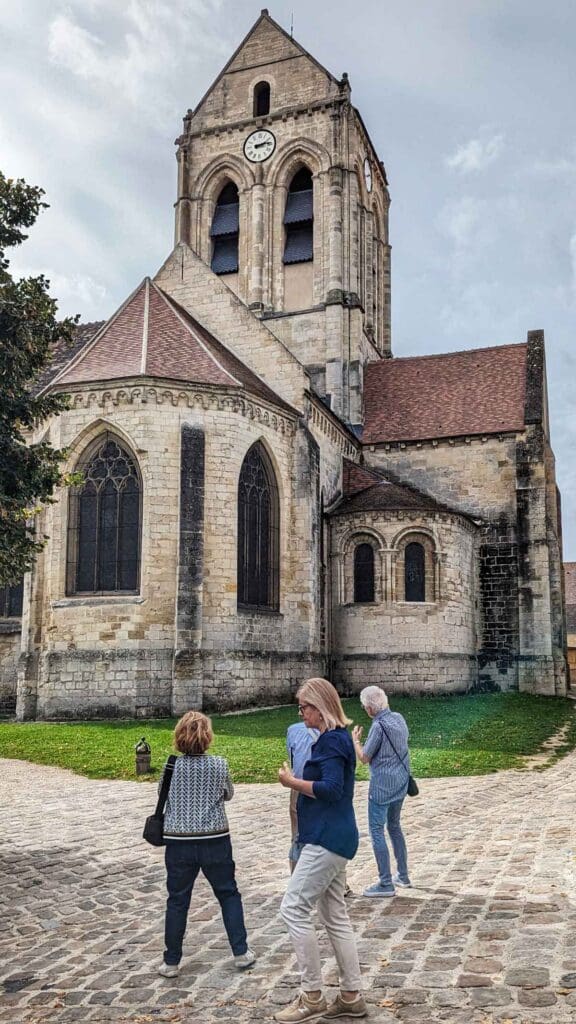
Our third day on board saw us arriving at Auvers-sur-Oise, Vincent Van Gogh’s last home and final resting place. It’s hard not to feel as if you know this charming French village already as on every corner you’ll find yourself in the middle of one of Van Gogh’s iconic works – the Church at Auvers, The Wheatfield with Crows, Farmhouse and Tree Roots.
He produced over 70 paintings and over 30 drawings in the 70 days he was in Auvers-Sur-Oise, including portraits of Dr Gachet, his friend, a doctor specializing in melancholia who lived there. Sadly, despite escaping into his art, painting and drawing obsessively, he committed suicide on 29th July 1890, just 70 days after he’d arrived. He is buried in the village cemetery alongside his brother Theo.

Auvers-sur-Oise is also home to a unique museum dedicated to the ‘Green Fairy’, the Musee de l’Absinthe. While numerous writers and artists have claimed to be inspired by Absinth, the potent drink was banned in Europe and the USA for nearly 100 years. The museum is the privately owned passion of Marie-Claude Delahay who has gathered an eclectic range of artworks, absinthe paraphernalia, adverts and photos which line the walls of the museum. If you are lucky enough to arrive in Auvers when the museum is open, as we were, you can learn about the absinthe ritual – a process where the potent spirit is dripped slowly onto a sugar lump balanced on an absinthe spoon into a glass and even try for yourself. And you can enjoy a glass too – it’s a bit like Pernod to drink.

On Board Activities MS Raymonde
Apart from eating and drinking, MS Raymonde comes equipped with a jacuzzi on deck that we didn’t quite manage to brave at the end of September. The itinerary sometimes has evening excursions, but when there’s nothing on shore, you may find the crew have something planned…

We spend one evening, following our trip to Chateau de Chantilly, learning how to make Chantilly cream from one of the members of the Confrerie des Chevaliers Fouetteurs (The Brotherhood of Knights of Whipping Cream). Yes, they do exist and they have their website. The technique for making Chantilly Cream involved icing sugar, vanilla and fresh cream – and a lot of whipping. Helped by a cocktail or two, volunteers whipped away, making the best frothy concoction ever. The secret lies in a chilled bowl, very fresh cream and careful whipping to just the right point!

Another evening saw the entire barge joining in a Karaoke session. We did have one guest on board who was a professional singer and added much to the quality of our vocals. What the crew organizes is very much adapted to the group, the Karaoke perhaps reflecting in part our talented companion, together with the fact that we all bonded well, despite minor language barriers. If you prefer a little peace though, the barges don’t generally travel at night, so guests who prefer to wander into the local villages should be able to do just that.
Summary
Even a brief stint aboard MS Raymonde demonstrated meticulous planning and a well-structured itinerary. The excursion program, a seamless blend of art, history, and heritage, left a lasting impression. The onboard Chantilly Cream experience, inducing laughter that echoed through the barge hotel, was a testament to the carefully curated entertainment. And, on a barge, we visited places that a normal river cruise wouldn’t reach.
The crew’s authenticity, warmth, and genuine hospitality were commendable. Their unwavering commitment to detail showcased an exceptional level of service, ensuring a seamless and enjoyable experience for all.
Behind the culinary excellence and exquisite wines lies the rich heritage of CroisiEurope. Founded in 1976 by Gérard Schmitter, the company’s roots trace back to a waterside restaurant in Plobsheim. What began as boat rides to the restaurant burgeoned into Alsace Croisières, officially established on May 1, 1976. Today, the family-run business, managed by Gérard Schmitter’s descendants, operates not only luxury barges but also larger river cruises spanning France, Europe, Asia, and Africa.

The friendly ambience resonates in the intimate setting of these barge hotels. This form of travel epitomizes the finest aspects of slow travel—no constant packing and unpacking, yet an exploration of diverse locales catering to varied preferences. The all-inclusive nature, covering entrance fees, guides, delectable cuisine, and abundant wine, adds a layer of comfort to this immersive and relaxing journey. A voyage on a CroisiEurope barge hotel offers a harmonious blend of curated experiences, promising memories that linger long after the journey concludes.
Essential information
A six-night Oise Valley hotel barge cruise costs from £2,935 per person based on 2024 departures between April and October. The price includes the cruise with all meals and drinks, entertainment, excursions, use of onboard bicycles, WiFi and port fees. Call CroisiEurope on 01756 691269 or visit www.croisieurope.co.uk