Last Updated on March 6, 2025
Two Must-See Houses in Sidi Bou Said – Tunisia.
Is it the sign of an excellent adventure when you don’t quite get through your itinerary because you are too interested in everything you see? I think it could well be if my recent trip to Tunisia is anything to go on. We had planned a morning visiting Sidi Bou Said – and, there were so many things to do that, after an admittedly relaxed lunch in Tunis, we managed to overrun to such an extent the afternoon’s schedule went completely adrift.

Just a brief glimpse of the Bardo Museum left me wanting more – and we never actually made it to Carthage. So, clearly, I’ll need to return!
Table of Contents
Baron d’Erlanger Museum and House, Ennejma Ezzahra Palace, Sidi Bou Said.

Sidi Bou Said is one of those villages that might be described as just a little too popular. Winding, narrow streets, brilliant whitewashed houses with deep blue and yellow woodwork, a plethora of pretty flowers and a view to die for.

But there are still some excellent places to check out, where you won’t find the massed selfie-takers in front of every brightly painted door or lurking under every bougainvillaea. I’d suggest starting with two museum houses, both stunning and very different.

We started the morning at the top of the hill, at the Baron d’Erlanger Museum, a splendid Palace that was the Baron’s former home, Ennejma Ezzahra. A French painter and musicologist, Baron Rodolphe d’Erlanger was born in France in 1872 but moved to Tunisia, a French protectorate at the time, at the turn of the century for the sake of his health.

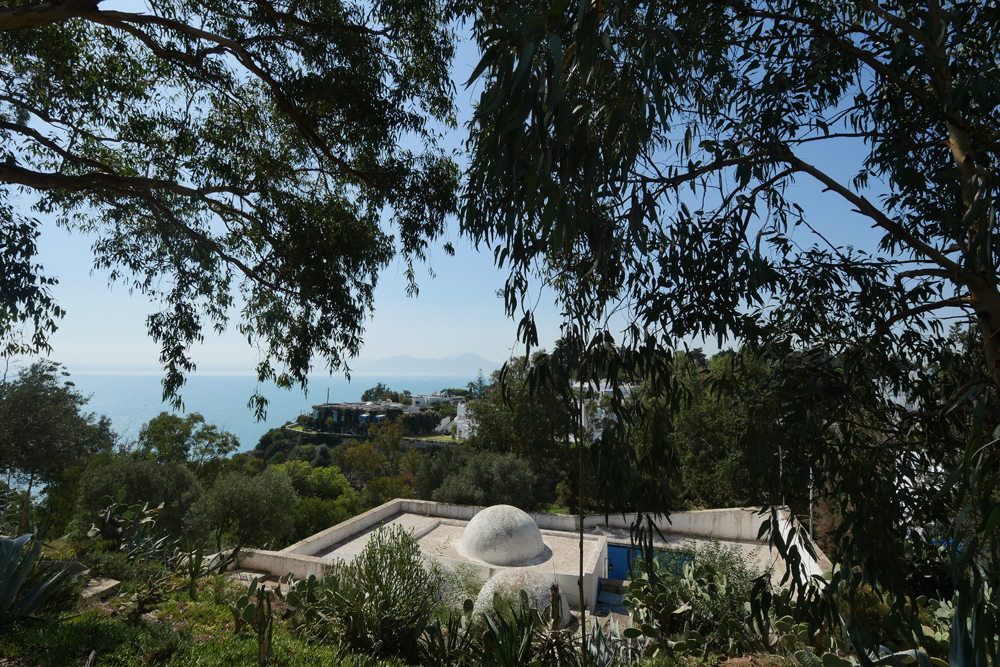
The story behind the palace is that the Baron’s wife ‘collected views’. This one, out across the Bay of Tunis, is particularly stunning. Apparently she bought the land as a gift for her husband. The palace of Ennejma Ezzahra was carefully constructed by digging into the hillside so that it didn’t obstruct the stunning view out to sea for existing homes.

It took more than ten years to construct the building which has a series of unique intricate ceilings and balconies and beautiful marble-lined walls and floors.
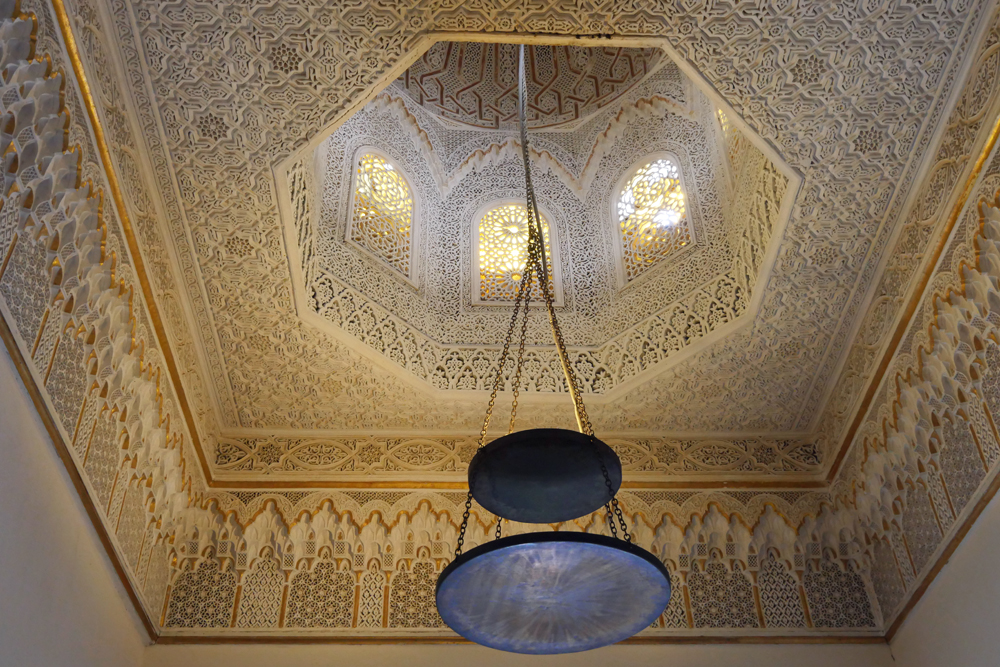
That’s despite a period of occupation during the Second World War when German soldiers were billeted there, damaging and looting some of the treasures.

After the war, Ennejma Ezzahra was restored to its former glory and the Baron’s son Leo lived there with his own wife, Baroness Edwina d’Erlanger. Following Leo’s death, Edwina continued to live there for a few years until she sold it to the Tunisian Government.

Now it is preserved as a museum complete with many of the treasures collected by the original owners, their son and his wife. There’s a vast collection of Arabic musical instruments too as the Baron was a specialist.

He wrote the seminal six-volume series on the rules and history of Malouf and is widely regarded as being responsible for this traditional Tunisian music played by small orchestras, consisting of violins, drums, sitars and flutes.

In addition, you can also see the living quarters of the family, kitchen, bedrooms, bathrooms and more.

The house and museum both have a real feeling of grandeur – and a sense that time has stopped.

It must have been a wonderful place to live.
Dar el Annabi – Sidi Bou Said.

By contrast to Ennejma Ezzahra Palace, the village of Sidi Bou Said itself is home to the Museum Dar El-Annabi, which has been opened to the public in order to showcase the typical homes in Sidi Bou Said. Built at the end of the 18th Century it was refurbished as a summer home in the 20th century. Today, the home is set up to demonstrate life for a Tunisian family and showcase traditional Arab-Muslim architecture.

Although it’s clearly a more modest space, it has a calm, spacious layout that makes perfect sense in the warm climate. There are living quarters built around a central courtyard, with shady terraces.
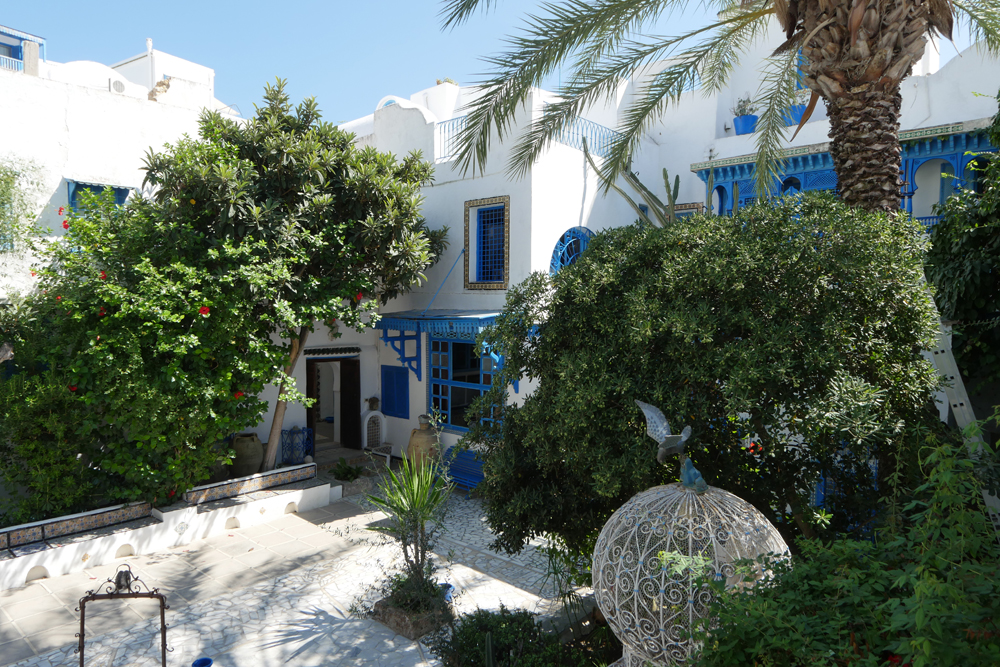
The central courtyard is full of flowers and plants, apparently built in Andalusian style with a central ‘impluvium’ to collect water from the terraces. The rooms themselves are a treasure trove of family possessions. I felt privileged to peek into the family prayer room and loved seeing the library with its collection of ancient books and manuscripts.

Climbing to the very top of the stairs you can reach a rooftop terrace with views of the village and out across the bay of Tunis.
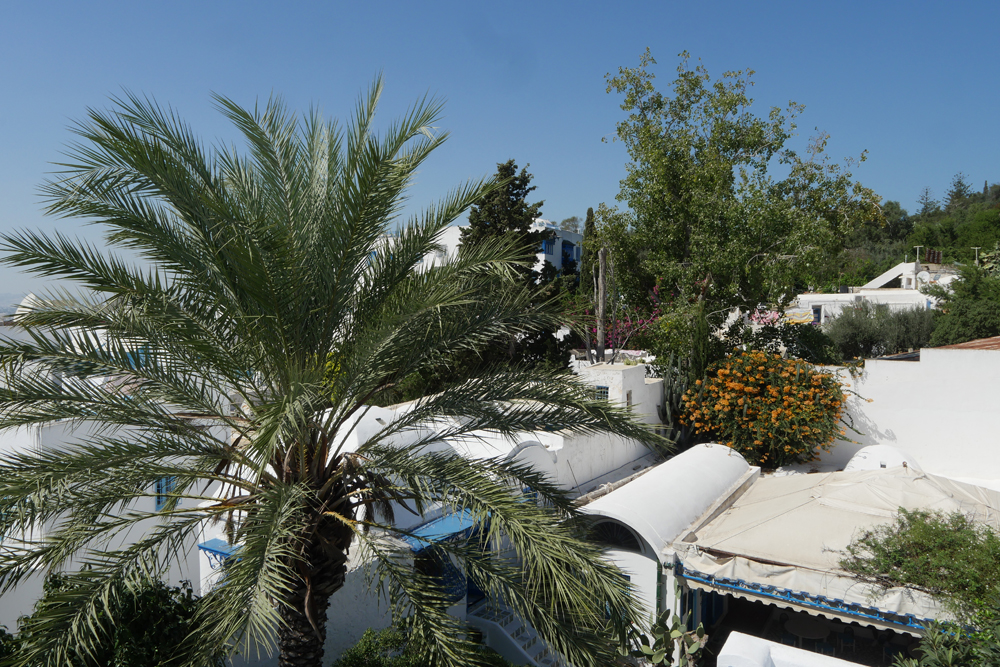
Right in the heart of the village, it’s a must-see – and a welcome break from the steep, crowded streets of Sidi Bou Said itself.
More to see and do in Sidi Bou Said.

If you do explore and need somewhere calm for refreshment, the lovely hilltop Café de Delices has plenty of space in the shade or sun, with seating set out in terraces so everyone can take advantage of the splendid view. It’s worth taking a look even if you don’t stop for more than a quick coffee.

There are plenty of Instagram worthy spots around Sidi Bou Said and D’Art Lella Salha & Des métiers is a crafts market in Sid Bou Said where you’ll find a wealth of artisan crafts and souvenirs to take home.

There are also a few boutique hotels and some elegant restaurants if you want to stay for longer. We peeked into Hotel Dar Said, in the heart of Sidi Bou Said, which has been converted from a wealthy merchant’s residence of the mid-1800s and I’d definitely be happy to find myself staying there. Furnished traditionally with vintage and antique fittings, the hotel has a sister restaurant just across the street called Dar Zarrouk which one of my colleagues reviewed on an earlier trip to Tunisia. She’s also written more about the Bardo, Carthage and Tunis itself all of which are in close proximity to Sidi Bou Said.
Whistlestop Tunis.

For us, it was back to Tunis for lunch, where we were treated to an authentic Tunisian meal at the Dar Bel Hadj in the heart of the Medina, before a whistlestop tour of the Bardo.

By 4.30 pm the museum was closing and it was time to book into our hotel, The Ramada Hotel, Cotes de Carthage in readiness for an early flight back to the UK the next day.

Worth noting if you do need a pleasant hotel near the airport, I was delighted to find a large outdoor pool complex and gardens and that I could walk to a pretty beach with a bar and café in less than five minutes.

There were also some of the happiest (yes really) looking camels I’ve ever seen and horses to hire if you fancied riding along the beach.

Somehow a stroll along the beach in the sunset, complete with camels, horses and local fishermen, yet less than 20 minutes from Tunis airport was the perfect end to our short break. Next time I’ll be back for longer.
Fact Box
I stayed at:
Ramada Plaza Tunis
Les Côtes de Carthage
Gammarth
Tunisia
Tel: +216 71 911 100
We enjoyed lunch in the heart of the Medina at
Dar Bel Hadj
17 rue des Tamis la Kasba
Tunis, Tunisia
We visited
Baron D’Erlanger’s House and Museum
Palace Dar Nejma Ezzahra
1934 Rue Du 2 Mars,
Sidi Bou Said 2026, Tunisia
Dar El Annabi
48 Rue Hedi Zarrouk,
Sidi Bou Said
Tunisia
and
The Bardo National Museum
P7, Tunisia
I was a guest of the Tunisian National Tourist Office
Complimentary flights from London were provided by TunisAir