Last Updated on August 2, 2025
Be a Traveller, not a Tourist and Experience What Others Don’t
I’ve always had a soft spot for small ship cruise itineraries like the Atlantic Legacy with Swan Hellenic Diana. There’s something about the intimacy and ease of being on what feels more like a floating boutique hotel than a traditional cruise liner. And, with a small ship, you can often reach parts that larger cruise liners can’t go. The absolute joy, though, is in travelling without stress as the ship carries you from one fascinating port to the next, while you unpack just once.

On this cruise around the Atlantic coastline with Swan Hellenic’s Diana, that seamless travel experience was paired with the Atlantic Legacy itinerary, which was so rich that it was hard to resist doing everything. Usually, I like to strike a balance: a few organised excursions mixed in with some solo exploration, leaving space to get happily lost in a new town (which, I’ll admit, I’m rather good at, whether I mean to or not). But this time was different.
With shore excursions included at every stop as part of the Atlantic Legacy itinerary, and a tempting handful of optional extras on offer, I found myself saying yes far more than no. From wine tastings to coastal fortresses and historic harbours, the days were wonderfully full. There wasn’t much idle wandering for me on this voyage, but for someone with a less-than-perfect sense of direction, that may have been for the best.

Our journey started in Lisbon, the capital city of Portugal. Flights, transfers and hotel accommodation can all be organised through Swan Hellenic. With a free afternoon and evening and a free morning the next day, there was plenty of time to explore if you wanted to. I took the opportunity to walk through Lisbon, revisiting some of the places I’ve seen before. It was partly a chance to rest and unwind, and partly that often-forgotten side of travel: revisiting places, where you gain a new insight.
The Atlantic Legacy Itinerary
Porto and Guimarães
The coach transfer to Swan Hellenic Diana was seamless and queue-free, as was embarkation. That evening, our first briefing gave us an insight into what lay ahead. We were visiting Porto, a favourite of mine, in northern Portugal. The included excursion was a tour of the Ribiera quarter and then of Cálem Port Wine House in Vila Nova de Gaia to learn about Port Wine production and (of course) to taste some port.

Cálem is one of Porto’s most iconic and tradition-steeped port producers, founded in 1859 by António Alves Cálem. It owns prime vineyards in the Douro Superior, notably the Quinta do Arnozelo estate, where vines are grown on schist-rich, sun-soaked terraces. It’s best known for its tawny port. We tried that and the rose port, with an integrated shop providing temptation indeed for many of us!

Many of the cruise passengers spent the afternoon exploring Porto, but I had signed up for an optional tour of Guimarães, a pretty town known as the ‘Birthplace of Portugal’ that has a stunning medieval centre. Afonso Henriques, later known as Afonso I of Portugal, was born in or near Guimarães around 1109. He was the first king of Portugal, having declared independence from León and defeated his own mother in battle when she opposed his rebellion.

I’ve been to Guimarães before, on a particularly rainy day, and my memories are of diving from one shop to another as we tried to reach the medieval town centre. On that occasion, we didn’t get the chance to visit the now restored Dukes of Bragança Palace (I believe it was closed to the public). This time we did. That, together with clement weather, made this a truly worthwhile trip for me.

Ferrol and Santiago de Compostela
Overnight, we cruised to Ferrol in Galicia, Spain. A city that began as a small fishing port, Ferrol grew thanks to its strategic location on the Northwestern Spanish Atlantic Coast. By the 17th Century, it was home to the largest arsenal of weapons in Europe, integral to the success of the Spanish Navy. Still a shipbuilding centre, it’s also the start of one of the Camino routes – Camino Ingles.


Swan Hellenic organised a unique excursion with the opportunity to hike a small section of the Camino to Santiago de Compostela. There are several Camino routes, and we joined what is sometimes called the ‘End of the World Camino’, an extension from Santiago de Compostela to Finisterre or Muxia that some pilgrims choose to do when they have finished their main hike.
We took the same route, walking in the opposite direction and joining the path about 5km from the city. I’d been warned by a friend that the main Camino routes can be extremely busy with pilgrims and school parties. This hike was blissfully quiet – we did pass a few pilgrims, but for the most part, the only faces we saw were from our group.

Perhaps a reflection of the group’s relative fitness level, almost everyone chose to hike rather than stay on the bus to Santiago de Compostela, and everyone finished enthusiastically, like true pilgrims (albeit ones who’d walked a much protracted route!).

Needless to say, the short visit to Santiago de Compostela was just one of the highlights of the cruise. Visiting Santiago de Compostela is a journey into history, culture and spirituality. At the heart of the city lies the majestic Cathedral of Santiago, where pilgrims from around the world arrive after walking the famous Camino de Santiago.

Our brief guided tour of the Cathedral gave us a chance to experience the magnificence of this structure and to admire the statue of the Apostle St. James. Outside the Cathedral, the cobbled streets of the Old Town, a UNESCO World Heritage Site, are lined with centuries-old buildings and lively plazas featuring bars, cafes, and restaurants.

One of the challenges of any cruise is deciding what to do, and on this occasion, I missed seeing much of Ferrol. Just an excuse to go back!
Santander and Santillana del Mar
Santander, our next Spanish port, was the starting point for a trip to Santillana del Mar, the main excursion for Santander on the Atlantic Legacy programme
Not a destination I’ve visited (or even heard of) before, I thought perhaps we’d be by the sea and that there would be a religious connection. I’m not the only one – it’s ironically known as the Town of Three Lies, not saintly, flat, nor seaside. It is, however, a charming medieval jewel in Cantabria, somewhat akin to a Spanish version of Lavenham in Suffolk, as many of the medieval buildings have survived largely intact.

A guided tour through the town was a good way to get an understanding of the historic significance of Santillana del Mar. We ended up in the Collegiate Church of Santa Juliana, a compact but stunning building that was a key religious centre attracting both pilgrims and wealthy merchants. The cloisters are composed of paired and quadrupled columns, with 42 intricately carved capitals. There are mythical creatures, ornate plant motifs, and biblical storytelling, including the Descent from the Cross. The four Evangelists are represented – there’s a winged man for Matthew, a lion for Mark, an ox for Luke, and an eagle for John. Dating from the late 12th to early 13th century, it’s a stunning reminder that before everyone could read and before TV, radio and the internet, communication was primarily visual.

The town itself is charming and popular for day trips. With a plethora of bars and cafes, it was a friendly and lovely spot to spend an afternoon.
Bilbao
The final Spanish port on The Atlantic Legacy itinerary was a city in one of my favourite parts of Spain. Bilbao is in the Basque region of Spain, and for me, there are two main reasons to visit. The first is to explore the Guggenheim Museum. With Swan Hellenic, we had a very special treat in the form of a private visit. I have to confess that when I saw it listed on the itinerary, I didn’t believe it was possible.

But it was, and it proved to be a truly memorable, money-can’t-buy experience. The stunning Frank Gehry designed museum is usually packed, and for me, it’s impossible to appreciate the art displays when it is. What a joy to have the place to ourselves (a group of about 40 from the ship).

My second Bilbao essential is to eat Pintxos – the Basque version of tapas. These small mouthfuls of deliciousness are often served on a morsel of bread, held together with a toothpick (pintxo means spike). The end of our walking tour of Bilbao was spent in a bar, accompanied by a glass of wine (or two) and a selection of pintxos. Delicious.

Overnight sailing took us round the Bay of Biscay to Lorient in France. Not before we spotted Dolphins sailing alongside the ship. We’d been warned that this was the only part of the cruise that might be choppy, but I slept perfectly. The ship is equipped with a special stabilisation device, making this small ship cruise truly relaxing.
Lorient
Our first French port on the Atlantic Legacy itinerary was another new destination for me. The included excursion was a five-hour trip to Concarneau and Pont Aven, two very different but equally stunning French destinations.

Concarneau may be one of France’s largest fishing ports. Still, the real attraction for most visitors is the beautifully preserved ‘Ville Close’ (walled City), a medieval fortress built on a small island just off the main harbour, first recorded in the 11th century. Its granite ramparts, towers, and drawbridges were constructed in the 14th century and later strengthened by Vauban in the 17th to 19th centuries. It’s easily reached on foot across a bridge from the mainland and has nine towers and three gates. Inside, narrow cobbled streets lead to half-timbered houses, galleries, cafés, artisan shops, and the Church of Saint-Guénolé.

With spectacular views across to the harbour, marina and bay, it’s a charming spot. There are also numerous small shops selling a wide range of items, from canned seafood and artisanal baked goods to elegant scarves and fine linen clothing.

Just at the entrance to the Ville Close is the Musée de la Pêche (fishing museum). Housed in the 19th-century Arsenal, this museum was established in 1961. I didn’t have a chance to go in, but it’s worth adding to your itinerary if you’re interested in maritime history.

Pont-Aven is the home of the Pont-Aven school of painting, founded by Paul Gauguin in 1888. Stunningly beautiful, the village was once better known for its role in the milling industry, with fourteen mills and just fifteen houses. But from the 1850s, painters began flocking to Pont‑Aven for its low cost of living and natural beauty. It was Paul Gauguin’s arrival in 1886 that transformed the village into the artistic centre it is today, with around 60 galleries and studios, as well as a variety of craft shops offering pottery, woodworking, and local produce. It’s a pretty destination that is perfect to stroll around for an hour or so, but would be worth a return visit to explore the galleries and studios in depth.
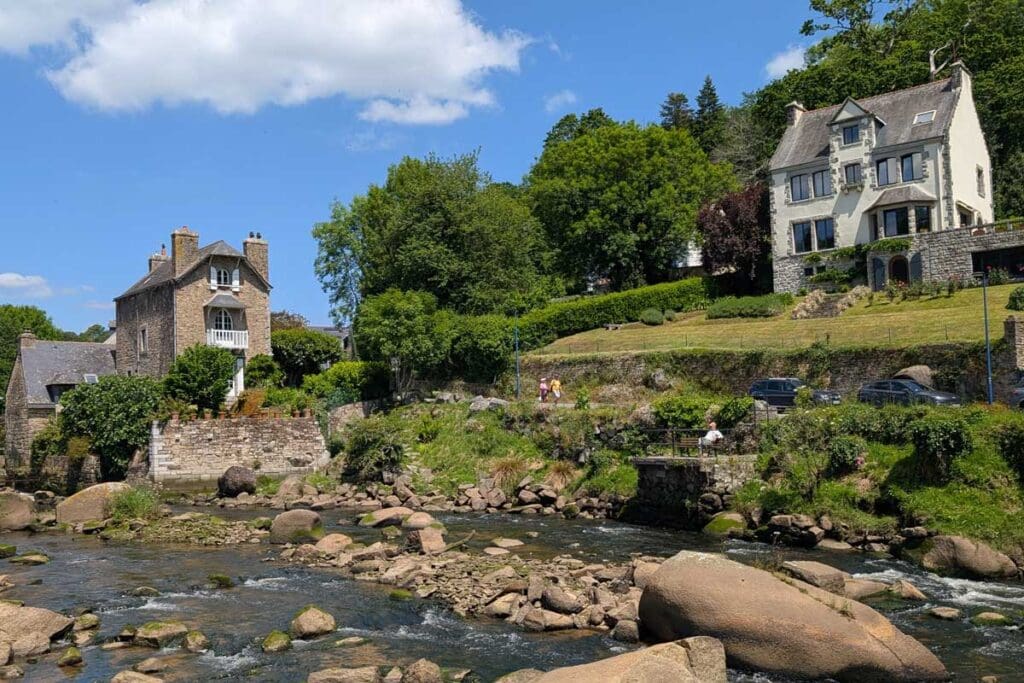
If you have a sweet tooth, then you shouldn’t miss the special Galettes de Pont-Aven, traditional biscuits which were invented in the 1890s and are still produced today. It’s also an excellent place to enjoy lunch, as we did, sitting al-fresco on the banks of the River Aven.

We had enough time on our return to Lorient to explore the area. It is a town that was nearly wiped out by Allied bombing in the Second World War, so it is a marked contrast to the medieval architecture of Pont-Aven and Concarneau. For us, it was a chance to shop away from the more touristic destinations we’d visited earlier – I returned to the ship with bottles of wine and more. Lorient is also home to the preserved Flore submarine, a reminder of the maritime importance of this French city.
Roscoff
I know of Roscoff because of the town’s connection with onions. Today, they are an elevated, gourmet product – a sweet, pink-skinned variety that has an AOC and PDO status, legally protected and only able to be grown with strict controls in a specific region of France. But Roscoff came to fame with the Brits because of ‘Onion Johnnies’, Breton onion farmers who crossed the English Channel every year to sell their onions door to door in Britain. Recognisable because of their striped shirts, berets, moustaches and riding bicycles with strings of onions draped over them, at one time in the 1920s, there were over 1,400 of them!

As I learnt on our included walking tour of the pretty historic town centre, there’s a lot more than onions in Roscoff, and it’s a worthy destination for the Atlantic Legacy itinerary. Near the port, you’ll find the Maison des Ducs de Bretagne, a stunning 16th-century granite house that is said to have hosted Mary Queen of Scots on her way to France at the age of just five.
The historic wealth of the town is most evident from the 16th-century granite church of Notre Dame de Croaz-Batz – a beautiful example of Breton Gothic architecture with an intricate bell tower and maritime carvings.

And, most fascinating, this town, with its strategic location on the North Coast of Brittany, near key English trade routes, grew in wealth through privateering – legalised Piracy where the French government issued “letters of marque” (lettres de course) to ship captains, allowing them to attack and seize enemy merchant vessels during wartime.

The loot (called a “prize”) was split between the privateer, their crew, and the state. You can still see the traps on the street where the goods would be stowed!

Roscoff flourished between the 16th and 18th centuries, through various wars including the Wars of Religion, the Franco-Spanish Wars and even the Napoleonic Wars. Home to several notable corsairs, many of the mariners in Roscoff were also part-time privateers.

A short boat trip from Roscoff takes you to the Île de Batz, a peaceful and largely car-free island that is easy to navigate on foot or by bike. There are stunning beaches, walking trails, and the Georges Delaselle Garden. For those looking for a tranquil afternoon of easy walking, it’s the perfect escape, as I discovered.

St Malo and Mont Saint Michel
Arriving at St. Malo, it’s easy to see why this charming fortress city is a popular destination. What you probably wouldn’t guess is that the Allied forces heavily bombed the whole city during the Second World War, and what you see now is a reconstruction. Originally a monastic settlement, it’s another city that was a base for privateers in the 17th and 18th centuries. The corsairs who made St. Malo famous were fiercely independent, and for a while, the town declared itself an independent republic.

The meticulous reconstruction after the Second World War means that you will find cobbled streets lined with shops, cafes and restored 18th-century buildings (many rebuilt after WWII). In the brief time I had to look around, I enjoyed following part of the Ramparts Walk around the old city’s walls, passing historic gates, bastions, and cannons, and taking in fabulous views out to sea.

I passed by the Etoile du Roy, A replica of an 18th-century corsair frigate, docked in the harbour. If, (unlike me) you have a little time, then you can climb aboard and explore its decks and cabins.

There’s plenty more to see in St. Malo, and the city is famous for its seafood restaurants, including those serving oysters from Cancale. But, we were packing in a trip to Mont St Michel on the same day, one of the most memorable parts of the Atlantic Legacy itinerary for me. No regrets – just a great excuse to return!

Mont St. Michel is about an hour away by road and is a not-to-be-missed destination. We started our journey there almost the moment we were able to disembark, to arrive ahead of the crowds. When we arrived at the car park, there was already a short queue for the Passeur – the free bus that takes visitors to the abbey. On the way back, the queues were long enough to convince even me that walking was the better option.

Encircled by vast mudflats when we first reached our destination, we learnt that there are areas of quick sand, and so wandering off piste is not advisable. And, the abbey is surrounded by some of the fastest and highest tides in Europe. But, of course, once you have gone through the entrance, you are on dry land – and the only way is up! There’s a ‘back route, which takes you away from the village shops and cafes (all very tourist-oriented), and that’s the way our guide directed us.

As you walk further and further up into the heart of the abbey, you pass through the cloisters and refectory, then up to the church at the very top. There’s a Grand Staircase and a museum. It’s not the monastic life we generally imagine; instead, Mont St. Michel is an imposing and majestic setting.

Founded in the 8th century and expanded in the 13th century, Mont St. Michel features stunning Gothic and Romanesque architecture, known as ‘La Merveille’ (The Marvel). The high walls and natural defences helped Mont St. Michel withstand multiple sieges, especially during the Hundred Years’ War. It became a major pilgrimage site and a stop on the Way of St. James, known as the Camino de Santiago. It’s now a UNESCO heritage site and one of the most popular attractions in France.

For me, it was a real highlight – and one where I was particularly grateful for the guided tour timing, which allowed us to avoid the masses arriving as we were leaving on our way back to St. Malo.
Honfleur and the Landing Beaches of Normandy.
Although the included trip at Honfleur was a walking tour of the city, I took the opportunity to join an optional excursion to the Landing Beaches of Normandy simply because exploring that part of Normandy without a guide is challenging. Even with a guide, there’s still plenty more to explore.

On the windswept coast of northern France, where salt air still mingles with memory, the beaches of Normandy bear silent witness to the largest amphibious invasion in history. June 6, 1944, marked the beginning of the end of Nazi occupation in Western Europe. Today, these five beaches remain hallowed ground for history, remembrance, and reflection.

We began with a visit to two of the landing beaches: Omaha and Gold Beach. On the morning of June 6, 1944 (D-Day), Allied troops landed on the beaches of Normandy in what would become a turning point in World War II. Among the five designated landing zones, Gold and Omaha beaches stood out for both their strategic importance and stark contrasts. At Gold Beach, British forces advanced with relative success, aided by meticulous planning and specialised armoured vehicles that helped break through German defences. Just west of them, however, American troops at Omaha Beach came under fire from the enemy forces, firing from entrenched positions on high ground. That led to some of the day’s heaviest casualties. Both landings ultimately succeeded; however, the differing experiences at Gold and Omaha underscore the complex, uneven nature of the D-Day invasion.

Then on to see the nearby American Cemetery, the resting place for around 10,000 US soldiers. Overlooking Omaha Beach, the Normandy American Cemetery in Colleville-sur-Mer is a solemn tribute to the more than 9,000 American soldiers who lost their lives during the D-Day landings and subsequent battles in World War II. Set across 172 acres of carefully maintained grounds, the cemetery features rows of white marble headstones and a memorial honouring those missing in action. As the last post sounded at midday, everyone stood still in recognition of the immense sacrifice.

Lunch was held at the beautiful Chateau de la Cheneviere in Normandy, now a luxury hotel. A welcome break with a light meal that was almost as good as the food we were enjoying on board SH Diana.

Finally, we spent some time visiting the Arromanches Museum. Perched above the remnants of the Mulberry Harbour on Normandy’s Gold Beach, the Arromanches Museum quietly tells the story behind one of World War II’s most ambitious engineering efforts.

Officially known as the Musée du Débarquement, it traces the construction and operation of the temporary port that enabled Allied forces to move troops and supplies ashore following the D-Day landings. With a mix of scale models, period artefacts, and modern multimedia displays, the museum offers a clear and accessible look at the logistical backbone of the 1944 invasion—less dramatic than the beach landings, perhaps, but no less crucial to the campaign’s success.

Our engaging guide turned out to have both a British and a French Grandfather, both of whom had played an active part in the Second World War. His French Grandfather was part of the Resistance movement, while his British Grandfather was in the Army and took part in the D Day landings.
Back on the Swan Hellenic Diana, I must confess that I found this particular excursion emotionally challenging. For me, it brought home the appalling consequences of war in a very real way. I’ve visited several Second World War sites in mainland Europe before, but nowhere else have I felt so moved.
Recommendations for Travelling with Swan Hellenic
This small ship cruise with Swan Hellenic was unlike any other I’ve taken part in. Although the Atlantic Legacy itinerary is based in Europe, it still has elements of the ‘Expedition Cruises’ that Swan Hellenic is best known for. If, like me, you prefer travelling to being a tourist, this is the cruise for you. As such, throw everything you thought you knew about cruising out of the window and start again!

Don’t just pass through—immerse yourself. The included shore excursions are expertly curated, designed not just to showcase the highlights but to offer a deeper understanding of the destinations along your route. These guided experiences are more than sightseeing; they’re windows into local life, culture, and history. You’ll be accompanied by Swan Hellenic staff guides together with local experts, offering the best of both worlds.
Be open to being gently challenged. Whether it’s stepping off the beaten path or hearing unfamiliar stories, these moments often become the most memorable. You’re in safe hands, and the Swan Hellenic guides are specialists, deeply knowledgeable and committed to your safety and comfort.
Take a moment to review the optional excursions as well. If something piques your interest, it may well be worth the extra cost.
And don’t skip the evening briefings. More than a rundown of logistics, they offer valuable insights into what’s coming next: the local context, what to watch for, and tips to enrich your experience the following day.
In short: engage fully, travel curiously, and trust that everything is in place to help you discover more. You will come home with some very special memories and, almost certainly, with a desire to explore further.
Fact Box
I travelled on the Swan Hellenic Atlantic Voyage from Lisbon to Portsmouth from Monday, 12 May to Wednesday, 21 May 2025
For more information about Swan Hellenic, please call 0207 846 0271 or visit www.swanhellenic.com
Price – CRUISE ONLY
A 10 night cruise only, 11-Day Luxury Cruise: Portugal to Netherlands | Swan Hellenic, departing 15 May 2026, on board SH Diana, costs from £6,380 pp (two sharing) and includes all meals onboard, 24-hour room service, coffee, tea, soft drinks, and selected alcoholic beverages available 24-hours per day, lecture programme by experienced expedition team and guest speakers, one selected shore excursion/activity per port of call, standard Wi-Fi, onboard gratuities and port taxes. A branded Swan Hellenic expedition parka and the use of rubber boots are offered in the Polar Regions.
The following services are not included with the cruise only:
- Flights
- Transfers
- Pre or post-cruise accommodation
For more about Swan Hellenic and our experience on SH Diana check our review