

Last Updated on November 13, 2023
Catflaps, Cardabelles and Templar Knights in Aveyron:
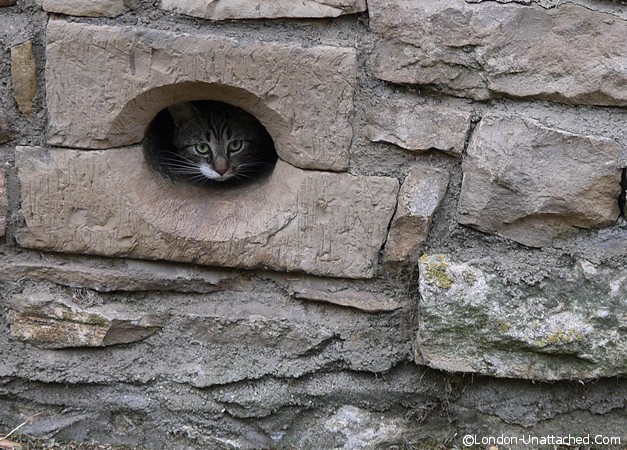
Meticulously restored medieval fortified villages are scattered throughout Europe. This is the first time though, that I’ve visited one with such excellent accommodation for cats. As we wandered through St Jean d’Alcas, a small face appeared from what might have been mistaken for some kind of drainage pipe and, as we took the obligatory snaps to post on Facebook, disappeared back into the safety of his limestone home.
There are five major Knights Templar sites in Aveyron, fortified villages that were positioned strategically in the Causse du Larzac to enable production of food supplies, shipped out through the nearby port of Montpellier as well as providing an income for the Templars and later the Knights Hospitallers.

Our short visit to Les Causses et Les Cevennes took us to two of them – both beautifully restored and, perhaps through the remoteness of the region, preserved much as they would have been in the 12th and 13th century.

The guide at La Couvertoirade told us that the site was particularly important for farming – horses, sheep (for wool, milk and meat) and grain and explained that the Knights Templar were great landlords whose wealth came at least partly from their ability to protect and support their tenant farmers. A religious military order, their original role was to protect pilgrims on the road to the Holy Land, then later to protect the land itself.

Although the Templars were ‘international’, their wealth and power in France grew to such an extent that at the start of the 14th Century, King Philip IV of France became concerned that his own supremacy was being undermined. On Friday 13th 1307 all the Templars in France were arrested and accused of heresy, treason and various other crimes. Many confessed under torture and the property of the Templar order was seized and passed to the Knights Hospitallers who had a similar role protecting crusades to the Holy Land.

Needless to say, a legend has grown up around the date of Friday 13th. The order of the Knights Templar was abolished in 1312 and Jacques de Molay, the Grand Master and two other leaders of the order were burnt alive at the stake in Paris on 18 March 1314. From the stake, legend says that Jaques cursed the King and Pope “from this your heinous judgement to the living and true God, who is in Heaven”, warning that within a year and a day, both would be called to answer God’s judgement. And, both did die within a year of his execution, Philip in a hunting accident and Clement from a long illness. Only the recent discovery of the Chinon parchment shows that papal trials had absolved the Knights before their execution.
I hadn’t realised that I visited one of the Knights Templar sites in Portugal earlier this year. My fascination with Monsanto was the construction of the village in between large boulders, but it is also a fortified Templar castle and village. At La Couvertoirade the original village, just behind the hill where the castle was constructed, was moved by the Templars, both to facilitate protection of the villagers and to site the houses close to water. The scarcity of water in the region means that houses were built with large ‘water tanks’ which stored rainwater collected from the roofs. And, even on the roads, an intricate system of drainage collected water to feed the animals.

Throughout the Middle Ages, La Couvertoirade continued to prosper, extended fortifications protecting the village during the Hundred Years War and it was not until the French Revolution that the property was returned to the farmers of the area. Like many rural communities across Europe, the population of La Couvertoirade declined rapidly during the 19th Century but the result is a small community where buildings are much as they always have been. Restoration by the Conservatoire Larzac Templier et Hospitalier and an active programme to encourage craftsmen and women to move into the village means that it now has a population of around 200, whilst, at its peak, there were over a thousand inhabitants.

The five Templar sites in Aveyron are La Cavalerie, La Couvertoirade, Sainte-Eulalie de Cernon, Le Vialade Pas de Jaux and St Jean d’Alcas. We only had time for a brief visit to St Jean d’Alcas, originally a Cistercian Abbey and which remained, for the most part, the property of the Church, governed by women even though it was one of the Commanderies of the Templar Knights.

And, although the original infrastructure at La Couvertoirade was the work of the Templars, later developments included the construction of the church by the Knights Hospitallers and a new Lavogne, just outside the village walls rather than inside.

Charming to wander through, for me taking one of the guided tours (there are both audio tours and ones led by guides) is a must to discover the history of the villages in a little more detail.

The inscription, from the entrance to the church, reads “Good people who pass by here pray to god for the departed” and is written in the native language of the region (Occitan), which our guide told us was still spoken by her own family at home. And many of the houses in La Couvertoirade had the Cardabelle on the door.

Exploring the story of the Knights Templar and Knights Hospitallers is just one of the many things to do in Causses and Cevennes – a unique and relatively unknown part of France. Read more on my other posts – And, I have more to reveal over the next few weeks.
And, of course, these Knights Templar and Knights Hospitallers villages are just a tiny number of beautiful villages across France waiting for you to explore. So, what are you waiting for?
More thanks to Jackie Bru, Inger Berckhauer and Lysiane Boissy d’Anglas from the tourist offices of Causses et Cevennes for their guidance and hospitality on this trip and hospitality on this trip.


The signal towers of the Templars stretch all along the south of France. From Jerusalem to Marseille where they split, up to the north of France, to Troyes, Paris and England (then), and westwards to Santiago in Spain, a huge Templar headquarters. These signal towers were the source of their wealth. They can be seen behind Monaco, Vence, Grasse, along to St Baume, home of Mary Magdalene for the last 30 years of her life. Loads of them. These men needed feeding. Look up Ferme des Templiers, Brignoles which supplied them. There are these templar farms everywhere across these routes to the Holy Land.
Great Content.
Another thing to add to my bucket list! I have never heard of the Templar sites before this post! You were able to soak in a lot of history and you retold it beautifully!
This seems like a really interesting place and for you to understand it more, its important to listen to the guided tours. There’s a lot you’ll get from it. Thanks for sharing.
Is that where the Friday 13th fears come from? I had no idea! Love all the Templars stories, it is a bit like watching a movie 🙂
I lived in Toulouse during my Erasmus exchange, but I was not aware of such a stunning place in the vicinity! What a shame, I would have loved to visit it! Did you go to Albi too?
Im a total history ignoramus, so would totally love to experience this. Love your piccies too, especially the first one with the kitty poking his head out. 🙂
It was a kind of cat tunnel – kitty could get in and out of the house through there!
VERY ATTRACTIVE VILLAGE
I have always been fascinated by the Templars. Love your photos. Stunning locations, so evocative.
I was blissfully ignorant till this particular trip. You can tell because I went around Monsanto without realising the Templar link last year. The French have done a sterling job of restoring and managing the five sites in Aveyron and you can’t escape a bit of learning as you go round!
Great pictures. I like to visit places like this when I get the chance to.
It’s a fascinating area Chris, I think you’d enjoy it. There are a lot of good hiking routes and some spectactular landscapes which I will write about soon!
this looks like a great place. I love the history and Knights Templar are very interesting.
Stevie
What a brilliant post. I really love history and know a little about this area but not enough so this was fascinating. You have made me really want to visit – definitely adding it to my bucket list!! Thank you for sharing.
Even though the crusades were crazy, they did leave some good stonework behind…I love the picture with the windmill…
The Knights Templar and Hospitallers were key in the development of europe for many reasons. These villages are fascinating because of the way they have remained pretty much preserved entact!