
Last Updated on December 12, 2025
UNESCO City of Gastronomy with a Unique Cuisine
Perhaps I have a romanticised image of Borneo. We followed my father to Malaysia when I was just six years old. An army doctor with the Royal Highland Fusiliers, he was attached to the Malaysian Rangers and sent to work in Borneo. At the same time, we were stationed in Ipoh, to the north of the Malaysian peninsula. In 1966, it took three to four days and nights of flying to reach Singapore from London, and our transfer was intended to ensure we could see my Dad occasionally.
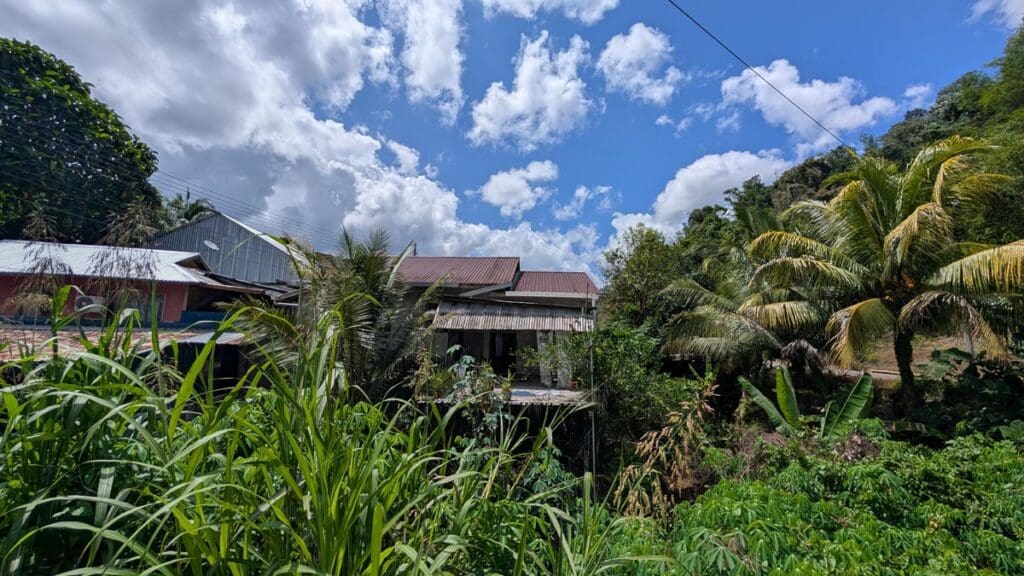
We never went to Borneo. Instead, my father would come home to our villa on the outskirts of Ipoh and tell us tales of being winched from a helicopter into the Jungle. He’d warn us of headhunters if we didn’t behave. We had, he’d told us, heads hanging on the wall watching over us to make sure we behaved properly, though years later I discovered ours were made of painted clay. And he’d bring us exotic presents – wicker baskets, beads and little carved figures that we could treasure when he was away.
Table of Contents
Introduction to Kuching and Sarawak
Arriving at Kuching, though, there was something of a sense of déjà vu. There was that same warm humidity we found in Ipoh, which wraps you in a comforting blanket. There was a pervasive friendliness. And, the feeling that, although the traffic moves fast enough, time itself is on a go-slow.

Our first Sarawak Laksa, ‘Breakfast of the Gods’ as Bourdain said, was at Choon Hui Café, a short walk from the Legacy Hill Hotel where we were staying. It’s one of those dishes that, as someone who rarely eats more than a bowl of yoghurt at breakfast, I hesitate, order the smallest on offer, and then regret not having asked for more.

The signature broth of the Sarawak Laksa is made by simmering a complex spice paste (dried chillies, shallots, galangal, lemongrass, kaffir lime leaves, turmeric, coriander seeds, shrimp paste and more) with chicken stock and a touch of coconut milk, creating a light yet aromatic soup that’s neither too creamy nor too spicy. Served with thin rice vermicelli, poached prawns, shredded chicken, omelette strips, fresh herbs, and a squeeze of lime, it offers a bright, elegant taste distinct from other laksa varieties. The “Queen of Sarawak cuisine” is a beloved dish that showcases the region’s unique culinary identity.

Choon Hui Café, with dishes from a handful of different vendors, is raw, gritty and authentic. Enjoy the breakfast of the Gods in a lively atmosphere and wonder if you’ll need to eat again. But this is just the start. Kuching is a UNESCO Creative City of Gastronomy, the first in Malaysia, and any visit to Sarawak, and to Kuching in particular, will take you on a journey through a rich and diverse food heritage.
A Melting Pot of Cultures
Sarawak is home to over 40 ethnic groups, each with unique skill sets and its own culinary heritage. The Iban are skilled warriors and longhouse dwellers, famous for Ngajat dance, weaving and unique tattoos. Bidayuh (Land Dayaks) are known for bamboo craftsmanship and round houses. Melanau are coastal and river fishermen. And the Sarawak Malay people are rich in traditional poetry, boat-making, and festive cuisine. The Sarawak Chinese communities (Hokkien, Hakka, Foochow, etc.) are part of the state’s multicultural identity and have been in the state for centuries. This diversity contributes to Sarawak’s rich culinary landscape.

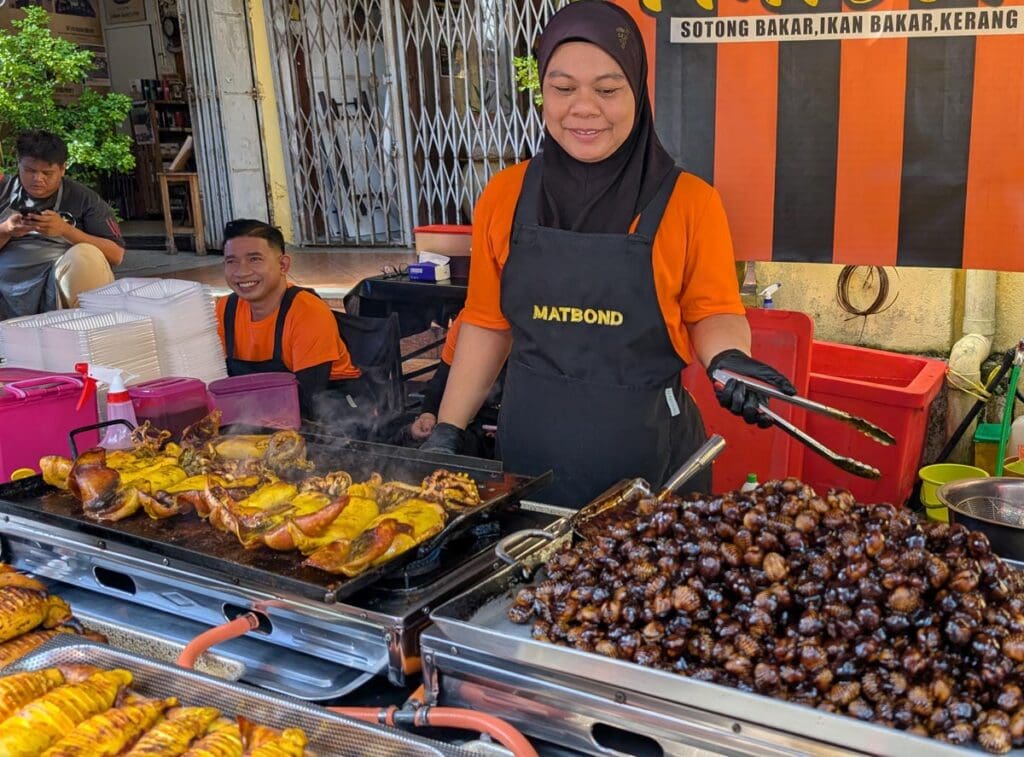
Kuching itself, with heritage shops, temples, food stalls and markets as part of daily life, provides the perfect base for a gastronomic journey like no other. And, the UNESCO inscription is recognition of that cultural creativity, sustainability, and preservation of culinary traditions. If you want to explore the cuisine of Sarawak, then it’s a great place to start. Whether you are walking around the City during the day or by night, you’ll find the streets packed with stalls. There seems to be a never-ending programme of festivals, with music, dancing and some of the best street food treats I’ve ever encountered.
Serumpun Sarawak
If you are lucky enough to be able to travel around Sarawak a bit, you’ll find even more – a land where foraging for local ingredients is part of everyday life. That’s something the local people are keen to promote, and beyond the restaurants, cafes and homestays, we were lucky enough to experience Serumpun Sarawak, which helped illustrate the unique biodiversity and heritage of Sarawak. In the heart of the Jungle, staying at Mulu Marriott Resort and Spa, we joined Chef James Won for a seven-course gastronomic journey based on the dishes and ingredients of Sarawak.

A cultural showcase, with fabulous music and dancing, it was a gastronomic adventure that paralleled the kind of development you might have experienced in the late 70s if you visited the Basque region of Spain, with Michelin-starred James Won elevating traditional dishes and ingredients into fine dining. A perfect storm, when a chef with James Won’s skills was let loose with a team of local chefs keen to showcase their own heritage and to evolve the dishes further. We also learnt about some of the local crafts and traditional ingredients that will surely bring success to the region. Having already encountered Kuching’s coffee culture, I was fascinated to discover more about one particular company, Earthlings Coffee, which is working to develop the indigenous Liberica bean, a heat and disease-resistant coffee variety with a unique flavour profile, which is just one example.

As part of the seven-course tasting menu, we enjoyed dishes like ‘Forest’ Bichotan Chicken with Gula Apong and Tempoyak (fermented Durian, which, bizarrely, has a soft, savoury taste and absolutely no unpleasant smell!). Made with free-range chicken marinated in native spices and then grilled over hardwood charcoal, it had a wonderful, tender texture with smoky notes from the charcoal. Glazed with wild palm sugar reduced with Bario cinnamon and a wild leaf called Ipah Kayuh to enhance the umami.

And ‘Mountain’ was highland lamb with Bario rice risotto and ferns. The meat, crusted with litsea, a local citrusy highland pepper and Bario salt, had a wonderful flavour.

‘River’, meanwhile, was a slow-cooked fillet of labang, a local freshwater fish from the river carp family, served with liberica blossom and snail broth with enkabang nut oil to add a rich aroma.
James told us there are plans to build an immersive culinary showcase or museum in Kuching, where visitors can learn more about the heritage dishes of Sarawak and about the local ingredients. His vision for a showcase that ends with a restaurant serving traditional dishes is one I’ll undoubtedly return to Sarawak for.
Traditional Foods of Sarawak in Kuching
Laksa
The ubiquitous Laksa can be found across Kuching. We tried several versions – each had its own champion. For me, the best Laksa was at Lau Ya Ken Food Court, but it was a close-run thing.

The version we enjoyed at Choon Hui Café was spicier with a somewhat thinner broth. And, while the Laksa at King Laksa was the prettiest to look at, it lacked depth of flavour.

I’ve come home with something of a craving for a good Laksa now!
Manok Pansoh (Chicken cooked in Bamboo)
The most fascinating dish we tried was Manok Pansoh, on the menu in many of the restaurants and cafes we visited in Kuching. It’s chicken cooked in a large hollow bamboo shoot, sealed with tapioca or banana leaves, or sometimes with a bamboo plug.

At the Annah Rais Longhouse, an hour or so from Kuching in the hills of Borneo, we were lucky enough to have a traditional cookery demonstration, watching the chunks of chicken, still on the bone, being mixed with local spices and herbs and then tipped into bamboo and sealed with tapioca leaves, before being cooked over a fire.

James Won explained that the process was like a primitive pressure cooker – the meat becomes wonderfully tender as the steam inside the bamboo builds. It’s served in its own broth – a delicious and healthy dish.

For those staying in Kuching, I recommend the Ayem Pansoh at The Lamin, Telang Usan Hotel (the Bidayuh version of Bamboo chicken, with rather more aromatic herbs) or the version at nearby Lepau Restaurant. It’s a delicate dish, perfect if you are cautious about heavy spicing or just want some comfort food.
Terung Asam
A local heirloom fruit from Sarawak, Terung Asam or Dayak, is a kind of brinjal or eggplant about the size of a tomato.

Bright yellow or orange, it can be used to add a sour note to Laksa or, as we tried at Lamin, in a dish called Terung Dayak Asam Pedas, a tart and spicy dish where the Terung Dayak is cooked in an asam pedas (turmeric and tamarind) gravy. A vibrant dish, it contrasted well with fish dishes.

Midin and Cassava
The most striking thing for me about the dishes we ate was the wealth of delicious vegetables. Midin, a local fern, was served stir-fried and garlic-laced. It appeared on almost every menu and was universally loved.
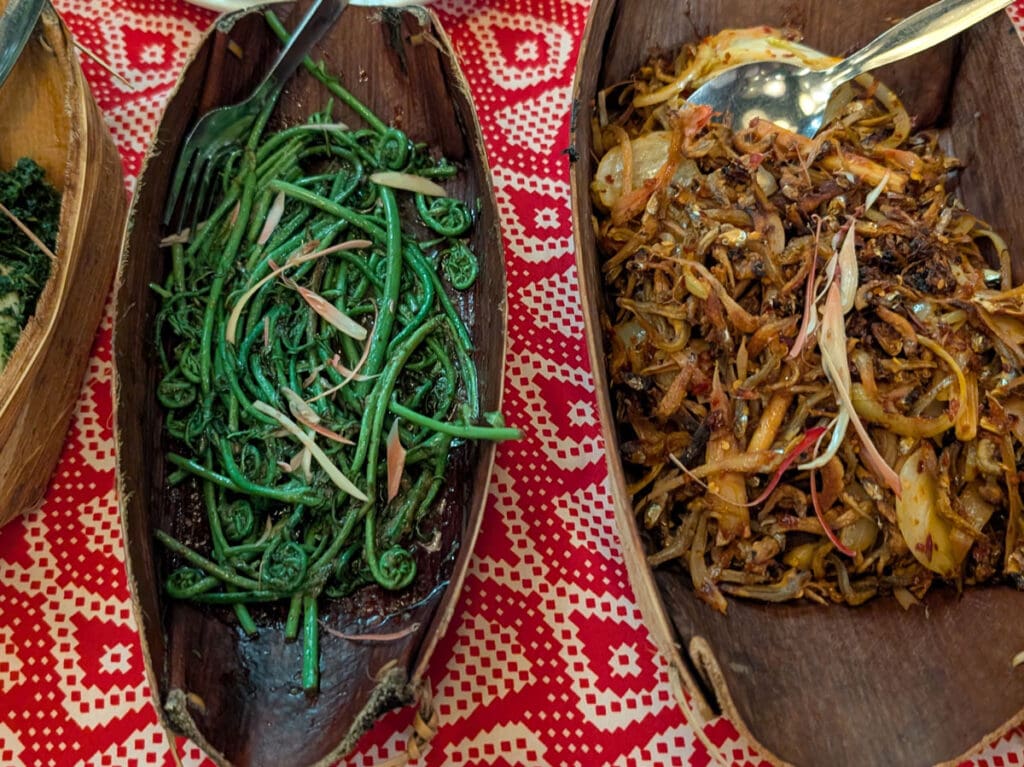
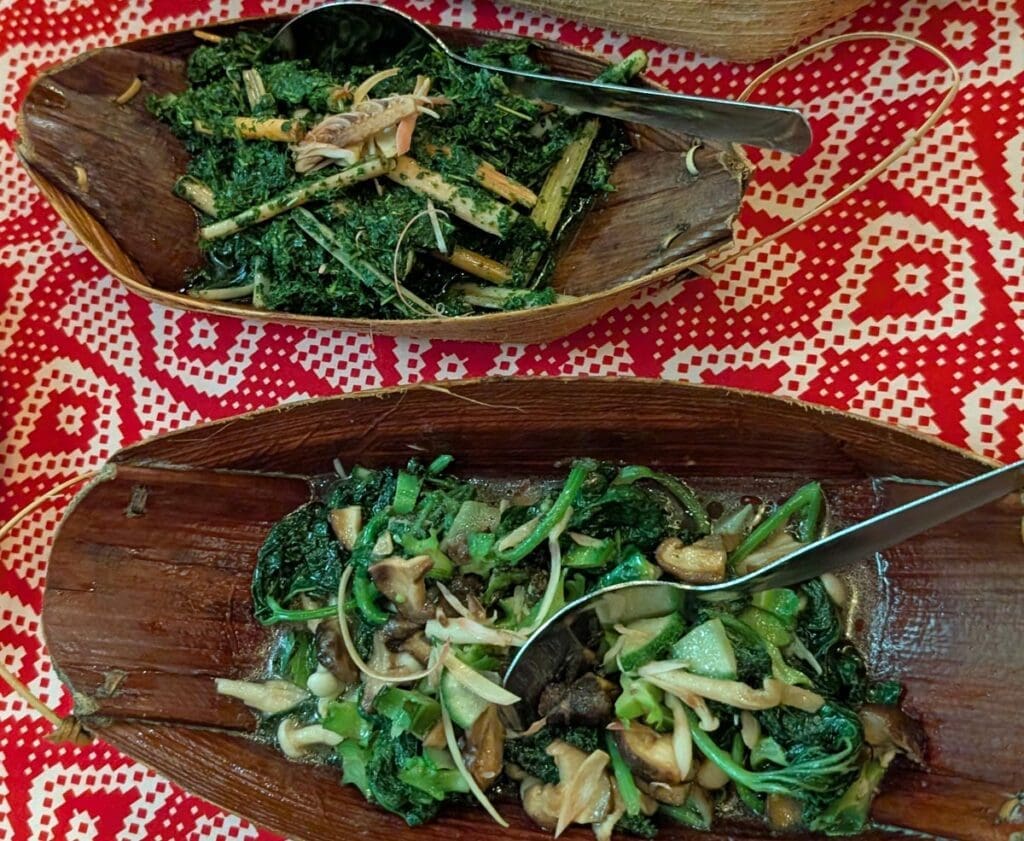
We also enjoyed Daun Ubi Tepus at Jak Ma’an – cassava leaves cooked with tepus, which adds a subtle gingery note, along with yet more vegetables.
Tempoyak
Fermented Durian appeared on many menus, too. At Pinggai Café, it was served with stir-fried pork, making a dish called Bati Goreng Tempoyak (the rice dish is petan fried rice – rice with stinky beans!). At Jak Ma’an, the durian was a star turn, served on its own, Tempoyak Goreng.

Just as we’d discovered at James Won’s seven-course dinner, the fermentation softens the flavour profile and removes any trace of that pungent smell that has this fruit banned from restaurants around the world.
Bario Rice
Bario rice is highly prized in Kuching, one of Sarawak’s signature premium products. Grown in the remote Bario Highlands of the Kelabit region, this heirloom rice is popular among locals and visitors looking for authentic highland flavours. Bario rice is recognised for its soft, slightly sticky texture and naturally sweet aroma.

The traditional cultivation and distinctive taste make Bario rice not only a staple but also a celebrated part of Kuching food culture. At Lepau restaurant, we enjoyed a rare purple Bario rice, earthy and nutty with a subtle sweetness. And, once again, this was an ingredient used as part of James Won’s dinner.
Fish – Sea and River
Sarawak is fortunate to enjoy a wealth of produce from the sea and the river.

From the deliciously spicy Serunding Kantan Sambal Ikan Bilis (shredded torch ginger sambal with anchovies), a spicy savoury condiment made from fried dried anchovies cooked in a chilli paste with shredded torch ginger, that we enjoyed at Jak Ma’an, to a feast of simple steamed fish, black pepper crab, lokan (cockle) soup and more that we ate at Top Spot, in the most unlikely setting of the top floor of a carpark!

Kuching really is a haven for the pescatarian.

Chinese Sarawak Heritage
Limited by time on this visit, the most memorable Chinese dish we enjoyed was at Pinggai Café, where we tried the Dayak Char Siew. This Sarawak dish blends traditional Dayak flavours with the Chinese method of roasting pork. Instead of the sweet red glaze found in Cantonese char siew, the Dayak version uses local ingredients such as lemongrass, torch ginger, and wild ginger to create a savoury, aromatic marinade.

The pork is grilled or roasted until tender, with a natural golden-brown colour and a gentle smoky flavour. Once again, there was a clear link with James Won’s glorious chicken dish and a similar flavour profile.
Where to buy ingredients
While we focused on the restaurants and cafes of Kuching, it’s worth venturing to Satok market, where you’ll find a wealth of ingredients from wet and dried fish to fresh vegetables to spices, coffee beans and more. I came home with nothing more than Sarawak peppercorns, but if I’d had more space, there would have been coffee beans and bario rice in my suitcase too.

Worth a visit to experience a different side to the vibrant food culture of Kuching, you can enjoy breakfast here too.

UNESCO and Beyond in Kuching
Kuching is rightly proud of its title as a UNESCO City of Gastronomy. Its food culture reflects a rare blend of indigenous traditions, multicultural influences and sustainable local practices. The City is known for its distinctive ingredients, such as jungle herbs, wild vegetables, and heirloom rice, along with traditional cooking methods like bamboo cooking and slow, wood-fired roasting. Its vibrant food markets, small producers and community-based food economy help preserve heritage recipes while supporting local livelihoods. Kuching also promotes culinary education and cultural festivals that showcase its rich gastronomic identity, making it a strong example of how cuisine can express history, biodiversity and community values.

As part of the Kuching Festival, the City has put together a lively food trail that leads visitors through its cafes, restaurants and food courts, highlighting the dishes that locals relish. James Won’s Serumpun Sarawak showcased how traditional techniques and local ingredients can be elevated into contemporary fine dining.

Yet, the real heart of the region lies in the everyday cooking that keeps these traditions alive. Some have live music, like Jak Ma’an, others, like Roselyn’s Gallery Cafe, showcase a range of local crafts.

In Kuching and throughout Sarawak, food is far more than a meal; it is a record of Borneo’s history and spirit, preserved by the people who continue to cook with care and pride. This strong bond between community, landscape and flavour is what makes Sarawak’s food culture so distinctive and so lasting.
Useful Addresses
Laksa:
34, Jalan Ban Hock, 93100 Kuching, Sarawak, Malaysia
Phone:60 82-243 857
Lau Ya Keng Food Court
19 Carpenter Street, 93100 Kuching, Sarawak, Malaysia
Phone: 012-904 6989
Dayak Cuisine:
99 Jalan Ban Hock Road, 93100 Kuching, Sarawak, Malaysia
Lot340, Telang Usan Hotel 345, Jalan Ban Hock Road, 93100 Kuching, Sarawak, Malaysia
85 Ewe Hai Street, 93000 Kuching, Sarawak, Malaysia
Dayak Chinese:
37 Upper China Street, 93000 Kuching, Sarawak, Malaysia
Local Food and Crafts:
45 Main Bazaar, 93000 Kuching, Sarawak, Malaysia
Seafood Streetfood:
Top Spot
off, Jln Padungan, 93100 Kuching, Sarawak, Malaysia
Ingredients and Produce:
Satok Weekend Market
Medan Niaga Satok, Q309, Petra Jaya, 93050 Kuching, Sarawak,
Cookery Demonstration, Longhouse Homestay and more
Kampung Annah Rais,
Jalan Borneo Height, Kota Padawan,
93250 Kuching, Sarawak,
Malaysia
I was a guest of the Sarawak Tourism Board.
Looking for more Gastronomy features? Check out our guide to the Urla Wine Route in the Turkish Aegean


