
Last Updated on March 2, 2025
A Castle, Cathedral and More – Things to do in UNESCO listed Durham:
Why, it’s wonderful – a perfect little city – and I kept thinking: ‘Why did no-one tell me about this?’ I knew, of course, that it had a fine Norman cathedral but I had no idea that it was so splendid. I couldn’t believe that not once in twenty years had anyone said to me, ‘You’ve never been to Durham? Good God, man, you must go at once! Please – take my car’.
Notes from a Small Island: Bill Bryson on Durham
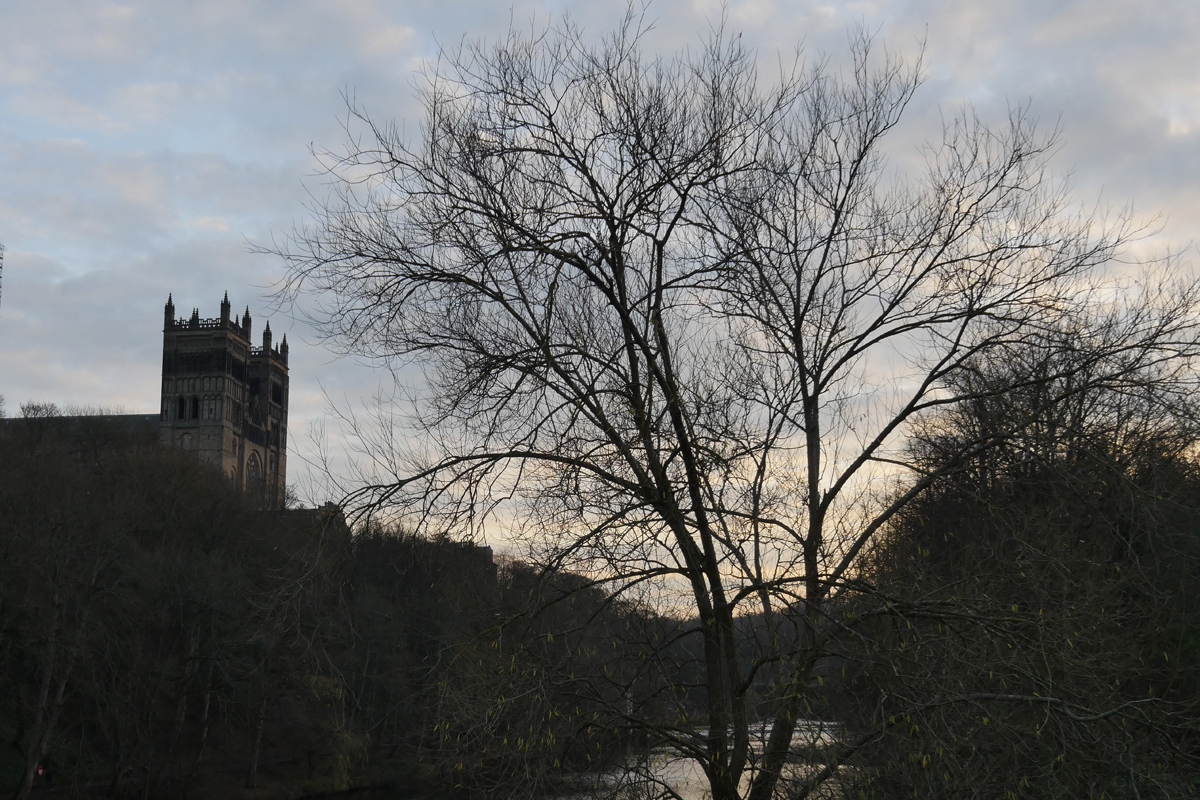
I suspect many of us will share that sentiment on visiting Durham City for the first time. Once you’ve found your way to the Castle and Cathedral (and the prettiest way is via the river up a steep tree-lined path), it’s hard to imagine a more perfect heritage City space. There are plenty of things to do in Durham, and, while perhaps it was just the time of year (for whatever reason I’ve only ever visited Durham in late Autumn or Winter), Durham City also benefits from what appears to be a quieter tourist market than neighbouring York for example. And that’s despite the Harry Potter connection.
Table of Contents
Things to do – Visit Durham Cathedral:
I first visited Durham Cathedral on the way back from a trip to Lindisfarne where we’d been providing a choir for the Parish Church of St Mary’s, a small church on the island which dates in parts back to the 7th Century. We’d stopped off at York Minster on the journey up and I remember vividly the contrast between the two buildings. Of course, it was partly down to the weather and partly the time of day, but compared with the heavy, solid structure of Durham, York seemed almost frivolous. Durham is a Cathedral which seems to epitomise the North of England. There’s nothing delicate about the construction, rather a towering and solid grandeur.

A magnificent Norman Cathedral, Durham is built in the Romanesque style with rounded arches and massive proportions. Construction started in 1093 and it took just 40 years to complete the building, much of which remains intact today. Built on the Durham peninsula, next door to the castle commissioned by William the Conqueror, the Cathedral is a real landmark. Originally the site of a Saxon church known as the ‘White Church’ the site was chosen by monks fleeing from Lindisfarne with the relics of Saint Cuthbert.

Thanks to those relics, Durham became a site of pilgrimage and the defendable position of the Church, the cash flow from pilgrims visiting the shrine and, thanks to the support of King Canute, the power of the church in Durham, lead to the growth of Durham. From the 7th century onward, the Bishops of Lindisfarne also acted as the civil ruler for the region ‘Lord of the Liberty of Durham’ with his own court and power equal to that of the King.

The See of Lindisfarne was transferred to Durham between 990 and 995 and after the Norman Conquest, William the Conqueror recognised the special role that the ‘Prince-Bishops’ might have in protecting the North of England from Scottish invasion and the region became known as the “County Palatine of Durham”.

Nothing much has changed from my first visit to Durham Cathedral, over twenty-five years ago. It’s one of the few Cathedrals that still doesn’t charge an admission fee for visitors. And, unless you have special permission, photography inside the Cathedral is not permitted (this may change in the next few months). There’s a calm atmosphere, visitors focussed on the architecture, the magnificent rose window, what is left of the Shrine of St Cuthbert and on the stunning wooden clock.

This 16th-century piece is said to have survived because of the thistle carved on the top. After the Battle of Dunbar, the cathedral was used as a prison for some 3000 Scots They wrecked many of the tombs, breaking up what wood they could find to make fires to heat the building. The clock, with its thistle, was saved though, purportedly because of the thistle!

What of the Harry Potter connection? Well, the Cathedral, along with Alnwick Castle in Northumberland, was used as the base for the model of Hogwarts that has been used in every Harry Potter film. And, some of the location shots for the films were based in the cloisters and in the Chapter House.
Open Treasure at Durham Cathedral:
Venture upstairs to visit Open Treasure, space which is used to display both permanent and temporary exhibitions from the Cathedral and beyond.

What was once the Monks’ Dormitory is now used as the main exhibition space. A stunning medieval hall, it was once divided into narrow cubicles where the monks would study and sleep. It now houses the Cathedral’s collection of modern theology and part of the space is used as a working library. Another collection of around 30,000 early printed books, music and antiquary collection are housed in the Refectory Library.

Walk through the Dormitory and you’ll find yourself in the 14th Century Great Kitchen, one of only two medieval monastic kitchens in England. Look up at the distinctive high rib-vaulted ceiling and enjoy the collection of valuables housed in this space.

St Cuthbert’s coffin, made in 698, his pectoral cross and the Conyers Falchion, a 13th-century medieval sword that belonged to Sir John Conyers and was supposedly used to slay a giant worm or dragon that was the inspiration for Lewis Carroll’s Jabberwocky. This space also houses the original 12th-century sanctuary ring. Offenders who touched the knocker on the north door of the cathedral would be granted 37 days protection from secular authorities. What you see in situ on the north door today is a replica that was made in 1980.

In addition to the permanent collections, Open Treasure has a programme of temporary exhibitions. Currently on display is an Armistice Day exhibition to commemorate 100 years of peace which closes on 2nd February
Opening on Monday 11th February there will be an exhibition titled ‘feasting and fasting’ focused on food and drink of the 14th Century and exploring how the Great Kitchen would have been used. There will be a 14th Century manuscript copy of the Rule of St Benedict on display. Originally written in the 6th Century we learn that Monks are expected to live a life of daily denial ‘some food, drink or sleep, needless talking and idle jesting’. Not all bad though, they did have a daily allowance of half a bottle of wine and a main meal which was to include two kinds of cooked food. Other exhibits include John Thacker’s book ‘The Art of Cookery’ dating back to the mid 18th century – as the cook to the Dean and Chapter of Durham Cathedral from 1739 to 1758 he supplemented his income by opening a cookery school in Durham. It sounds fascinating – a chance to see manuscripts and books seldom on display to the public.

That’s followed in the summer of 2019, by The Vikings in Northumbria – the history of the Viking raid on Lindisfarne in 793 and more.
Things to do in Durham – explore Durham Castle:
Ever wanted to live in a castle? At Durham University some of the students get to do just that. Not just any old castle either…this one dates back to around 1072, when William the Conqueror, anxious to stabilise his lands in the North of England, ordered the construction of a new fort, probably on land which had previously been the site of a Saxon fortress. Construction of the Castle took place under the supervision of the Earl of Northumberland, Waltheof, until after rebelling against William he was executed. The next Bishop of Durham, Walcher, purchased the earldom and was the first of the Prince-Bishops of Durham.

The Bishops of Durham who inhabited the castle had far more powers than Bishops today. The North-East of England was so far from Westminster that the ‘Prince-Bishops’ were given powers to hold their own parliament, raise armies and generally rule over the diocese. Indeed Bishop Antony Bek commented in 1299 that ‘There are two Kings in England, namely the Lord King of England wearing a crown in sign of his regality and the Lord Bishop of Durham wearing a mitre in place of a crown’. Known today as the Prince-Bishops, their role remained much the same until the Great Reform Act of 1832 which largely removed their powers.
Although the castle is now a residential college for the University, you can still take a guided tour of parts of it, including the Great Hall, originally built by Bishop Bek (1284 – 1311) and then extended and embellished by Bishop Hatfield (who had also commissioned the Bishop’s Throne in the Cathedral to be higher than the one at the Vatican). Despite some remodelling, what remains is a grand statement of wealth – in daily use by students and staff at the University as a dining hall. It was used as one of the models for the Dining Hall in the Harry Potter films.

It’s definitely worth taking a tour to learn more about the history of this fortification. Be sure not to miss the Black Staircase with pineapple finials – another statement of wealth by the inhabitants. Even the gatehouse has a tale to tell. Although it dates from the Norman period, the original arch was dismantled in the 16th Century and reconstructed as a wider structure to allow the Bishop’s carriage to pass through more easily.
Things to do in Durham – Take Tea at Crook Hall and Gardens:
Whilst I couldn’t quite see myself taking up residence in Durham Castle as part of a Prince-Bishop’s household, I could definitely see myself ensconced in Crook Hall.

A welcomed invitation to try the afternoon tea in this home, originally built over 700 years ago as a Medieval Hall, The Jacobean Mansion which makes up a large part of the building was built some 400 years later, then extended again in 1720 with Georgian sections added by the Hopper family.

Tea in the Georgian Drawing Room provided the opportunity not just to feast on homemade sandwiches, scones and seasonal cakes but to sit looking out at what must be one of the best views in Durham of the Cathedral.

The house itself, in mid-December, was splendidly decked out for Christmas celebrations. It was easy to imagine the White Lady who is said to haunt part of the house, descending from the old stairs into a room full of winter greenery.

We marvelled at the stunning Medieval Hall with its timbered roof and loitered by blazing fires in the Jacobean fireplaces.

Walking through the gardens, still beautiful in mid-winter, I made a mental note that I needed to return to see more of the carefully managed 5 acres, particularly the Georgian walled garden and the Maze. And the Silver and White garden planted by previous owners, Dr and Mrs Hawgood to celebrate their Silver Wedding Anniversary.

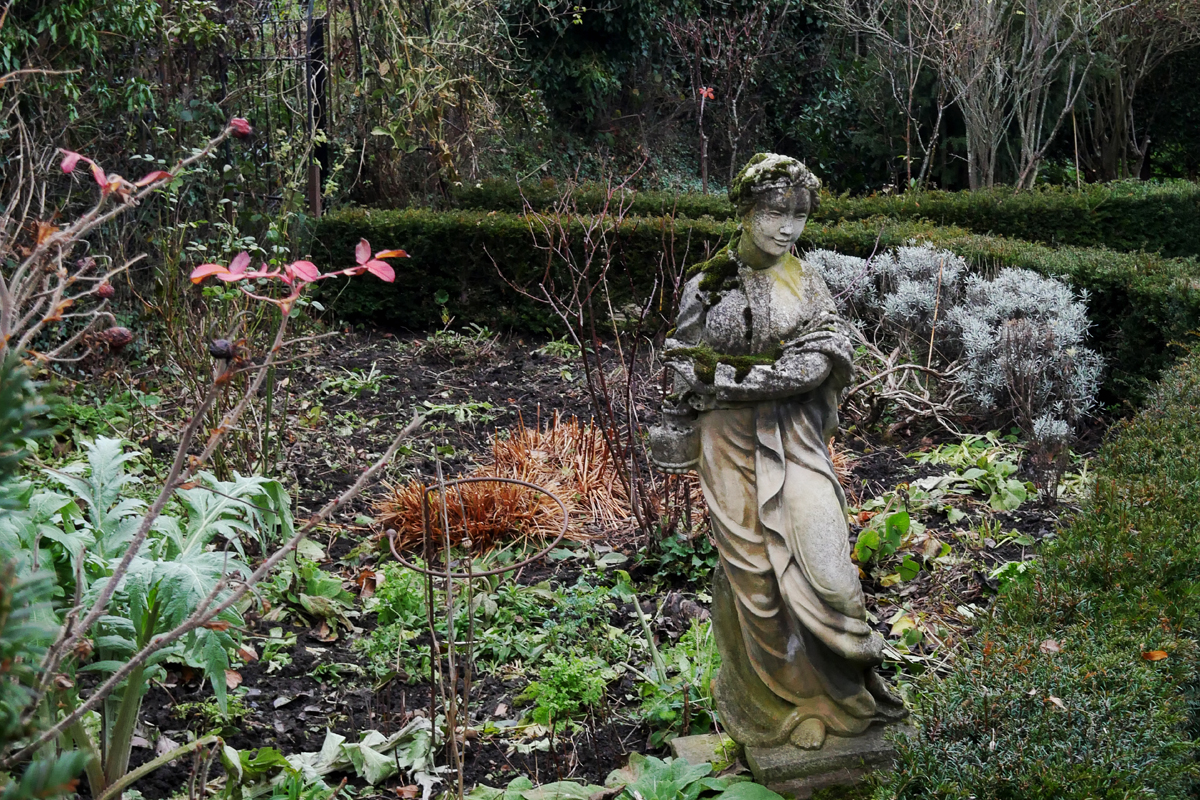
Crook Hall, while open to the public, is owned by Keith and Maggie Bell who bought the house in 1995, carried out much of the restoration while making it their family home and still live there today.
While it’s easy enough to imagine living there now, I do wonder if I’d have been brave enough to take on such a major project. The end result is a warm and friendly place that reflects the home it must have been to so many generations. Oh, and afternoon tea is definitely recommended. Be sure not to eat lunch before though!

The Oriental Museum:
Elvet Hill House which flanks the Oriental Museum was built in 1820 by Ignatius Bonomi as a private home. Now part of the University of Durham, it was home to the School of Oriental Studies from 1955 onward, part of the University that had thrived since being set up by Thomas Thacker with the aim of training more linguists proficient not just in the languages of the Near and Far East but in the culture and way of life – essentially to provide specialists for British intelligence.

Establishing a museum was initially to provide students with an insight into the ‘cultural background of the oriental peoples’ something Thacker regarded as essential The collections on display in the museum are predominantly from wealthy travellers. The Northumberland Collection, for example, was originally sent to the British Museum, but never unpacked thanks to the onset of the Second World War. Instead, after the war, the university purchased the collections using the rationale that Durham would never be a military target. Later collections were donated by major benefactors such as Malcolm Macdonald and Sir Charles Hardinge.

Such a major collection had completely overtaken the original objective to support departmental teaching and in 1957 the Gulbenkian Foundation donated £60,000 to fund the first stage of the creation of the museum, which has subsequently been extended.

What is on display today is just a fraction of the treasures owned and managed by the museum. The treasures are arranged to allow both adults and children to draw inspiration – and there’s an active schools programme.

I particularly enjoyed the way the museum was structured. Of course, as part of the University, the function of the museum should be educational and what is achieved in this relatively small space is impressive. The tiered layout allows visitors to ‘walk through’ the heritage of different cultures in a way which highlights change. There’s nothing stuffy or boring here – and I can imagine schools groups leaving truly inspired. What is on display ranges from simple everyday objects through to the rare and precious. Dr Craig Barclay, Head of Museums at Durham University, who showed me around, picked out one object I would probably have overlooked. The Ancient Egyptian Girl Carrying Vase, he told me, dates from around 1390-1350 BCE and is remarkable partly for the quality of workmanship but perhaps more significantly for the naturalistic depiction of the girl, who has to thrust her hip out to one side in order to support the jar she is carrying. That breaks away from the usual formal conventions of Ancient Egyptian art.

Definitely worth the walk up the hill.
What else to see in Durham City:
There’s plenty more to see in Durham and I’d certainly like to return and explore the City a little more. Here are a few more ideas to consider.
If the weather is fine, then there’s a riverside walk which takes a couple of hours. Both the Castle and Cathedral are built on what is known as Durham Peninsula and the circular walk is mostly along the banks of the river around the rocky outcrop that made this UNESCO site such a great defensive position.

The Grade II listed Town Hall is worth visiting, especially the Main Hall with stained glass windows and hammerbeam oak roof.
Palace Green Library and the Museum of Archeology is home to a collection of medieval artefacts found in and around the city and more than 70,000 volumes printed before 1850.

Apart from visiting Crook Hall when the gardens are in bloom, Durham Botanical Gardens and Wharton Park should be on the list for anyone with an interest in horticulture.
And, both Durham Heritage Centre and Museum and the World Heritage Site Visitor Centre provide more information on Durham’s rich past.
Durham County:
On this particular trip, I moved on to Seaham to explore a little of the Heritage Coastline and will be covering that in my next feature. For those looking to travel beyond the City, Durham has plenty to offer besides a stunning coastline.
I’d love to explore the Vale of Durham, the cradle of the railways, where on 27th September 1825, the world’s first public passenger steam railway began its maiden journey. And, the Durham Dales, part of the North Pennines Area of Outstanding Natural Beauty and UNESCO Global Geopark.

Auckland Castle at Bishop Auckland is due to reopen in 2019 and, having learnt just a little about the Prince-Bishops I’m keen to explore further.
And, of course, there’s a wealth of food-related activities, from food festivals to pubs and bakeries serving traditional dishes to Durham’s monthly producers’ market.
Definitely somewhere to come back to and stay for a little longer.
Useful information about visiting Durham City
I travelled to Durham with This is Durham, the County’s official tourism centre.
For more information please call the Visitor Information Centre on 03000262626 or email visitor@thisisdurham.com

I stayed at The Kingslodge Inn, a charming pub with rooms a few minutes from the City Centre. Rooms start from £79pn and you can find more information here
For more information about Crook Hall, please check their website
For more information about Durham Castle and to book a tour
For more about the Cathedral and the Open Treasure exhibition
To find out about the Oriental Museum
Thinking of visiting Durham yourself? why not pin this post for later.

Looking for somewhere to stop off on the way from London to Durham? We recommend Ye Olde Bell Spa Hotel and Restaurant in Nottinghamshire.


MAN! First I’ve heard of Durham and I have spent time in that area. Such a bummer when that happens. Love that the castle is being used as a college
I love all the history you provide about Durham Cathedral. The Open Treasure space looks like it would be a fun place to visit. That’s cool that part of Durham Castle was used as a model for the Great Hall in the Harry Potter films!
The cloisters of the Cathedral are also used in Harry Potter films
The stained glass windows in the Durham Cathedral are absolutely stunning! I never would have guessed that the Elvet Hill House holds a museum, but it looks fascinating!
It looks like a great place to go for a weekend or a bit longer.
What a fascinating destination! I’d love to learn more about the Battle of Dunbar. I can’t imagine a cathedral large enough to use as a prison for 3000 Scots
It is vast. But I suspect they were still quite crowded!
And don’t forget Kynren in Bishop Auckland, the third best show I the country according to Trip Advisor.
I haven’t been there – maybe next time!
I certainly think I now need to visit Durham City. The cathedral is definitely a stunning building. No wonder it was used as a model for Hogwarts. We like to do Afternoon Tea when we travel. This one looks tasty. So many things to do in this UNESCO town.
The gardens are beautiful too. I’m going to post a (borrowed) pic of the gardens in summer because it looks so pretty!
Durham looks like exactly the sort of place I love to visit. Castles and cathedrals are definitely my kind of thing, and that afternoon tea looks fabulous. I’m bookmarking this post for when I get around to a trip to Durham!
Crook Hall looks as if it would be truly spectacular in summer – the gardens are really beautiful.
What an amazing city. The Oriental Museum sounds especially fascinating. Some of those pieces must be worth a small fortune too. Back in the day wealthy travelers were also able to pay top dollar for original and important artifacts that maybe shouldn’t have been sold, right?. I wonder if the countries of origin know about the museum and the full content?
I think many of them do because the University has very strong reciprocal arrangements with the countries represented (exchange programmes etc). It’s a different feeling to the British Museum, which can sometimes feel a bit colonial
What a beautiful city and so many fascinating historic places to visit, I love all the architectural details of each of these treasures. Definitely putting this on my list of places to visit when I visit some day.
Noel, if I was visiting from overseas, I’d take a car and travel up from York to Durham and then up the Heritage coastline to Edinburgh – it’s truly stunning
Durham is a mystical place to me. I am intrigued by the castle, the museum, the Crook hall, and seriously there is so much to do there. I wasn’t very aware of the place before and now I am really impressed with this UNESCO-listed site. Durham is surely going to be in my list.
Durham looks like a lovely historic city to explore, with a good mixture of things to do and see. My husband and I are thinking about visiting relatives in the UK around Christmas time and Durham looks like a fantastic spot to spend a few days. Durham Castle is certainly grand.
I’m going to write another piece about the coastline – which is stunning. I’d definitely recommend it, though I have to say it is a little chilly in winter!
Wow, Durham does look and sound incredible! I’m sure I would love to visit here some day. I’d especially love to savour the tea at Crook Hall and Gardens! 🙂
I love the quote you start this with, and now I am also thinking, oh, well, I’ve not been to Durham and clearly I really need to visit! I love the idea of a city with a strong cultural heritage, and lots to see and do. I’d heard of the castle and cathedral, but good to see more about what makes them so appealing compared to others. I’m particularly drawn to the Oriental Museum, I think I’d really enjoy that.
The Oriental Museum is a real hidden gem. I kept spotting things from my childhood in Malaysia too, which made it quite special. I suspect Feasting and Fasting in the Cathedral will be excellent too.
Oh and Bill Bryson loved Durham so much he went on to be Chancellor of the Uni – so you never know Kavey…