
Last Updated on March 2, 2025
Blending Traditional Arabic Architecture with Contemporary Styling – Muscat, Oman:
Muscat in the Sultanate of Oman has a wonderful ring to its name. Like something from the Arabian Nights, I’d imagined bustling souks, fantastic palaces, mosques, and historic fortresses. All of that is real enough in Muscat but one of the most remarkable things about the City is that two of the landmark buildings are actually relatively new yet conform beautifully to the Arabic architecture of the old City.
To compound this apparent paradox, one of those buildings is a stunning interpretation of a European icon of culture, an Opera House.
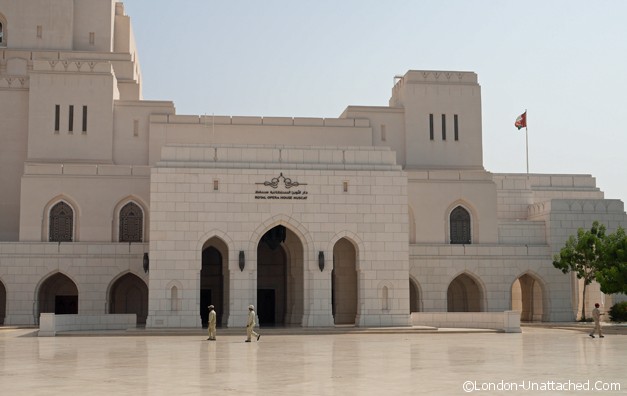
From the outside, the Opera House is Palatial and built in a classic Islamic style. Constructed from Omani desert rose stone with stucco wall coverings and surrounded by landscaped gardens, a shopping mall and pristine terraces and walkways, the building has a timeless quality. The Architects, Wimberly, Allison Tong and Goo are responsible for many of the landmark constructions of Arabia including Atlantis the Palm in Dubai and King Abdullah Economic City, Qudimah, Saudi Arabia.



Inside, the building fuses Italianate styling with traditional Arabic features. It is a new ‘Grand Opera House’ with careful attention and lavish investment in the intricate décor.
Originally called the House of Musical Arts, the building was finally named the Royal Opera House before opening on October 12 2011 with a performance of Turandot starring Placido Domingo. It has been designed to be multi-form though and can be transformed from a proscenium theatre for opera seating over 1,000 people to a concert hall.
In fact, the programme of performances varies from Grand Opera and Ballet, through to Arabic Jazz, Symphony Orchestra concerts by the Royal Oman Symphony Orchestra and classical Arabic Tarab singers.
Like the Grand Mosque, the Royal Opera House was commissioned by Sultan Qaboos bin Said. The Sultan is a longstanding fan of classical music and the Opera House is particularly significant in that within the Arabic peninsula there is only one other, in Cairo.
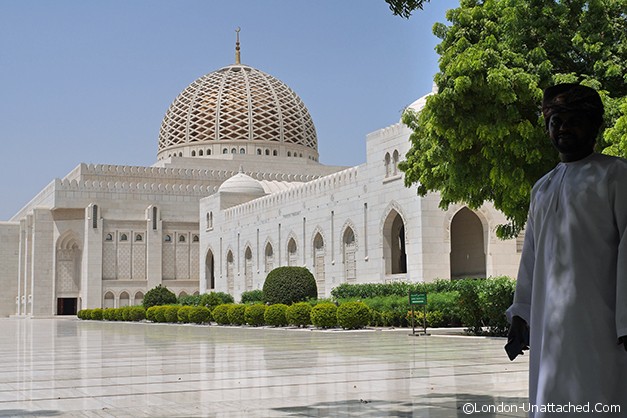
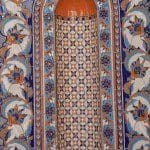
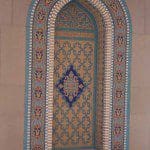
Perhaps the Sultan Qaboos Grand Mosque is a more predictable construction for Muscat but this building is also relatively new. It was commissioned in 1992 by the Sultan and the architects were chosen through an international competition. Lead architect Mohamed Saleh Makiya is particularly known for his incorporation of traditional Arabic forms into contemporary building. And, the Grand Mosque demonstrates this almost academic skill throughout, even down to detailing on the tiles. It was completed and opened by the Sultan in 2001.
With a total capacity for over 20,000 worshippers, the site is also home to a large library and to a lecture theatre and seminar rooms.
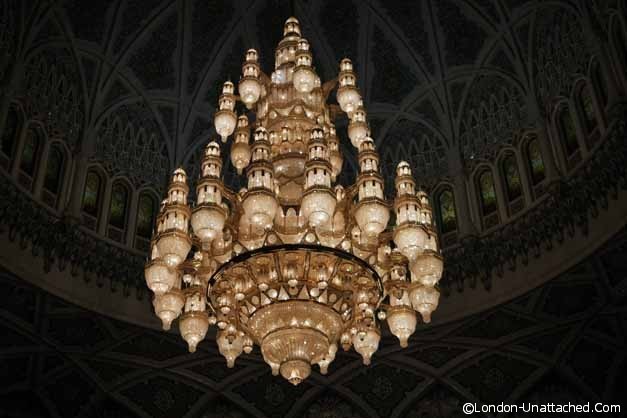
The most striking part of the Mosque is the men’s prayer hall, which can accommodate up to 6,600 worshippers. The floor is covered with a massive hand-made Persian carpet, a single piece measuring 70 x 60 metres with over 1,700 million knots. The carpet took 4 years to produce, initially woven in Iraq in pieces, which were transported to Muscat and woven together in situ. From the ceiling in the centre of the hall hangs a massive Swarovski crystal and gold plated central chandelier 8 metres in diameter and 14 metres in length. With over 1,100 lamps, the chandelier weighs around eight tonnes.

Both buildings are remarkable. And I believe both will form part of a new heritage for Oman, a legacy from Sultan Qaboos bin Said for the people of his country.




Read more about my recent trip to Oman on London Unattached.
- Oman Air has daily non-stop flights to Muscat Oman from London.
- Rooms at the Five Star Ritz Carlton Al Bustan Palace start from around 155 rials a day rising to 350 rials, while the two bedroom presidential suites start at around 550 rials per day
- Rooms at the Five Star Grand Hyatt are around 155 rials per day, with suites from 250 rials
- Further information about investing in Oman is available from the Oman Ministry of Tourism
- Old Muscat Tourism provide drivers and guide services throughout Oman


That’s interesting! Thank you for providing practical info at the end of the post – it’s really useful and you have a BIG + for that 🙂
This is amazing. I love Arabic architecture. And the ornaments….
To say that these buildings are beautiful is an understatement. The details are amazing. And the chandelier! Thank you so much for sharing this us 🙂
It is quite unexpected isn’t it!
Absolutely stunning! I can’t get over the chandelier.
There are some beautiful geometric details in both these locations. Oman is an interesting country, to visit one day soon, I hope.
What a gorgeous building! Thanks for sharing all of these great details!
My family used to live in Saudi and Libya. So I know a bit of a cross section of Arabic culture. This is quite the easiest country I’ve visited as a single woman, definitely worth visiting. There’s plenty outside Muscat too – even a Tropical region to the south of the country
For whatever reason, an Opera House in Oman was surprising, certainly less traditional than a mosque. Beautiful architecture!
The Sultan is a big fan of Western Classical Music!
Loved the chandelier…very different style…very Arabic! Thanks for this detailed look at their architecture.
I was particularly impressed that such contemporary buildings were so beautifully intertwined with the past
The immaculate cleanliness is striking. Lovely architecture and culture, too!
cleanliness is a recurring theme in Oman. You can be arrested for having a dirty car!
What an amazing trip you had. I am so envious! It looks phenomenal. The ability to appreciate their culture and their architecture in person would be such an fabulous time!
Thanks for the interesting insight and the great pictures!! I have already beri in Muscat twice, but just for some hours on a cruise, so I didn’t get to know things exactly.
Rosa