
Last Updated on May 7, 2024
Exploring Beaujolais on a quick visit
Having spent the winter working in Les Arcs in the Haute Tarentaise in the French Alps I was keen to visit a different area of France on the long drive back to catch Le Shuttle from Calais to England. This is a journey I have done several times and I have always been intrigued by the signs off the main roads and péages advertising local attractions and places to visit, the chance to head off into a region and discover more about it has appealed to me. The Beaujolais region, just North of Lyon was an ideal place to stop and explore.

Thinking about Beaujolais immediately conjures up a picture of Beaujolais wine, the celebration of the new harvest, and the much-feted arrival on the third Thursday in November of Beaujolais Nouveau, the fresh and young wine from the new harvest produced by the region. I was to discover that there are numerous appellations and ten crus in total produced in the Beaujolais region, all with their unique characteristics depending on the geology and the soil. The significance of the geology of Beaujolais has led to the area being officially designated one of the UNESCO Global Geoparks. The majority of the vineyards in this region grow the Gamay grape producing a variety of red wines, it also produces light and refreshing Beaujolais rosés and Beaujolais Blancs from Chardonnay grapes.


I was staying in the lovely Hotel Savigny and Spa in the small village of Blacé, just north of the town of Villefranche surrounded by woods and vineyards. The landscape was fresh and green with rolling hills and pretty villages. This was perfect as a base for driving through the surrounding countryside.

This part of Beaujolais is home to the Pierres Dorées, golden stone, villages aptly named as they are built from mellow golden stone which seems to glow in the sunshine. The best example is the medieval village of Oingt, named one of the Most Beautiful Villages in France. Perched high on a hilltop, with stunning views of the surrounding countryside this immaculately maintained village is a joy to visit.

The narrow streets are lined with lovely houses all built of golden stone. The stone originated from the chateau which once dominated the hill, now only the tower remains. Today the village is home to many artists and creative people. You can walk around the village on what were the original ramparts, vestiges remain after they were dismantled, this gives a great viewpoint of the surrounding landscape. Less famous than Oingt, but equally beautiful is the small village of Theizé situated on a nearby hillside with its pretty church and chateau.

The opportunity to visit the organic vineyard of Célia and David Large was a highlight of my brief visit. Their vineyards are dotted around the hills by Montmelas-Saint-Sorlin, wine making has been in David’s family for generations. We drove to one of their parcels, a small plot of land planted with vines, to taste a sample of the wines they produce in situ. A wine barrel was placed in a prominent position as a table to hold the bottles and glasses, we then sampled some of their wines, surrounded by vines with a spectacular view down into the valley.
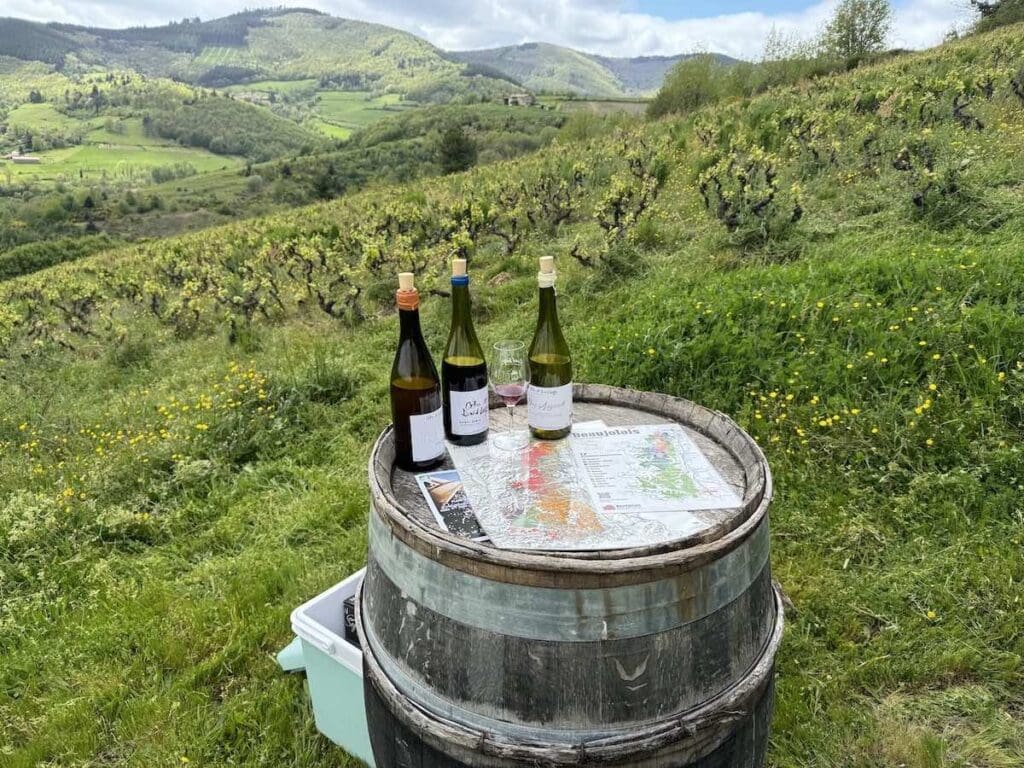
The vines were in their spring flush with bright green leaves bursting out of gnarled hands. The wine was full of flavour, somehow tasting better in the fresh air. I learned that the production of organic wine is arduous manual work, especially when the vineyards are on hillsides, noticeably the vines were growing out of vegetation rather than being intensively regimented in clean rows.

This couple works on every aspect of producing their wine from the cultivation of the vines to storing the vines in a variety of containers made of materials including concrete and fibreglass to bottling and selling the finished result. Their wine has a young, vibrant, and slightly quirky feel to the packaging.

Heading from Montmelas-Saint-Sorlin it is a short drive to Mont Brouilly, which rises up from the vineyards that produce the grapes for the Brouilly Cru. A perfect spot to take in a panoramic view, Mont Blanc is visible gleaming in the distance on a clear day.

My visit to the Chateau of Pizay was a very different experience. This stunning chateau is set in the midst of around 80 hectares of vineyards making it one of the largest estates in the Beaujolais region. The Chateau is surrounded by formal French gardens designed by Le Nôtre, the gardener of King Louis XIV who is best known for designing the gardens of Versailles.
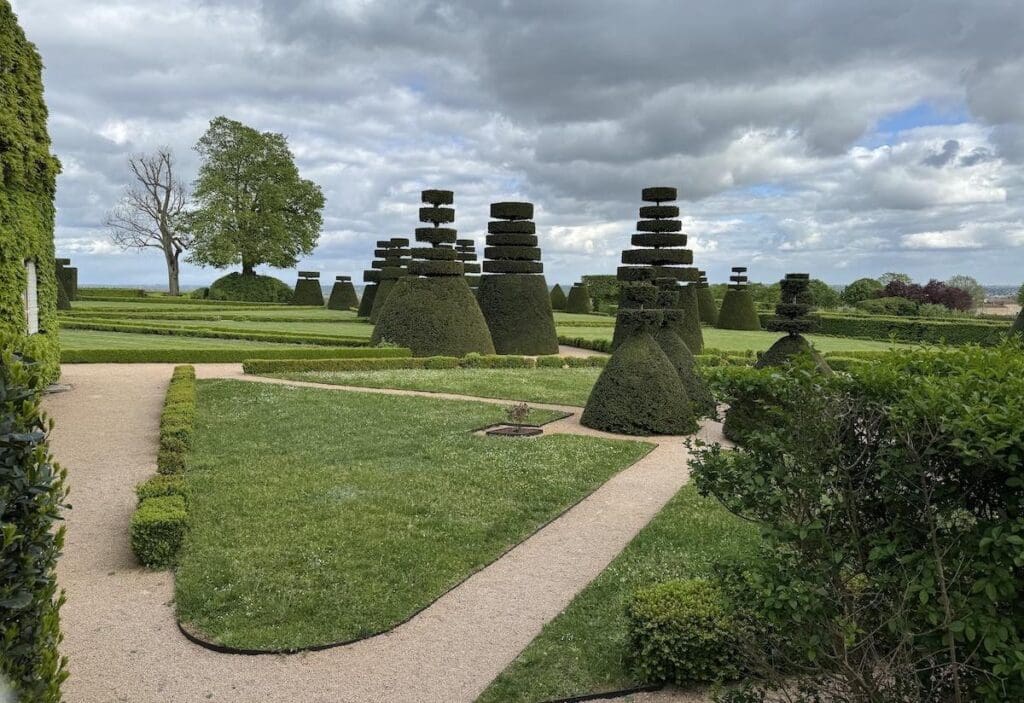
The drive up to the chateau is by an impressive avenue lined with trees. The chateau itself has now been turned into a luxury hotel and spa. I had an appointed time to follow their wine sensory journey. As the name would suggest this explored wine through taste, sight, smell, and touch with descriptive text then the opportunity to try and identify which liquid, or wine had a certain characteristic. For example, identifying the age of a wine by its colour or determining which wine had been aged in oak barrels. At the end of the quiz when I received my results, I was pleased to learn that I had done well.

The spacious oenotheque and shop allow you to taste the wine produced in the extensive vineyards with the option to buy if you wish. Fortunately, I had my car with me, so I happily bought a selection of my favourite wines following the tasting.
It was time for me to leave Beaujolais the following morning and wend my way north towards the Channel. The Hameau Duboeuf was on my way, so a stop there was perfectly timed. This wine theme park, created by the famous wine merchant Georges Duboeuf, known as the king of Beaujolais, was the first of its kind when it opened in 1993. It is situated in Romanèche-Thorins close to the boundary with the Mâcon region and offers an immersive wine experience.
The striking entrance hall, the Salle de Pas-Perdus, a reconstruction of a 1900s station hall is the starting point for a visit.

More than 3000 artefacts in the museum tell the story of winemaking and its evolution ranging from huge oak wine presses to barrels, bottles, and even corks. Along the way, you pass the impressive wine cellars with rows of barrels containing ageing wines.

The immersive elements of My Beaujolais include the story of a winemaker told through his own words and a projection of the history of wine-making through the centuries from the Roman invasion to the 19th Century. Interestingly Julienas, one of the ten Beaujolais Crus, is named after Julius Caesar. A 3D film depicts the celebrations at the end of the harvest with simulation pods for visitors to experience the beauty of the landscapes.

The tour of the indoor area ends in the magnificent, opulent tasting room where a sommelier guides you through tasting the wines of the Beaujolais and neighbouring Mâconnais regions. During the summer months, there are also outdoor attractions and experiences including a visit to the vineyards and winery as well as extensive gardens.

Leading on from the tasting room there is a shop selling an extensive selection of wines from both Beaujolais and Mâconnais, wines from producers around the region are stored, bottled, and sold through this outlet by the Duboeuf family.

The Beaujolais region is a beautiful and interesting area to visit, my stay there was short, and I wish I could have stayed longer. The landscape in springtime is so pretty with verdant hills of green vines stretching into the distance. Why not take the time to visit this lovely region – I know I will be back.
Useful information about Beaujolais
For more information on the Beaujolais Region
I was a guest at the Hotel Savigny and Spa, situated in Blacé close to Villefranche.
The most famous of the Pierres Dorées, golden stone, villages is Oingt which is well worth a visit.
Details for visits to the organic vineyards of Célia and David Large
More information on the sensory wine journey at the Chateau de Pizay
Discover more about the Hameau Duboeuf


