
Last Updated on April 19, 2025
Spring is the perfect season to visit Sweden’s capital
Stockholm is an attractive city at any time of year – outside of the modern centre, Stockholm’s island old town, Gamla Stan, is a year-round, cobbled Olde Worlde delight. Elsewhere, there are the grand royal buildings – the king’s palace, opera house, and theatre; the grand public buildings – parliament and the city hall. There are many walkable, tree-lined streets of sturdy 19th-century mansion blocks, wide boulevards and the odd park and square.
Lovers of winter cosiness may prefer the darker, cooler seasons, but spring really brings out the best in Stockholm – fresh leaves burst out, while the warming sun glitters on the water tempting lunchers and diners to outside tables.

But given the number of other attractive and interesting European cities only a short flight away from the UK, why pick Stockholm?
Because, quite simply, there’s so much good stuff to see and do!
Sweden’s fascinating history is never far away, as are the chilly Baltic waters (not for nothing is Stockholm called ‘’the Venice of the North’’ (one of many, to be honest, but it’s well deserved in this case). There’s plenty of great food as well as restaurants, and superb shopping opportunities.
Table of Contents
Vasa Museum
The standout attraction for me – and worth the flight to Arlanda all by itself – is the Vasa Museum, an impressive home to the best-preserved 17th-century ship anywhere.

The pride of King Gustavus II Adolphus, Vasa sank on its maiden voyage in Stockholm harbour in 1628, only brought back to the surface in 1961. Since then, it has been slowly and carefully preserved and painstakingly restored. Housed in its own bespoke museum, it is a seriously magnificent sight, as it looms over you, the visitor.
Djurgarden
The Vasa Museum sits on Djurgarden, one of the many islands that make up the city, and as well as the many ferries, which shuttle between them, it’s walkable and bussable. Djurgarden is where Stockholmers go for relaxation and entertainment, and it features a range of attractions for every interest.

For example, a short walk, but a world away from the Vasa Museum, sits ABBA The Museum, full of glam stage outfits, instruments, awards and other memorabilia. For budding (or frustrated) pop stars there’s an interactive experience which gets you to sing and dance, and become the fifth member of ABBA, if only for a few minutes.
A tasting experience you’ll definitely want is to be found at the Hotel Hasselbacken, home of the eponymous potato created by a chef there back in the 50s. It’s a great lunch spot, where you can try traditional Swedish meatballs with potato purée, pressed cucumber, red lingonberries and cream sauce.

Djurgarden is also home to amusement park, Gröna Lund, a Stockholm institution. As well as a range of stomach-churning rides, you can enjoy live concerts. And there’s Skansen, the oldest open-air museum in the world and Stockholm’s zoo, featuring animals native to Scandinavia. The massive elk are really something to behold.
Vikings
Further along the shore is the interactive Viking Museum, which tells the story of the Viking-Age seafarers from Sweden, who headed down the rivers of what is now Russia and Ukraine to Byzantium. A fun feature of the museum is a dark ride which brings to life Ragnfrid’s Saga, a dramatic Viking journey through 10th-century Europe.

If you want even more of the Vikings, then a walk up to the nearby posh area of Ostermalm will bring you to the Historiska Museum with its spectacular Viking World exhibition, featuring many very beautiful objects among the 2,500 displayed.
If peckish, not far away is the Saluhall, the recently renovated, 135-year-old market hall where you can enjoy meals and a range of local delicacies.

Gamla Stan
Or jump upon a ferry for the short voyage from Djurgarden to Gamla Stan, a must-see on every Stockholm tourist’s list. And rightly so – its pretty, pedestrian streets are a mixture of shops, restaurants and cafes, but you won’t fail to be enticed off the beaten track to follow its narrower passages.

At its heart is Stortorget, Gamla Stan’s charming main square and the city’s oldest. Site of the Stockholm massacre of 1520, its eateries and colourful 17th century buildings are very photogenic.

The northern part of Gamla Stan is taken up by the 600-room Royal Palace, one of the largest in Europe. Its splendid interiors from the eighteenth and nineteenth centuries are open to the public, but history buffs should not miss the Livrustkammaren in the dark cellar of the palace.
There, you can contrast the splendid royal costumes (like the coronation robes of the enigmatic Queen Christina) with Gustav II Adolf’s bloody shirt worn when killed in battle and his stuffed horse, Streiff; Karl XII’s muddy uniform worn when he was killed in 1718; and the outfit Gustav III wore to the masked ball of 1792 (immortalised in Verdi’s opera) where he was assassinated.
Ironically, these relics really bring their owners to life…. In death, however, they’re buried in the Riddarholmskyrkan a short walk away on a small island connected to the old town.

The City Hall
Worth the effort, a bit more of a stroll takes you to Stockholm’s iconic City Hall, built from eight million bricks, which hosts the annual Nobel prizewinners banquet in the Blue Hall followed by dancing in the Golden Hall, with its spectacular gold mosaics.

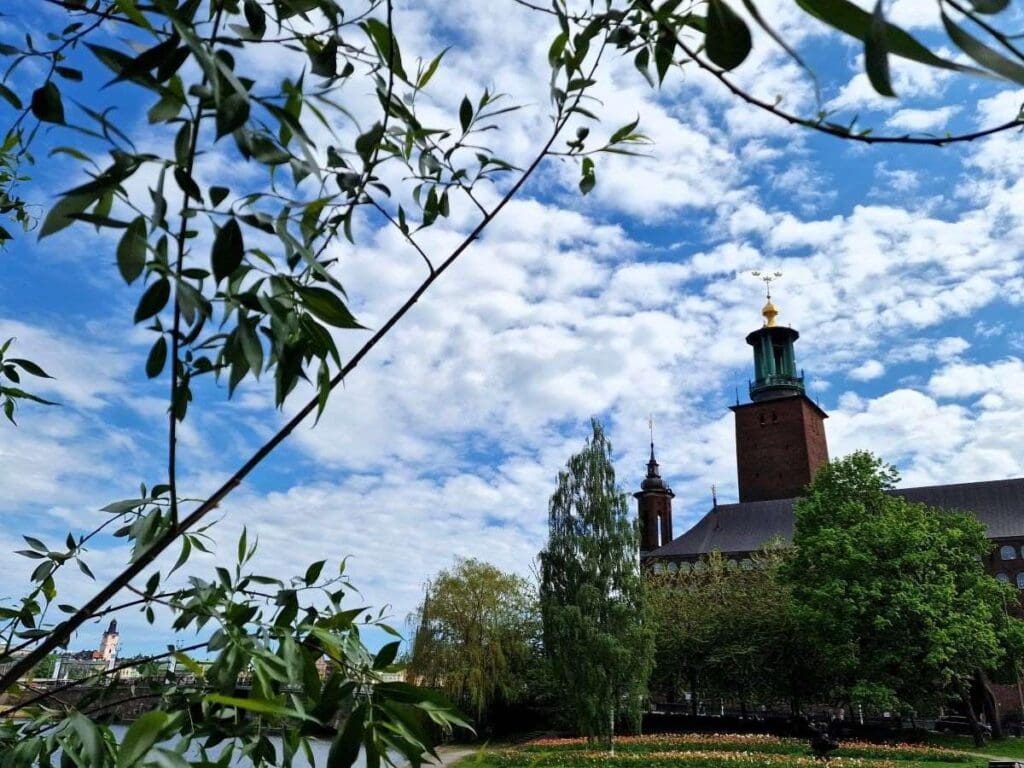
The view of Gamla Stan and the wider horizon from the top of the 106-metre-tall tower is magnificent. The climb up to it is pretty good too – as you ascend you go through the Tower Museum with its various statues etc., the giant 7.40 metre plaster model of Stockholm’s patron saint St Erik is impressive.

Grand Stockholm
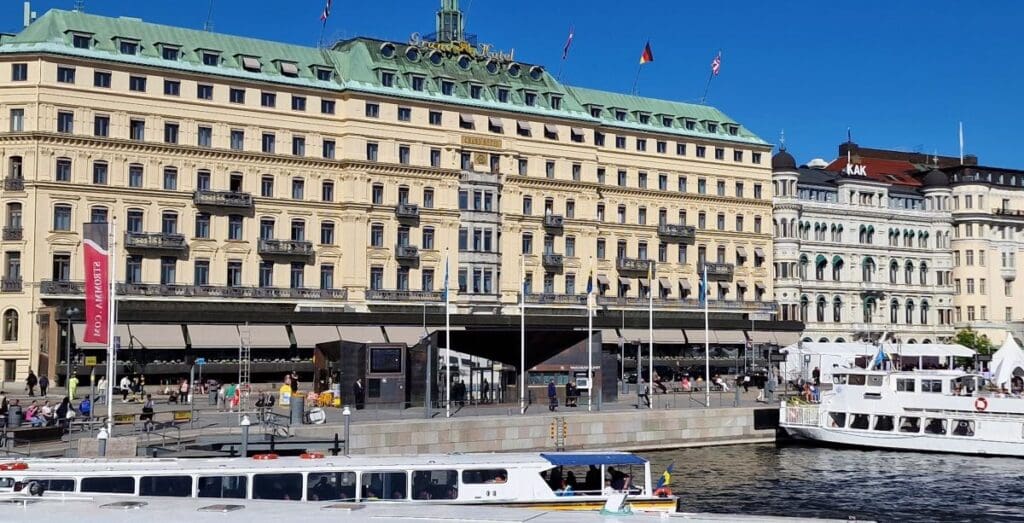
Or from Djurgarden walk along Strandvagen, with its grand, waterfront, and Paris-style apartments to the Paris-style Grand Hôtel, graced in the past by both Princess Grace of Monaco as well as Greta Garbo; by tradition, Nobel prize winners stay here. It’s a classic, five-star hotel with one of Stockholm’s best addresses and views, across from Gamla Stan and the Royal Palace.
Walking past the Grand’s enticing terrace and veranda, head along the water to the National Museum, Sweden’s preeminent gallery of art and design. There you’ll encounter international and Swedish greats such as Rembrandt, Gentilieschi, Goya, Renoir, Gauguin, Zorn, Larsson and more.
Skeppsholm and Kastellholm
Then go on, to Skeppsholm and Kastellholm, two peaceful, leafy islands where the city bustle feels miles away and the water views are lovely. If you’re not sated by great art, Moderna Museet features artists like Picasso, Dali and Matisse.

This is a short canter through some personal Stockholm favourites and others which should be on everyone’s list. There are many more museums, galleries, sights and restaurants to visit than mentioned here – the best thing is to go and find your own favourites – there’s so much to enjoy!
For more information click here


