
Last Updated on June 5, 2025
Tunisia – Why visit Hammamet.
While we’ve written about Tunisia on London-Unattached before, this is the first time I’ve had the chance to go myself and write about this North African country renown for food, culture, heritage and beaches. I have to confess to being just a little excited. While I wasn’t going to visit the Star Wars sets in Tunisia or to take part in Carthage Jazz, I was going to visit Hammamet, Sidi Bou Said, Tunis and the Bardo Museum. Something of a flying visit, we were staying in the North of Tunisia, travelling from Tunis airport to Hammamet and start our trip around the Northern part of Tunisia.

Just over a couple of hours flight from London, you don’t even have to change time-zones. But, the weather is a real attraction – average monthly temperatures through the year range from 7c in January up to 27c in July. So, it’s never really cold – and nor does it suffer from the kind of hot weather which means you’ll be dashing from one air-conditioned building to another. Culturally, Tunisia is a melting pot of Arab and European influences. Children still learn French at school from an early age with half the curriculum taught in the language of the country that was the Protectorate of Tunisia until independence in 1956, which was the result of negotiation rather than any rebellion. First impressions count and mine were of a Country that was friendly, clean and stress-free. I do speak French and found that if I couldn’t communicate in English everyone seemed to understand my somewhat haphazard schoolgirl attempts.

Arriving at Tunis airport our transfer to Hammamet took just over an hour by car. This kind of transfer appears to be the easiest way to travel around Tunisia – we learnt that it would cost around £40 for a car to take you from Tunis to Hammamet, which makes it a reasonably priced option for most visitors. Hammamet, thanks to its beaches is one of the main tourist destinations in Tunisia. We were based at Hotel Menar Magic for our time in Hammamet, an all-inclusive holiday resort hotel with its own beach and a wealth of facilities to accommodate the needs of a whole range of visitors.

My room was spacious, with a fridge containing soft drinks and fresh milk, a kettle and a safe. There was airconditioning, a spacious bathroom with an over-bath shower and two fluffy robes hanging up. The wall-mounted TV had a guide to all the hotel’s facilities. Best of all, I was in what is described as a ‘swim-up’ room with a small pool just in front of my private patio and gardens beyond. The perfect place to relax.

We spent an indulgent afternoon exploring the hotel’s spa facilities and Thalasso treatments. For me, a salt scrub and algae wrap left me feeling blissfully relaxed, with glowing smooth skin. There was a good range of spa treatments on offer in an area which also housed an indoor pool, hamman, sauna and more. When you travel it’s always good to have this kind of on-site facility – if you do arrive feeling tired or jet-lagged, it’s the best way I know to recover quickly.

Apart from the spa facilities, the hotel is very well equipped with everything you might need if you don’t ever want to leave the resort. There are several restaurants, including a large self-service buffet where we enjoyed breakfast each day and a fine-dining Italian restaurant. There’s also a swim-up bar at one of the pools and seating for the main restaurant both on the terrace and out into the water-feature. The beach is a stone’s throw from the main hotel buildings and access has been carefully thought through so that there are ramps and pathways for wheelchair users and buggies.

There are also clearly marked accessible loungers, parasols and deckchairs both within the hotel grounds and on the beach.

There are a whole range of activities to keep everyone busy, from a cat cafe through to a whole range of water slides and, for the more active, sports like tennis, beach volleyball, windsurfing, jet ski and archery. Some are an additional cost but there are plenty which are part of the inclusive holiday package. So, if you choose, you could just stay at the hotel. But why not explore a bit, there’s plenty to see and do once you leave the resort.

Nearby Nabeul is one of two important ceramics centres in Tunisia (the other is in the south, in Guellala on the island of Djerba). It’s a traditional craft which dates back to Neolithic man and evolved through Phoenician, Carthaginian and Roman civilisations. With the coming of Islam to Tunisia in the 6th Century AD, the craft evolved and, after the 17th century, the arrival of skilled earthenware craftsmen who were exiled from the Iberian peninsula, brought with them the distinctive swirling designs which are now integral to the craft in Tunisia.


Then, during the French protectorate around the late 1980s, a number of French ceramists established themselves in Nabeul and opened factories which used a fusion of European techniques with the expertise of the potters of Nabeul, famous for their green and yellow works.

We spent some time in two of the Nabeul’s ceramic centres watching the craftsmen and learning more about how the designs evolved. The men and women we met at the Société l’Artisan shop and workshop had started work at 14 or 15 years old, getting to know the business little by little. Most of them had worked in the industry for over 30 years.

We watched the process from wheel to kiln. Each product is handmade in house and fired three times, once as an undecorated earthenware, once with the hand-painted design and then finally with a top glaze. Every design is hand-painted too and although there are a wealth of traditional designs, there are also some more contemporary options.

We asked how new designs were chosen and learnt that they were given a range of patterns to choose from which are made up and take to the local souk. Whatever sells best is then integrated into the products already offered. It’s the kind of place where you wish you’d arrived with an empty suitcase and a lot of bubble wrap – everything is very reasonably priced and you could easily fill your kitchen cupboards with the stunning works of art.
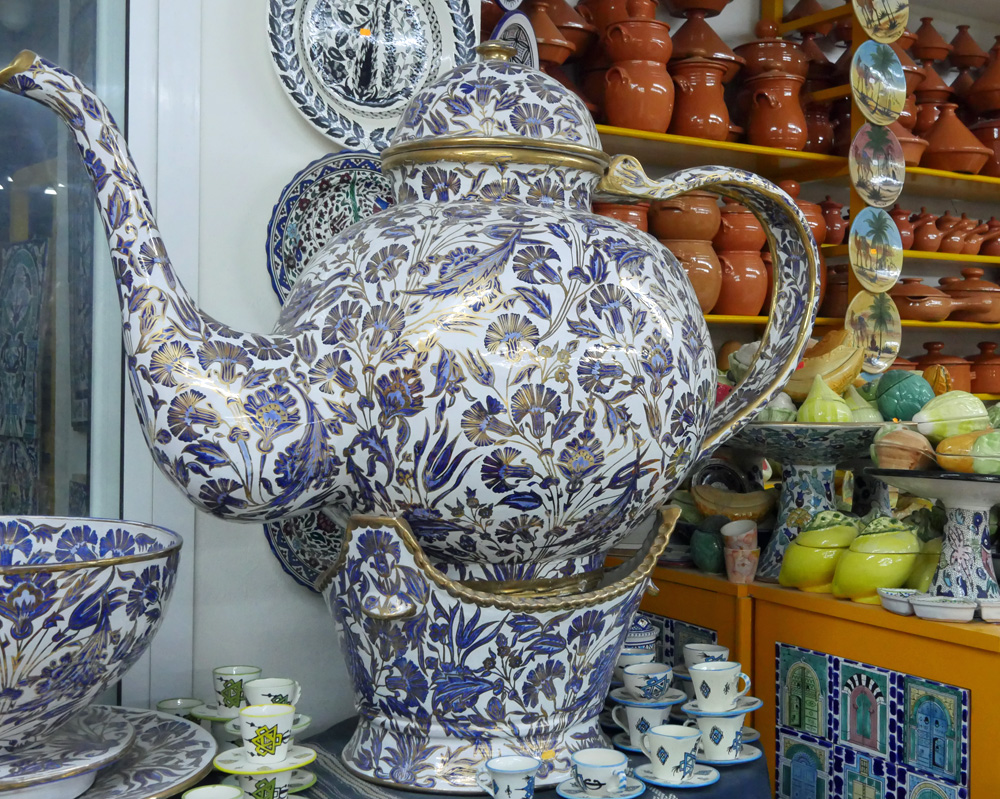
Just in case you were in any doubt, you’ll find various giant ceramic constructions decorating roundabouts around the town.

It’s worth heading to the Medina of Nabeul particularly if you are there on a Friday, when you can, apparently, buy anything from camels to leather slippers.

The rest of the time, there’s still plenty to see and buy – while I resisted the ceramics, I did end up buying half a suitcaseful of harissa and saffron. I was delighted to find that this part of Tunisia at least has a more relaxed atmosphere and heckling in the medina was pleasantly limited.

Apart from spices, there ise a whole range of artisan products to buy including sheet metalwork, “balgha” slippers made from leather, olive oil, jars of olives and pickles and all kinds of fresh foods.

This is a market that caters for a mix of tourists and locals with a friendly and welcoming atmosphere.

A little further along the coast, Hammamet itself is best known for its beaches and for a jasmine district which clearly isn’t in season in September when we were visiting. A charming old fishing village that has been developed to accommodate the tourists who visit Hammamet for beaches and sunshine, it’s a great place to explore.

Essential for any visit to Hammamet, The Kasbah is an old fort that dates back to the 9th century and was modified to become the city governor’s residence in the 1400s. By the 16th century, it was taken over by the military and adapted again to accommodate firearms (you’ll still find cannons in the courtyard).

There’s a small museum but, perhaps most notable are the stunning views from the ramparts across the medina, the fishing harbour, and beaches.

In Hammamet itself, we headed for Chez Achour for lunch, a charming traditional restaurant with a large private courtyard area for al-fresco dining.

I enjoyed my seafood brik (a fine pastry not unlike filo, used to wrap a seafood filling and then carefully fried to make a crisp flaky outer shell with a warm filling) to start the meal and then a delicious freshly grilled seabass.

I also loved the Tunisian wines here and although they are not widely available outside of Tunisia, they are both cost-effective and excellent quality.

I’d have liked more time to explore on this visit to Hammamet – it is a part of the world where I felt totally relaxed and safe throughout my stay and would be happy to visit by myself. While Hammamet is a well-known family holiday destination, there’s plenty for singles and couples too, especially if you are interested in food, culture and heritage. And, there are boutique hotels to cater for those who prefer something other than an all-inclusive resort. It’s remarkably well priced as a destination – if you are not staying at an all-inclusive resort it’s not expensive to eat out – a three-course meal for two will generally set you back less than £20. Five-star hotels can cost less than £100 a night and, while you’ll probably find it easier to take a taxi than to drive yourself, an hour’s journey will cost you less than £40.
Thinking of visiting Hammamet yourself? Why not pin this post for later

Fact Box
I stayed at:
Holiday Village Manar,
Route Touristique
Merazga,
Hammamet 8050, Tunisia.
We enjoyed lunch at
Chez Achour Restaurant
Rue Ali Belhouane,
Hammamet,
Tunisia
We visited
Société l’Artisan Pottery
121 Ave Habib Thameur
Nabuel
Tunisia
I was a guest of the Tunisian National Tourist Office
Complimentary flights from London were provided by TunisAir




Thank you! Heading to Tunisia in April
I loved it there!