Last Updated on October 29, 2023
Two Michelin Star dining brings the sea to the table.
In Llanҫa, a coastal town north of Barcelona, I ate one of the finest meals I have had the privilege to enjoy. Overlooking the crescent-shaped beach, Miramar is home to Michelin star chef, Paco Pérez who holds five Michelin stars – two at Miramar, two at Enoteca Paco Pérez in Barcelona and one from 5-Cinco in Berlin. He has also opened a restaurant in Gdansk, Poland and a Catalan tapas restaurant, Tast, in Manchester. Llanҫa is his spiritual home and the inspiration for his cuisine, based in the landscape of Catalonia.

The tasting menu – Sea ’23 – at Miramar is outstanding but the experience goes beyond what is served on a plate. While all fine dining should marry terroir with the chef’s talent and imagination, what set the experience above and beyond many of the Michelin star meals I have eaten, was how Pérez’s love and respect for the sea was transported to the table. Like an alchemist turning metal into gold, Pérez removes his ingredients from the seabed and transforms them skilfully in the kitchen. Ingredients such as shellfish, fish and seaweed that co-exist in a natural ecosystem in the ocean, co-exist also on the plate, natural bedfellows both in and out of the water. I found this approach to be moving, revealing a great respect for nature, allowing the underwater world to be experienced by the diner as if one had been taken diving. I was reminded of The Beatles singing “I’d like to be under the sea, in an octopus’s garden in the shade.”

Miramar has a wonderful setting with wall-to-wall windows that link the restaurant with the sea and the mountains beyond. From the elegant terrace and interior to the welcoming staff, smartly attired in navy suits, the ambience was relaxing. As we sat down for lunch the table was simply set with a solitary amber ant perched on the table. It symbolises, for the team, the collective effort of ants that work as a social entity towards their goal.

The Sea ’23 menu was a journey of waves of courses inspired by the sea. The first wave brought nine dishes to the table in a choreographed manner. It opened with ‘The Beginning of Everything’, a coupe containing a distillation of seawaters with essential seaweed oils, the aroma of which was inhaled before tasting, thus enhancing a full sensory appreciation. This vitamin infused drink had a slight salinity along with oils that gently coated the tongue in the essence of the sea. Alongside sat a small white dish with an oyster salad with dashi of oysters and a range of seaweeds. Another dish, that has imprinted itself on my mind’s eye since eating it, was ‘A Fish Called Iris’ – a red mullet ceviche served in its own fish juice. It was shaped into a tiny fish, with eyes of caviar, and was floating in a small translucent bowl the underside of which had glass bubbles, as if the fish were breathing. This playful presentation was perhaps the most ethereal mouthful I have eaten.

While the colour palette of the meal was akin to an underwater watercolour with muted shades, there were pops of colour too as if catching sight of a brightly coloured fish while out snorkelling. ‘Starfish’ was plated on a small marble square into which a starfish shape had been carved. It was filled with an eye-catching mix of crabs and caviars – oscietra, tobiko (flying fish) and trout. There were also spherifications of seaweed. All popped gently in the mouth.
A rust-coloured dish, ‘tuna vs. tuna’ was a nigiri served on a rattan mat. Using both loin and belly of tuna, it contained koji rice caramelised with homemade apple syrup. It was sweet and nutty with a beautiful textural contrast to the soft, sweet fish. We were encouraged to eat this in one bite, lifting it with our hands so as to feel the texture, enhancing our sensory experience. The Japanese influence in the dishes as well as the presentation transported me to a superb lunch I ate recently in Kyoto where reverence for ingredients was equally matched with Miramar, with the peerless skill of the chef and attention to presentation with both sophisticated and minimalist beauty.

Brown crab on a sponge was an edible Abstract Expressionist artwork. Served in a small round, black bowl filled with a collection of shells, a light green round of seaweed bread was topped with spider crab and its own mayonnaise and garnished with black, v-shaped kelp.
With these bite-sized offerings, we drank Gaba do Xil o Barreiro, 2022, an organic Galician wine from the Telmo Rodriguez winery which is a single 16 hectare estate vineyard. It has a distinct freshness with some salinity and a long, dry finish.
Subsequent waves brought dishes of clams, prawns, seaweed crackers, glorious green, silky Verdina beans cooked with cod belly, aged seabass, seaweed with pil-pil of John Dory, and a sea cucumber and egg white flower with miso and garden flowers.
Some of the dishes were presented table side. I enjoy a bit of culinary theatrics and also value the opportunity to meet the chefs who are responsible for the dishes. I like that they are able to engage with the diners whose appreciation and enjoyment they can experience first-hand. ‘Ethereal…of Sea’ was presented in this way. Served on a glass plate with inlaid green swirls resembling a Jackson Pollock, a green, edible seaweed sponge was topped with molluscs – a mussel, a piece of shrimp, a barnacle and a sea snail. This was anointed with a seaweed broth and olive oil. The sponge collapsed on contact with the mouth and one was left with the flavour of seaweed and the subtle flavours of the seafood. This dish brought the Miramar philosophy to the table: to present the sea as it is seen, with no filters. The molluscs eat seaweed and on the plate, they were presented along with the seaweed and a sauce made with seaweed water and mollusc liquor.

We drank Terra Remota Caminante, 2022. Produced in the winery of Emma and Marc Bournazeau, this delicately flavoured, organic white – a coupage of chardonnay, chenin blanc and garnacha blanca, aged in wood spends 12 months in French oak barrels. It is produced in Saint Climent Sescebes, Gerona, D.O.Empordà.
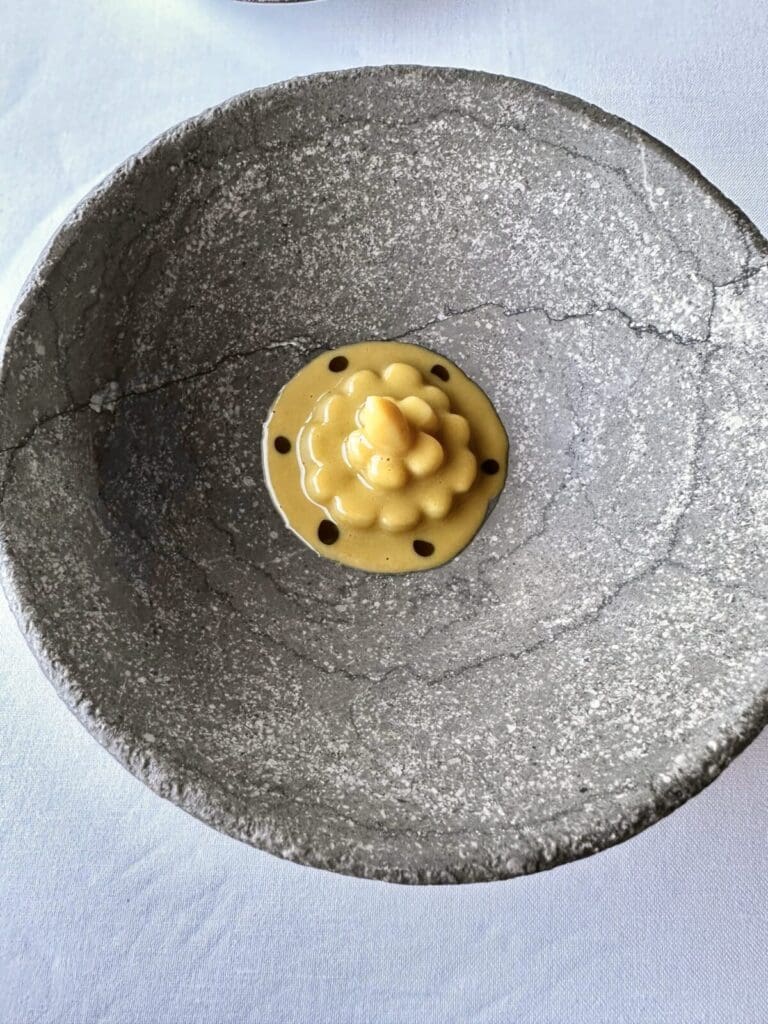
Razor Clam Flower sent me into raptures. Served in a deep, warm bowl the razor clams had been cooked, cut into perfect rounds which were shaped into a flower. The mustard-hued sauce contained clams, butter, seaweed and mollusc liquor and brought salinity and umami flavours to the dish. The Michelin Star level saucing was superb throughout. The sort of flavours so intense that if I was at home I would certainly be licking out the bowl.

Seafood paella was referenced in ‘Under an octopus blanket, Rice’ where a wafer-thin mosaic of octopus was draped over a small bowl of smoky, fermented rice. This was unlike any rice dish I had encountered in Spain in the past six weeks, both elegant and subtly flavoured.

The third wine pairing was El Zarzal 2021. A godello grape, as with the first wine, produced at the Emilio Moro winery, D.O.Bierzo in the province of Castilla y León. This elegant wine was fruity on the nose with a long finish
A second tableside dish was a langoustine brushed repeatedly with oil heated to 160 degrees. It was served with a hazelnut cooked under pressure for six hours so that it tasted like a well-cooked chickpea. Using a matcha whisk, the chef created a sauce made with freeze-dried langoustine and seaweed powder mixed with langoustine leg consommé, which accompanied the sweet langoustine along with a hazelnut milk foam. Texture, colour, tastes – sweet, saline and nutty – there were so many processes and concepts behind this dish.

Moving up in intensity, we drank a Remirez De Ganuza Rioja. Blanco Reserva 2020. This creamy and elegant white rioja is fermented and aged eight months in the barrel. It had tropical fruits on the nose and notes of vanilla.
Moving on to blending of land and sea, ‘Whites and Greys’ boldly paired almonds with caviar. An almond disc – that dissolved in the mouth – was topped with caviar and served on a covetable gold plate in which the disc was reflected. The gold dish was so beautiful that I mused briefly on whether I might slip it into my handbag. The disc was accompanied by a martini glass containing almond horchata (a refreshing Spanish nut drink) and Laurencia oil – a red seaweed – which lent a pleasant saltiness to the rich nut milk.
The wine pairing changed to Planeta Cometa, 2021, Sicilia Doc. This Sicilian winery was the first to use grapes from around the island. It had tropical fruit on the nose and was fresh yet intense in the mouth with a long finish.
The fish and dessert courses were bridged by a Mushroom Tartlet which combined hazelnut, coffee and mushroom into a bite that demanded closing your eyes to fully appreciate the umami flavours.

The dishes were as light as air, each plate a visual and gustatory treat. At Miramar, I found the food to be perfectly seasoned, the natural salinity of the sea allowing the sweetness of the fish and shellfish to shine. It was a seascape. I glanced up from my plate over to the beach outside where sunbathers were catching the afternoon rays and the sea was mirror still. Nature felt sublime both outside and in.

Several hours after we first sat down for lunch, I had lost the power of description and had surrendered to the non-verbal sensory pleasures of this meal. I mulled over the weaving in and out of the ingredients that had made their appearances in various dishes as if characters on a stage or a novel, or perhaps fragments of a poem entitled Elegy to the Sea.
With dessert, we drank a final dessert wine, a muscatel from the area of Malaga in southern Andalucia. Jorge Ordoñez & Co. No. 2 Victoria of peach and pineapple were noted in this ambrosial drink.
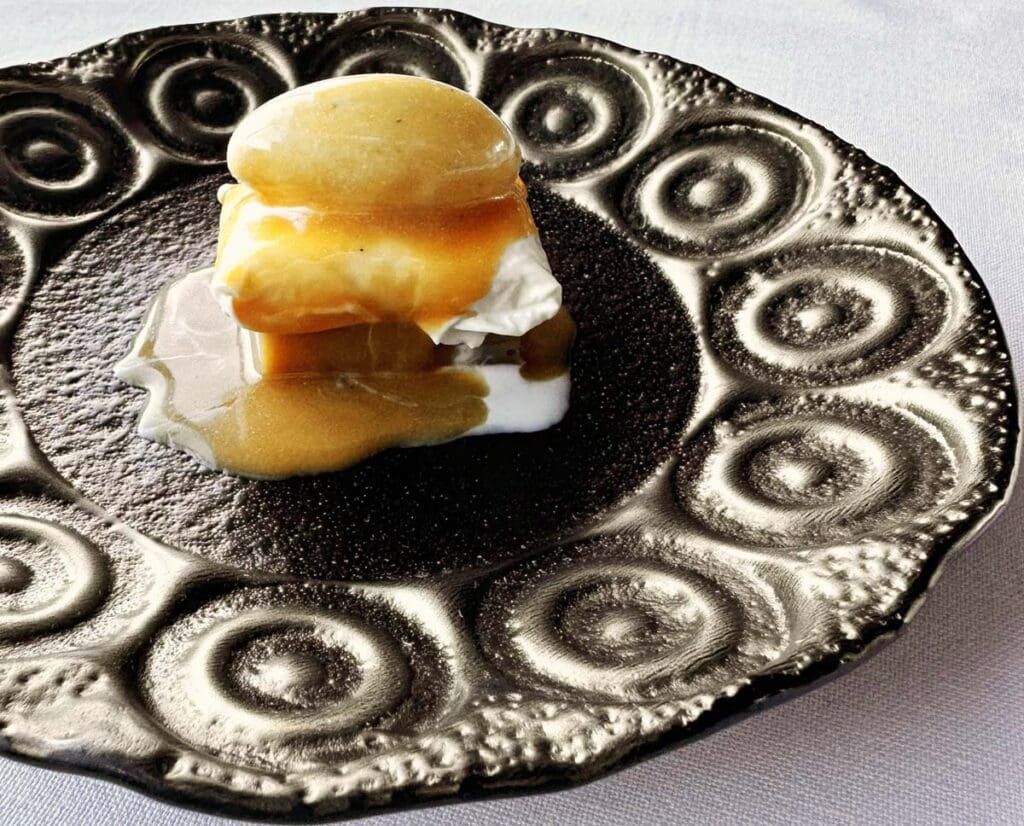
There were three desserts with some presented by the pastry chef who explained her creations. One of these was ‘Forest Tocinillo’. Tocinillo is a traditional Spanish dessert – a flan made with egg yolks, sugar and water. At Miramar, nothing is what you expect and this creation contained mushrooms. A white pillow was made with the skin of milk, cream and a local cheese. This was accompanied by kumquat confit, a quenelle of wasabi and yuzu ice cream and finished off with a salsa Suzette.
Another was ‘Lulo, Coconut, Coffee and Mint’ which took the form of an iced bowl shape made from lulo (a tropical fruit), passion fruit foam and a heart-shaped tropical flavoured disc on top. Inside were hidden tiny coffee-flavoured spheres. A deconstructed cappuccino took the form of a candyfloss dumpling alongside a coffee bean (made from chocolate and coffee) and emulsified milk.
Although we were served a plethora of dishes as part of this sumptuous feast, each was light and I did not feel I was struggling towards the end of the meal as I often do with tasting menus. The wines were thoughtfully paired, the intensity growing glass upon glass.
After lunch we took mint tea and coffee on the elegant terrace which overlooked a kitchen garden. Olive trees, large tomatoes hanging pendulously on their vines and enormous courgette flowers sang of the Mediterranean. As a final flourish, we were served a choice of nine petits fours which go by the name ‘…in a Mondrian …’ due to the design of the glass plates on which they are served.

At this point, we encountered Pérez and our server chatting after service. We discovered that our server, who had provided a wealth of information about the food and wine, the philosophy of the chef and much else, was Paco’s son. Miramar is a family business. Pérez’s wife, Montse Serra – who is in charge of the cellar – is the third generation to run Miramar which opened in 1939. I had a feeling that the sense of family went beyond blood relatives and, when I ate at Enoteca Paco Pérez in Barcelona a few days later, this hunch was confirmed by the warmth and devotion with which the staff spoke of working with Paco Pérez.
Miramar at Llanҫa is a destination restaurant and one to which it is without question worth the effort of travelling whether you are in Barcelona (easy access by train) or near the French border from where it is a short drive. No matter how you get there, put aside the entire afternoon for a meal to savour and remember. Miramar has rooms above the restaurant that enable visitors to stay overnight. You might never want to leave.
The tasting menu Sea23 is 225 euros with wine pairing 140 euros.
Miramar, Passeig Marítim, 7, 17490 Llançà, Girona