

Last Updated on January 29, 2020
Foie Gras d’Oie in the Perigord Noir and a Guilty Conscience.
The Fest’Oie in Sarlat is a celebration of one of the region’s greatest (and in the UK most controversial) delicacies. Festivities include the Bodeg’oie – a street feast focussing on various dishes made with goose, the Sunday Street festival and, the highlight of the weekend – a multi-course goose lunch, the Fest’OIE. More about that later, this post is about the farming and production of Foie Gras d’Oie.
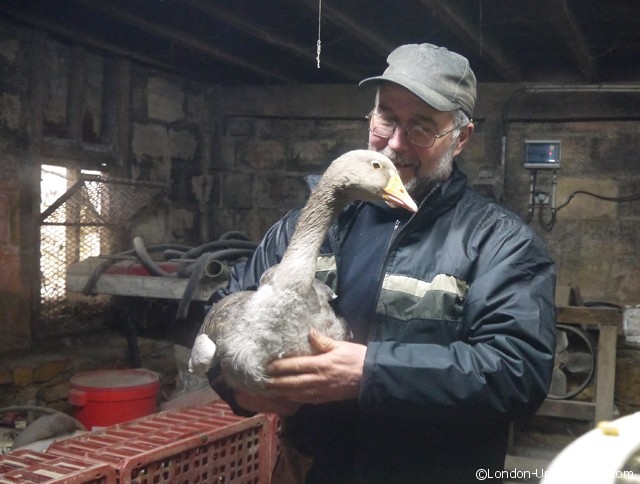
In addition to the feasting, Fest’Oie offers locals and visitors the chance to learn more with open farms and foie gras producers where you can go and find out more about how the delicacy is produced, from egg to jar so to speak.
I’ve been pestering every French person I’ve met recently to get a view on Foie Gras. So, when I had the pleasure of meeting both Michel and Albert Roux recently I wanted to find out a little more about their views. Albert Roux, one of France’s greatest exports, verbalised my own attitude to Foie Gras.
‘I eat it but I feel guilty. It’s cruel’
Albert Roux is, as I’ve mentioned, a charmingly anglicized French man. His food has a French heritage and all the disciple of the great French kitchens, but his attitudes are English. Not surprising since he’s lived in the UK for around 60 years. By comparison, when I asked the French journalists and people of Sarlat if they saw any issue with Foie Gras all I got was a mystified look. Why would they have any concern?

There are many arguably cruel practises in farming. From Halal meat butchery through to rearing of chickens in cages or raised indoors (although battery hen cages are now banned in the UK). But, the fact that there are other wrongdoings doesn’t make this particular farming method any more right. I wanted to see the process of raising a foie gras goose at first hand. I wanted to see whether foie gras production was entirely cruel or, as those French who have not been subject to English, influence seem to pretty much unanimously believe, just part of normal farming practises.
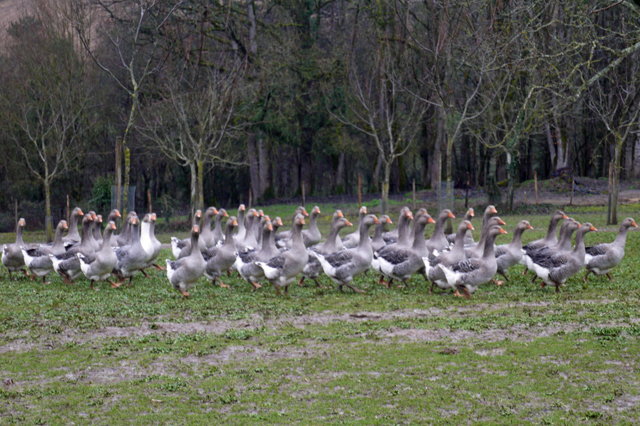
At the farm in Paulin, a gaggle of geese at the end of the field were feeding on grass supplemented by corn. Normally free range until they reached 5 to 6 months, these were just a little older, the farmer told us because they would be in the town centre the next day as part of the Fest’Oie.
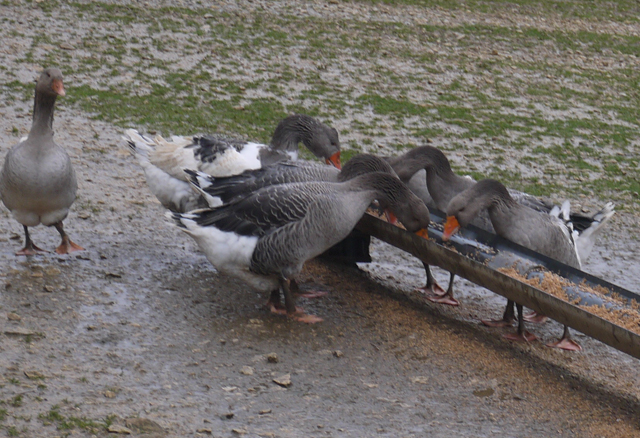
Happy, healthy birds, is it enough to reassure yourself that the source of your foie gras is treated to the equivalent of a five-star start in life?

Once they are ready for gavage – for fattening up – the geese move indoors. At this point, they have a few weeks left before slaughter. Those geese in the barn once again had luxury accommodation. The floor laid with a thick layer of clean straw, the geese free to roam.
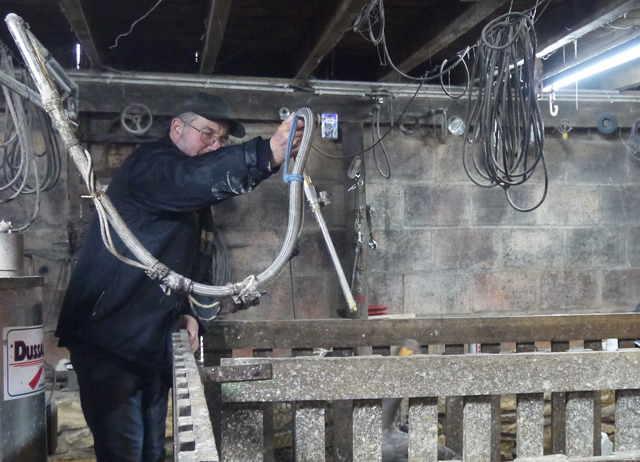
Gavage, as demonstrated to us, involved the birds being moved to feeding pens where each bird was held by the farmer to be fed a dollop of corn and cornmeal through a feeding tube, before having their throats gently rubbed so they swallowed. The process appeared a lot less painful for the geese who didn’t struggle or try to hide than trying to give my cat a pill.
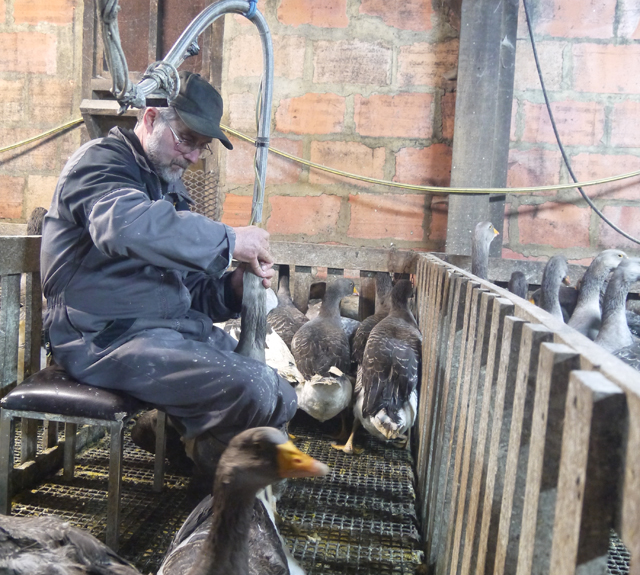
The farmer explained that during the process the liver of the goose would grow from around 200g to a kilo. At that point, the bird would be slaughtered. Of course, there are extreme examples of cruelty in foie gras production, with birds kept in poor conditions and treated violently to force feed them – and of course as guests of Sarlat that is not what we saw.

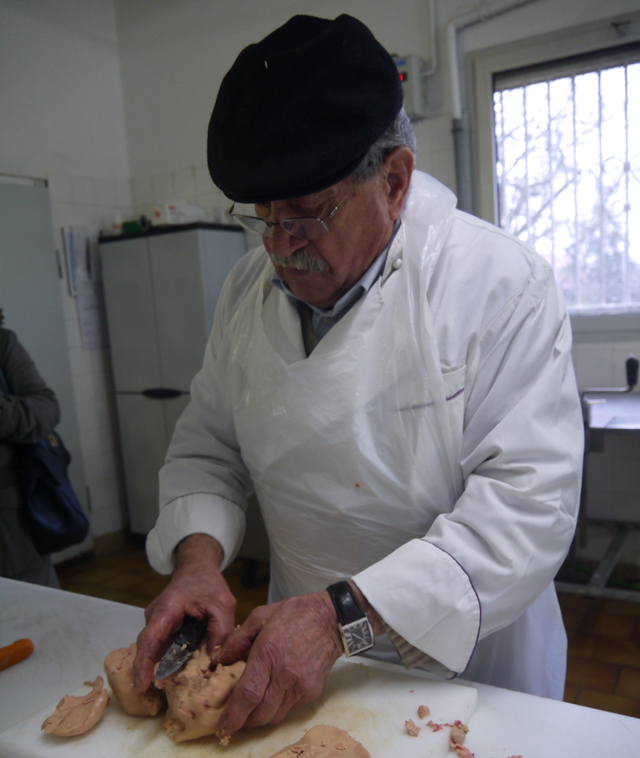
In addition to the farm trip, we went to learn more about how foie gras is prepared and how it can be used in a range of recipes at Crouzel in Salignac, an award-winning family-owned foie gras producer. I have to admit I’d never realised that foie gras could be served raw, half-cooked or fully cooked as well as being preserved in a whole range of styles from entier (preserved with salt through to various mousse and pates).
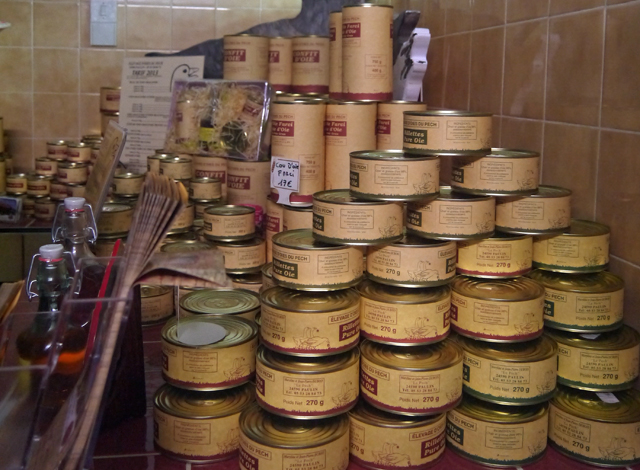
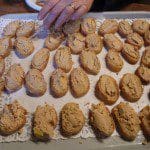
All of which are quite strictly regulated. Of course, we are used to having various kinds of foie gras as part of a canapé platter but I’ve never tried cooking with it – until now. We made Nem au Foie Gras d’Oie et Pain d’Epices. Nem turned out to be a kind of spring roll, made with Brick pastry (very like Filo) and then fried in goose fat. The recipe below was delicious and rather surprised me because the idea of cooking foie gras other than in a terrine wasn’t something I’d thought of. But then, we were in the heart of the Perigord Noir.
Nem au Foie Gras d’Oie et Pain d’Epices

- 250 g Raw Foie Gras
- 6 sheets Brick or Filo Pastry
- 6 medium slices Gingerbread
- 20 g Rocket
- 1.5 tablespoons Goose Fat
- 2 tablespoons Balsamic Vinegar
- 2 tablespoons Runny Honey
- Salt and pepper
- Cut the gingerbread and foie gras into small dice
- Take a leaf of brick or filo and lay it flat. Fill it with a ‘sausage’ shape of about a sixth of the gingerbread, foie gras and rocket. Season with salt and pepper.
- Fold in the ends of the pastry over the sausage, then roll it up loosely

- Mix the honey and vinegar in a bowl
- Heat the goose fat in a large frying pan and then cook the nems, turning them constantly until they are golden brown on the outside
- Serve hot with the honey and vinegar dipping sauce on the side. You can cut the nems into slices for canapes or serve a whole nem as a starter.


Now, I’ve tried to be objective and write about what I saw. I am left with a contradictory and confusing set of messages in my head. I can’t say the treatment of the geese we saw was unforgivably cruel, rather a traditional method that was managed with compassion. But I am sure we saw the best. I’m aware of a whole range of other farming techniques that seem just as bad to me. But, I’m also aware that my mother would be turning in her grave saying ‘two wrongs don’t make a right’.
I will probably continue to eat foie gras on special occasions. And I’ll continue to try to avoid an excess of foods produced using poor farming techniques. My general rule of thumb is that food produced with kindness tends to taste better. And since I am the most unlikely person to become a vegetarian, Foie Gras will remain on my guilty list.


For more information on Sarlat and the annual Fest’Oie held in February:
Email Katia Veyret: k.veyret@sarlat-tourisme.com
Sarlat Tourist Office
City Jet flies to Brive in the Dordogne from London City Airport:
The Brive Dordogne Valley Airport
19600 Nespouls
France
We stayed at Hotel le Renoir, a few minutes from the Town Centre


Sounds like a fantastic event! Thanks for sharing. & Looking forward to your future posts. ;D
informative post! I can’t stand the ‘fattening up’ process 🙁 xx
Would be on my guilt list too Fiona.
Well written about a sensitive subject and it was wonderful to see you there as well as make those nems with you too! Karen
I have never tired it, but it is really interesting to read about it.
great piece Fiona. I never eat foie gras because I had heard about the inhumane practices (how much different is that from the way some cattleman and chicken and other farm animal breeders– in a lot of ways.. not much but depends on the each different breeder and how they treat animals).
I like what I saw in your piece. Less feeling like it was inhumane.
The recipe looked amazing too.
thanks for sharing
A great piece Fiona. It’s so hard to be objective about Foie Gras, I do eat it, I do love it, But I do feel guilty about it. I’m sure you saw the best, it’ll be my guilty pleasure. GG
I’m not a vegetarian but would never eat it. Recently I asked my butcher how they source their meat as I would like to know in what conditions animals are kept, still waiting for an answer.
A good butcher should be able to tell you. Definitely
I do like pate but because of the methods I don’t eat foie gras knowingly. It is of course the tastiest! Nice trip though.
Being a vegetarian this would upset me. The geese in the picture look so happy not knowing what’s going to come to them.
I think if I was an ethical vegetarian I would be upset too. But, I am not and there is a lot of controversy about foie gras production which I thing verges on the hypocritical if you eat meat. I wanted to find out more
I think you are quite brave to write about fois gras. I have tried it once on honeymoon and it was lovely, but never again, your article seems very balanced to me.
Thank you Clare, it was hard to write because, like Albert Roux it feels like a guilty secret to me
What an interesting read. Foie gras is one of Marks favorites.
It felt very tricky to write – I like foie gras but in principle I’ve always had qualms about the production methods. Here I saw nothing so terrible that I’d stop eating it, although I appreciate for some people it’s too far down the cruelty to animals line.