
Last Updated on August 5, 2019
The making of Comté cheese.
An iconic French brand, Comté was one of the first kinds of cheese to receive an AOC (Appellation d’Origine Controlée) status in 1958. Having lived and worked in the French Alps I was already a fan of Comté and Tomme cheese, both of which are made in this area, and was delighted to be given the chance to learn more about how Comté is made. Typically a pale yellow colour and semi-hard in texture, Comté cheese is extremely versatile – something to stock both for cooking and for your cheeseboard.

We flew into Geneva and were very quickly over the border and into France. The Jura massif is a landscape of green pastures full of wildflowers, forested hills and beautiful lakes, a great place to visit during summer. As we drove along, small herds of the classic Montbéliarde, brown and white cows, were contently grazing in the fields.

Lunch was the start of an epic cheese experience, first small pieces of Comté with tasty cheese pastries as appetisers. For the first course, melon with Comté and vegetables, followed by veal with mushrooms and melted Comté, then, after a fresh and fruity dessert, the cheese dome appeared containing wedges of enticing cheeses to sample, amongst them locally produced Comté, Morbier and Tomme.

Next, a visit to one of the farms in Bouverans to see the cows being milked. Our guide explained the process in detail; the cows are milked twice a day, morning and evening. We had the opportunity to milk the cows by hand and sample milk fresh from a cow, it was light and warm with a slightly sweet taste. Like a lot of farms, the one we visited is part of a cooperative, with four farms working together. During the long summer days, the cows are out to pasture, in the winter they are kept mainly undercover as conditions are too harsh. The hay from the pastures is cut twice annually, the first summer cut being called foin. The hay provides feed for the herd of ninety cows at the farm throughout the year. No chemicals are used in the fields, making Comté an organic cheese.


The milk used to make Comté is not pasteurised as this would kill the bacteria that give the cheese its flavour, instead, the milk is freshened to a temperature of twelve degrees and goes to the dairy or fruitière (the name for a traditional mountain dairy in this part of the world) daily. The cows have plenty of land to graze on – if cows can be said to be happy the ones we saw on the farm in Bouverans certainly seemed to be so.
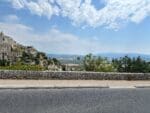
Les Rives Sauvages hotel and spa in Malbuisson, where we were staying, proved to be a comfortable hotel with very spacious rooms, on the edge of the beautiful lake Saint-Point and an ideal base from which to explore the Jura region. With each of the sixteen rooms looking out over views like this it’s definitely somewhere I could have stayed for longer!

Our supper was at the aptly named Restaurant des Fromages in Malbuisson, very close to the hotel, where we continued our cheese journey; small crispy balls of choux pastry with Comté, called gougères, to start, followed by a cheese fondue.

It seemed strange to be having a fondue in the summer – I’m used to eating it in the mountains in winter. This one was full of flavour and delicious accompanied by the classic combination of potatoes, salad and mountain charcuterie as well as locally produced Jura wine.

The next day we visited the fruitière of Frasne to see Comté being made. Every Comté producing farm has a dairy within a sixteen-mile radius to ensure the milk is processed at the perfect time.

Large copper vats containing the milk are heated to a temperature of 31 degrees and rennet added until the milk separates into curds and whey, the whey is drained off and the curds are transferred into moulds and pressed. The resulting product is a wheel or circle of cheese, weighing around 42 kilogrammes.

The edges are trimmed to make an even surface, then the cheeses are transferred to caves to age. The outside of the cheese is brushed regularly with salty water to help the rind to form. The atmosphere in these caves is cool and moist as it helps the cheese to develop. Each wheel is marked with the Comté appellation stamp with the month and year of production.

It is certainly an impressive sight. As the milk is not pasteurised and the cheese aged for a minimum of four months, up to around thirty-six months, no wheel of Comté is the same. The aromas in the wheels coming from the season when the milk was produced as well as the diversity of the flowers in the pastures where the cows graze.

Later that day we visited the hotel and restaurant Le Bon Accueil, in Malbuisson, to see the head chef, Marc Faivre, demonstrating a recipe made with Comté. Gaudes façon gnocchis au Vieux Comté du fort Saint-Antoine; little rolls of gnocchi made from corn flour, and eighteen months aged Comté, on a bed of leeks with melted Comté on top. Though very simple and relatively easy to make, the resulting dish was absolutely delicious.

The following morning, we visited the Cave affinage Juraflore, a Comté ageing cellar in Les Rousses. Thousands of Comté wheels, a staggering total of 135,000, are aged in this building, which was formerly used as a fort, it was built by Napoleon to protect the region from invasion via Switzerland.

The wheels are packed floor to ceiling in tall, wooden, racks made from spruce, this wood is used to help the ageing process. The walls are extremely thick, up to fourteen metres in places, keeping the temperature even during both summer and winter. The master cheesemaker chooses which cave, and there are many, each with their own microclimate, is the right one for a particular wheel of Comté. Twelve robots work amongst the racks of cheese, their job being to lift, brush and replace the cheese wheels.

The floors of the caves are wet, and the overwhelming aroma of the ageing cheeses hits your nostrils when you enter the building. I was amazed at the vast number of cheese wheels that were ageing in these caves. The fort is one of many buildings where Comté is aged in the region. We sampled twelve months, two years and three year aged cheeses, each cheese was totally different to the taste.

There are many aromas identified with Comté, from lactic to fruity and even nutty. If the cheese is a pale colour it is due to it being produced in winter when the cows are fed on hay, a deeper yellow colour denotes a cheese made in the summer when the cows are grazing outside on wildflowers in the pastures.
Discovering more about how Comté is made and the different ways it can be used was extremely interesting. It can be enjoyed at any time of day, as a snack, in recipes or as part of a cheeseboard. The ideal temperature to taste Comté is from fifteen to eighteen degrees Celsius. I love the depth and flavour of Comté and will certainly continue to eat it whenever possible.

If you are travelling in the Jura mountains do take the opportunity to explore Les Routes du Comté, You’ll find details of farms, fruitières and cellars that are open for the public to visit.
Comté is readily available to buy in supermarkets or speciality cheese shops in the UK.
For more information visit www.comtecheese.co.uk.
For details on the Hotel and Spa Les Rives Sauvages
Looking for recipes to enjoy with Comté cheese? How about this delicious easy truffled Mac and Cheese or this Potato and bacon hotpot with leeks and cheese.


This sounds fascinating – and I’m really surprised it is a trip we’ve not made yet as our daughter lives in that lovely valley between Geneva and the Jura so it would be easy to explore from there. I must persuade them to take us!
Yes, I would definitely recommend visiting the area, it’s stunningly beautiful and really interesting if you like cheese. The herds of cows are dotted about in the pastures and you can hear the lovely sound of their bells as they move about.