
Last Updated on March 2, 2025
Exploring the Dehesa – Iberian Ham.
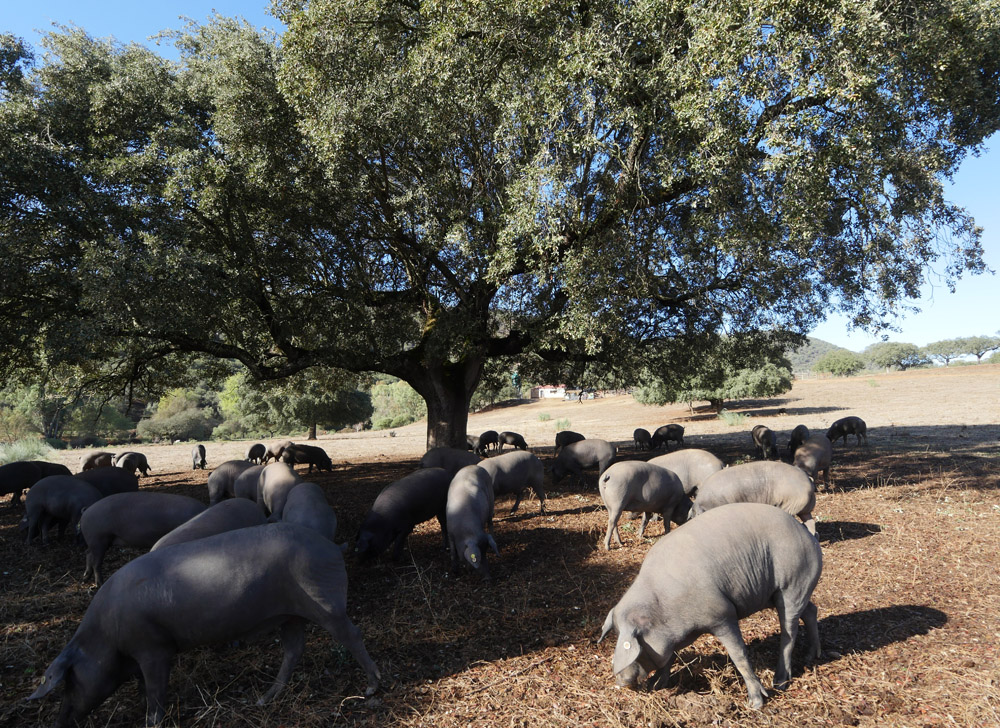
What makes Iberian ham (jamón Ibérico) so special? Obviously, the best way to find out is by travelling to Spain to Seville and then on into the countryside to the North, to the Dehesa. In our case that was to an area around Huelva, Cumbres de San Bartolomé, close to the Portuguese border, where the rural landscape is punctuated by ancient oak trees and bushy shrubland, where time seems to have stood still and where, at this time of year, you’ll find groups of happy black pigs rooting around the trees.

We got to meet some of these very special Iberian pigs in the pasture, where they stay for around five months from October through to March or April the following year, feasting on acorns. Spain is the fourth-largest pork meat producer in the world, although only a tiny proportion of the pigs slaughtered there each year are Iberian – just 3.5 million or around 7 % of the total Spanish pork market. And, a smaller proportion still is acorn-fed (around 1%) to make the premium Iberian Bellota Ham

Apart from geographic indicators, Iberian pigs are carefully managed in terms of what they eat and how they are reared. We learnt from Manuel Gonzalez, the Technical Director of the Asociación Interprofesional del Cerdo Ibérico (ASICI) that to be designated Iberian, piglets need to be born from a 100% Iberian mother, though the boar need only be 50% Iberian.

Then, for the last part of their life, the pigs are carefully managed – only those pigs which are allowed to roam and are fattened on acorns in the Dehesa can produce what is often called Bellota ham. There are four labels used to track the origin of each ham, colour coded to make it easy to distinguish what is being offered. A black label indicates a 100% Iberian pig that has been acorn-fed at least for the last six months of its life. Red can be 50% to 75% Iberian (if the boar is not purebred) but the same feeding restrictions apply. A green label shows a pig that is free-range, fed on a mixture of cereal and cebo de campo and can be anything from 50% – 75% Iberian. White shows a farmed animal, cereal fed and usually 50-75% Iberian. Of the total production around 20% each year gets the prestigious black label or red label, 17% is green and 63% is white.

Over dinner, we ate plenty of jamón Ibérico and learnt more from Antonio Prieto, president of ASICI, about the passion behind the movement he heads up. The production of Iberian ham is a fusion of traditional and modern techniques to create a premium product. The farmers work very closely with the land; the unique ecosystem of the Dehesa is a perfect example of sustainability; a balance between respect for the environment and the sustainable use of natural resources. The renaissance of Iberian ham is one of an ancient tradition that we can now all enjoy. Of course, the largest market for Iberian ham is Spain itself, but there are growing markets in France, Japan, Korea and even Mexico – and the UK. There’s even an app now, so you can check the origin and authenticity of the Iberian ham you buy.

All this means little until you see the pigs. We arrived at the Dehesa to meet a party of farmers, dogs and, of course, pigs. Friendly beasts, the pigs ran up to our entourage to greet us. And, followed us through the shrubby countryside to a large and rather beautiful oak tree. The honey oaks can be up to 400 years old and the acorns they produce are the main food for these animals at this stage in their lives. There are around 3.5 million hectares of Dehesa across the south-east of the Iberian Peninsula and apart from Iberian pigs, the land is also farmed for cork, all types of mutton and beef and for products like honey. Each pig needs 6-10 kilos of acorns a day – and for that, the regulations state that there should be no more than 2 pigs per hectare of land. In reality, at least at Cumbres de San Bartolomé, they have even more space – when we visited we were told there were around 150 Iberian pigs roaming on 400 hectares of land.
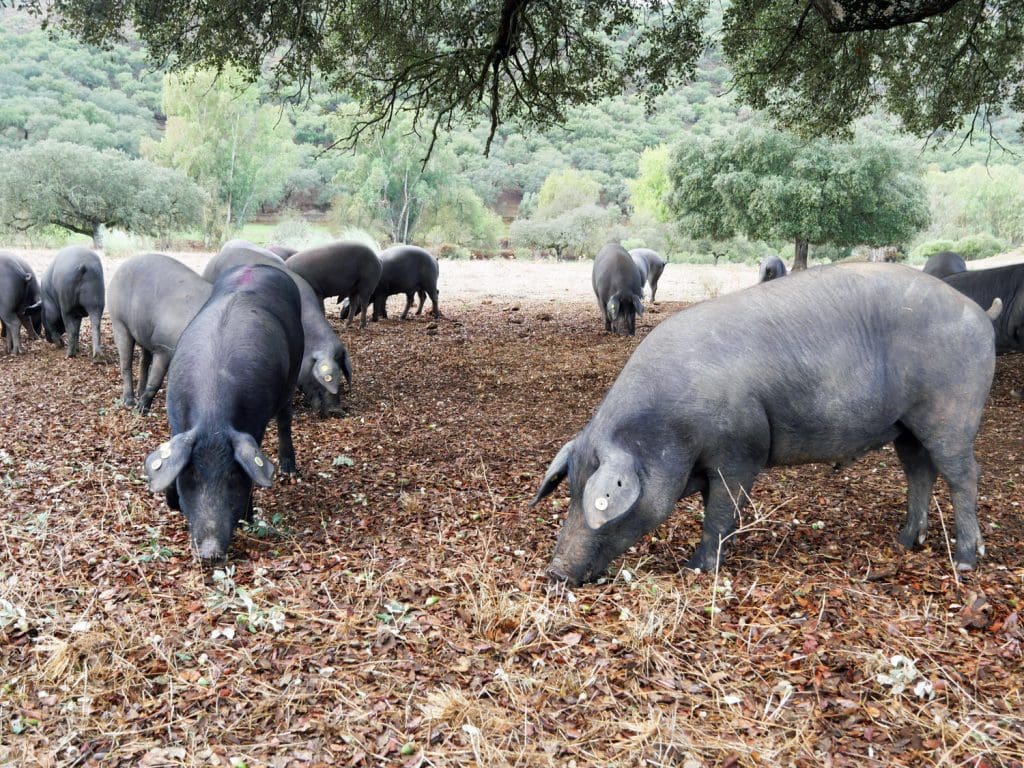
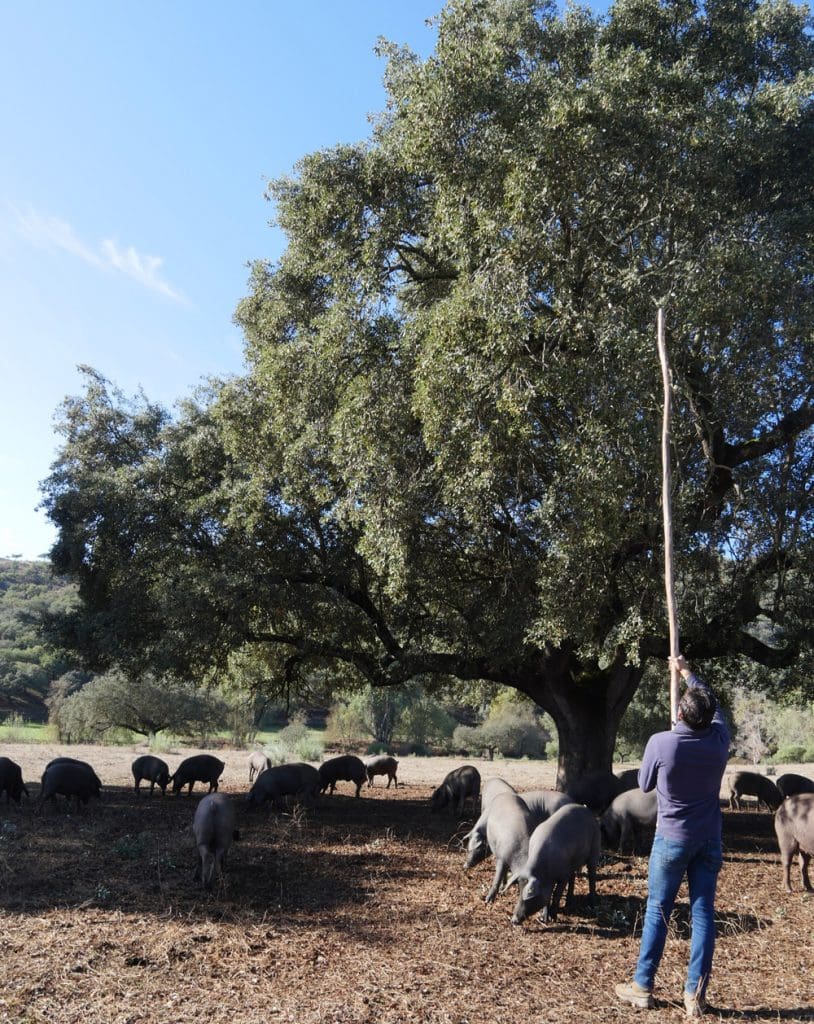
If you were wondering about the ultra-friendly pigs, the so-called ‘Pata Negra’ (black feet), all became clear when we reached the oak tree. One of the farmers was carrying a large stick, about three times his own height. Surrounded by excited pigs he started to hit the branches of the tree, resulting in acorns raining down – and happy pigs filling their bellies!
In addition to acorns, the pigs do eat grass, worms and mushrooms but they are not fed any animal products throughout their life and if, as sometimes happens, there’s a bad acorn season they will be fed on other nutrients and the ham will be down-graded to green or white. To meet the quality standard of Ibérico, the pigs have to spend at least 61 days freely eating acorns and roaming the Dehesa. They can do this for up to three years, returning to the farm for the summer, when the land is used to graze cattle. Black label Ibérico Ham comes from pigs that are at least 14 months old (more often 20-24 months old) and that meet a minimum weight criteria.

From the Dehesa, we travelled to Jambugo to learn about the process used to make Iberian ham (jamón Ibérico). Two processing factories, side by side showed how the ‘modern’ process differed very little from the traditional method used at La Joya. The peak season for the sale of whole Iberian ham in Spain is Christmas, so when we visited in November, most of the hams were nearly ready for packaging.
The hams arrive from the abattoir labelled to show their designation and origin. Initially, they are trimmed, weighed and covered with wet salt in a special chamber at 90% humidity. It takes one day per kilo of weight to salt a ham and once the salting process is complete, the hams are rinsed and then gradually dried. That process takes a further three months.

Finally, the curing takes place. We saw two different options in the ‘modern’ factory, where the hams were strung up by plastic toggles on racks lined up by windows. We learnt the windows were opened and closed to regulate the temperature and humidity of the ham, for a year or two in the case of acorn-fed.

In the cellars of La Joya, the twine tied hams are allowed to sleep for at least a year and a half and curing requires no human intervention- the constant humidity and temperature (between 12 and 18c) means that they can just be left to let nature take her course.

Once the ham is ready, each one is tested with a cala, a special tool used to check the cure, smell and taste the final product. Then, it’s carefully packaged, labelled and boxed, ready to be shipped!

What stood out at Industrias Reunidas de Jambugo and La Joya was just how simple this process is. It’s a very natural way of preserving meat, a method that has been passed down through the centuries and depends on patience, good salt (Spanish sea salt of course) and the right environment. There’s very little intervention and nothing is added beyond the salt.

The result is delicious of course, but, better still, it’s regarded as being healthy. The acorn diet of the pigs results in meat which has very high oleic acid content. That means unlike much red meat, the fat is healthy with over 50% Oleic Acid – something which facilitates the production of HDL (good cholesterol) in the body while reducing LDL (bad cholesterol). It’s rich in B vitamins and in Iron, Magnesium, Zinc and Calcium – and in Phosphorus. It’s also high in vitamin E and an antioxidant. And, if you still need a reason to try and you are concerned about your carbon footprint, this is the kind of rich flavoured meat which suits a flexitarian diet perfectly. Pigs are not ruminants and all pork meat has about a third of the carbon footprint of beef or lamb – about the same level as poultry. So, this is a passion to indulge and enjoy!

Fact Box
We were guest of the Jamones Ibericos de Espana as part of the EU funded Ham Passion Tour
We stayed at the Parador de Zafra
We visited the Dehesa Cumbres de San Bartolomé to meet the Pata Negra pigs
We visited Industrias Reunidas de Jabugo and La Joya Factory to learn about how Iberian Ham is made.


Was really great to read this, especially as I love Iberico ham…..once tried, all others seem not quite as great by comparison.
Interesting info. Never knew about these pigs and this ham. Sounds delicious and if I were to travel to Spain I would choose a visit there.