Last Updated on April 12, 2022
Wine, Food and Art in the Land of No Taxes.
Ok, maybe that last bit isn’t quite true – but the name Franciacorta, the word now used both for the wine region and the traditional method sparkling wine it is famous for means ‘exempted from paying duties – from the latin ‘franchae curtes’. It’s a section of the province of Brescia in Lombardy that is particularly well suited to making sparkling white wine and, although Franciacorta, the eponymous fizz, is now thought of as the champagne of Italy, it’s only just over 60 years old and Ca’ del Bosco is younger still.

It must have been fate that led Annamaria Clementi to buy a little house “Ca’ del Bosc” with five acres of land in Erbusco. And, fate sent Maurizio Zanella on a bus journey to Paris and then to some of the most famous winemaking areas of France. Travelling with a group of Italian winemakers he was trying to escape the farm work his father had consigned him to as punishment for his wayward behaviour. The story goes that when the winemakers started to visit the cellars in Burgundy, Zanella initially refused to get off the bus. When he was finally persuaded to do so, fate conspired to make that cellar Domaine de la Romanée-Conti, arguably the finest in Burgundy and Zanella was so impressed that he spent all the money he’d taken with him, 1000 francs (plus 50 borrowed from the bus driver), to buy three bottles. On his return to the bus, the Italian winemakers tried their best to persuade him to trade the wine he’d bought for hundreds of their own wine, but Zanella took his purchase home – the start of a passion for excellence in wine.

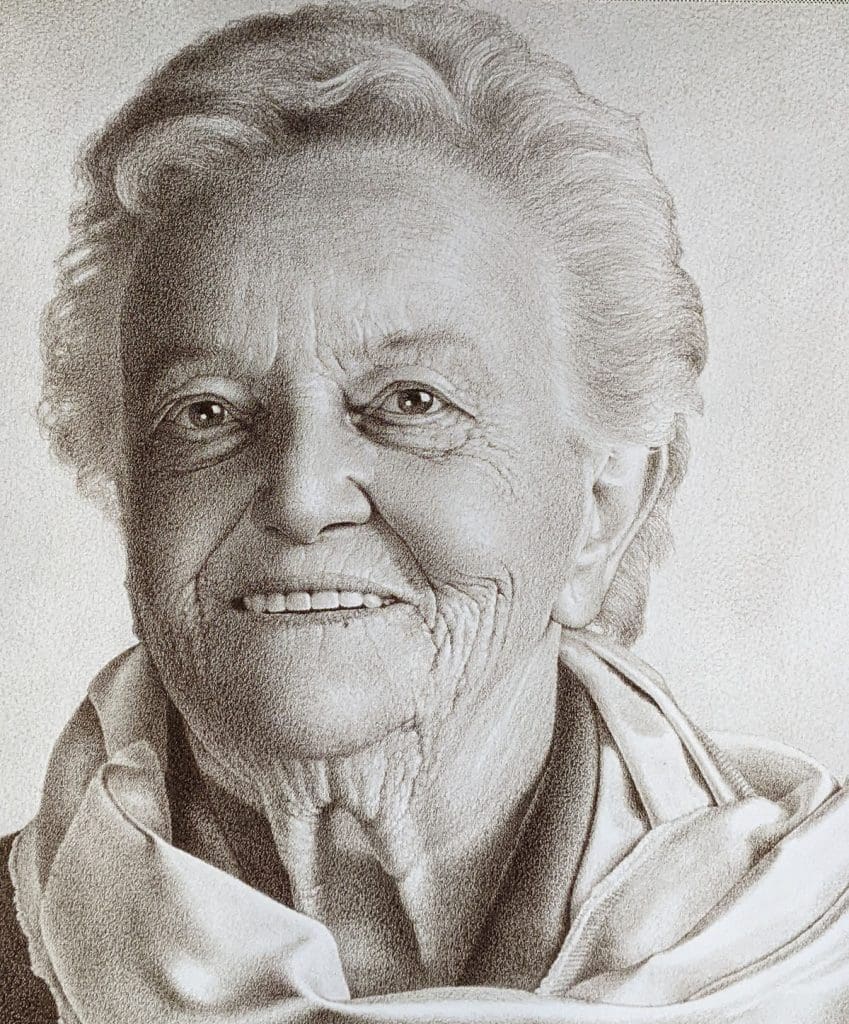
The first vineyard at Ca’ del Bosco was planted in 1968 and the first wines were produced in 1972. From then on Zanella has gone from strength to strength and Ca’ del Bosco is a real tribute to this quirky and entirely Italian character. The estate itself now sprawls over around 240 hectares and produces in excess of 1.6 million bottles of wine each year.

And the winery was completely re-built – it’s ultra-modern with a whole pack of bright blue wolves looking out from the curved roof. Around the grounds and scattered through the winery, you’ll find a collection of contemporary art including some stunning and unusual pieces.

I was particularly taken by ‘Water in Dripping’ by Zheng Lu which fits so seamlessly into the rooms filled with steel tanks. Probably for all the wrong reasons – it reminded me of something from a Harry Potter set.

And, outdoors there’s a Japanese water garden and that series of striking sculptures. Even the entrance gate is a work of art, Cancello solar by Arnaldo Pomodoro

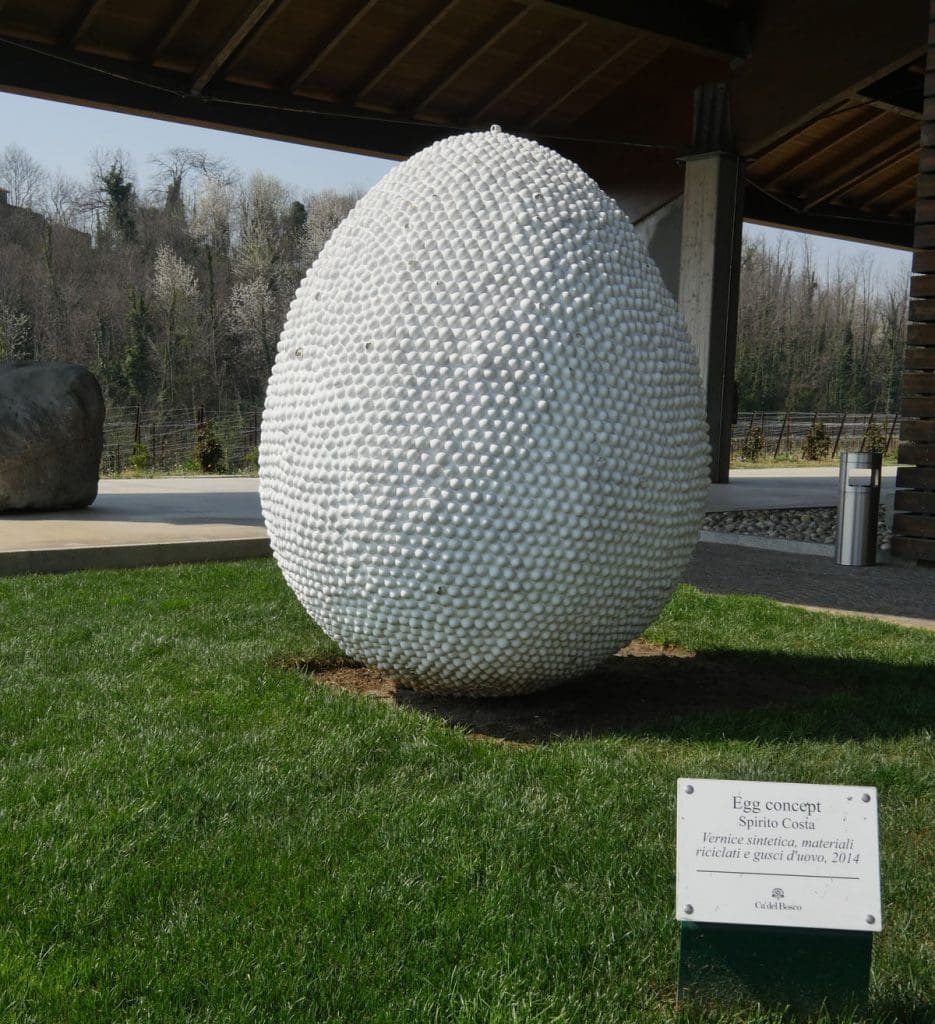
There’s a cheeky and quirky approach to much of what is laid out across the estate, including the infamous blue wolves (deliberately at odds with the landscape). And sometimes nature fights back. Who couldn’t love the small birds who apparently like to peck at the “Egg Concept” by Brazilian artist Spirito Costa, made from thousands of real hollowed-out eggs. I wonder if the artist realised his work would become part of the natural cycle of life in quite that way.
What of the wines though? While Ca’ del Bosco is now owned by Grupo Zignago, Zanella still retains an equity share and is the chairman of the company. Whilst his initial inspiration came from his first visit to France where he visited cellars in Burgundy and Champagne, he’s worked to develop Ca’ del Bosco wines into the award-winning portfolio of today. The initial Chef de Caves was André Dubois, from Moët & Chandon Champagne, who joined at the age of 65 and was clearly a significant player in producing the early Franciacorta of Ca’ del Bosco.

He remained in that position until his death in the 1990s. His successor, Stefano Capelli was already working at Ca’ del Bosco. From what he learned with Dubois, Capelli has added his own approach using technology to its best advantage and respecting the differences in terroir between Franciacorta and Champagne.

The estate has been organic registered since 2014 and the vines are densely planted at 10,000 vines per hectare, more like those of Champagne than traditional Italian planting. Each vineyard is vinified separately so that the integrity of the terroir is maintained, with the wines blended at the final stages.
The grapes themselves are then all washed before they are fermented, in a “berry spa” that uses three soaking vats and a unique air-bubble bunch washing system. The theory is that the cleaner the grapes the purer the wine. The resulting fruit is free of insects and pollutants, the wine doesn’t need to be clarified and sulphites are reduced to less than 50% of the allowable level according to Italian regulations.

It’s an attention to detail that produces a very easy to drink Franciacorta in a number of different expressions, all of which are currently based on classic champagne grapes (Chardonnay, Pinot Noir and Pinot Bianco). Zanella has focussed on producing zero dosage or low dosage wines and moved away from using cane sugar to organic grape juice some seven years ago. To prove the point, we enjoyed three excellent meals with paired Ca’ del Bosco wines (a bit more about that to follow in a separate feature). It’s hard as such to pick a favourite because the wine and food for me become intrinsically linked. If I was shopping for a special bottle though, it would probably be one of the Annamaria Clementi Vintage 2013 Franciacorta we enjoyed with this seafood dish at the winery

What’s astonishing for me is that were it not for the label, I would not have realised it was zero dosage. I suspect that’s partly because of the long ageing on lees (At Ca’ del Bosco the Cuvée Prestige is aged on lees for 25 months rising to 8 years for the zero dosage Annamaria Clementi vintage Franciacorta). Yet these wines are soft and delicate, without the acidity of some champagnes. And, of course, so low in calories you can drink a whole bottle…and still enjoy plenty of pasta.

What makes this Stile Italiano? That fusion of Art with Life which, until you visit Italy doesn’t mean anything but once you are there fall into place. Finding wolves on the roof of Ca’ del Bosco, a rhinoceros suspended between the wine tanks and landscaped gardens surrounding the winery that are worthy of a visit in their own right.

That sparkling wine called Ca’ del Bosco Franciacorta works brilliantly with breaded lake perch and foraged wild asparagus at La Foresta, a local restaurant on the banks of Lake Isola. And, it can happily pair with every course of a three-star Michelin meal at Da Vittorio.

Although that in itself epitomises Stile Italiano for me, through quirky ‘beyond Blumenthal’ dishes and an exuberance that spills over into every corner of the evening.

My overriding impression from this all too brief visit to Ca’ del Bosco is that this winery, under the direction of Maurizio Zanella, encapsulates Stile Italiano in a way that is hard to put into words. Art, a philosophy of life that is all about passion, a love for good food and great wine. If the end result is a bottle of Ca’ del Bosco on my table, I’ll be very happy!
Ca’ del Bosco Winery is open to the public by appointment. You can find more information and how to book a tour on their website.
You can buy Ca’ del Bosco wines from Selfridges, Hedonism Wines and other good online wine retailers in the UK.
We stayed at Hotel Cappuccini
We ate at the three Michelin Star restaurant Da Vittorio
Ca’ del Bosco
Via Albano Zanella,
13 25030
Erbusco (BS)