
Last Updated on May 28, 2024
Spa town Baden-Baden has culture, casinos – and roller coasters:
Guest post by Oliver Segal
Our trip started in Baden-Baden, a deeply Germanic spa town. Like Bath in Avon, its history goes back to the Roman empire. Emperor Caracalla built the original bath, but it was transformed from a forgotten city in the 19th century by Kaiser Wilhelm I, who summered there for 40 years. Very little of the original Roman spa is left, so the area has a Victorian holiday-town feel.
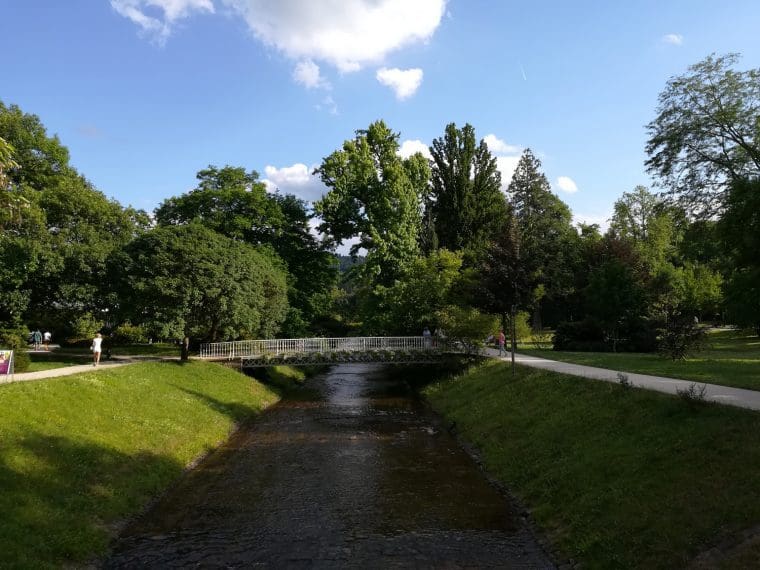
Baden-Baden is in a beautiful setting. The centre of town is dominated by a long botanical park, the Lichtentaler Allee, which has a river running through it and museums on one side. At one the end of the park is that great German speciality, a fantastic neoclassical building – in this case, the Trinkhalle, which could have been spirited here from ancient Greece, bedecked as it is with scenes from local myths. It’s the pumping station, where visitors would take the curative spring water. The waters were said to cure all manner of diseases; Mark Twain swore he “abandoned his rheumatism” in the baths.

The other big draw in the 19th century and also today is the casino. Founded because the French banned gambling, like a Victorian Macau, it used its location by the border to draw in heavy gamblers and become rich. The tour guide explained that the main church in Baden-Baden is the only one in Germany where the steeple was paid for out of vice. Bismarck moralistically banned gambling in 1872, telling the locals it would destroy their town. He was wrong and, oddly, they have a statue of him (I can’t see Liverpool getting a Thatcher statue anytime soon). The casino reopened and operated throughout World War II. Fyodor Dostoyevsky’s novel The Gambler was based on his losses there, although I can’t complain – this writer won €30 on the roulette wheel.
By the vagaries of European dynastic politics, the local princess married Catherine the Great’s grandson, who eventually became Tsar. Tsarina Elizabeth advertised the town to Russians, and many of the great Russian novelists and aristocrats visited to bathe and gamble, including Gogol, Turgenev and the above mentioned Dostoyevsky. Many wealthy Russians visit today to see the places where their literary heroes stayed.
This inspired Russian businessman and philanthropist Alexander Ivanov to open a museum in the town focusing on 19th-century jewellers. It has the world’s largest dinner set, made in Sheffield for a Rajah, and a historic gold exhibition. The main focus is on the greatest jeweller of all time, Peter Carl Fabergé, and his pieces. The centrepiece is the eggs made for the Romanov dynasty, the most exquisite of which is the last-ever Fabergé egg, a blue oval with a map of the heavens studded with diamond stars. Poignantly, it was left unfinished and missing the final element, a group of golden angels, due to the Russian revolution.
Fabergé’s workshop was far more than an egg factory. There are thousands of carved animals, which are a treat for the eyes. In one corner of the museum is a row of elephants, ranging from matchbox sized animals to an exquisitely carved jade piece the size of a cat. There are also kangaroos, which I find delightful from an artist based half the world away from Australia.

The jeweller didn’t just cater for European tastes. There is also a bowenite Buddha with a ruby tongue designed for the King of Siam that had been previously owned by Jackie O.
The next town on the trip was the more business-like Karlsruhe. It has a sumptuous palace for a sovereign prince which is well worth admiring, with fountains and parkland around. In the palace complex is a well-stocked history museum.
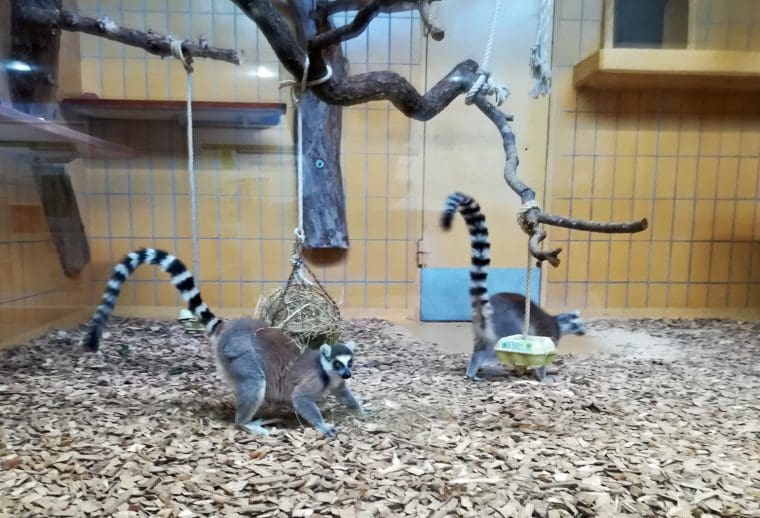
The zoo in the city had everything you would want, from hippos and leopards to lemurs and seals. Like most of the museums and the local extensive tram network, the zoo entry is included when you purchase a Karlsruhe card for only €18.50 for 24 hours.

The city has one of Germany’s best universities. Inexplicably, the campus has a giant pink hot water bottle outside one of the student accommodation blocks. As it happens, your correspondent went to a nuclear engineering conference there a couple of years ago. This time around, I rediscovered a pub I had visited previously and chatted to locals about my next destination: a Europe-themed amusement park.

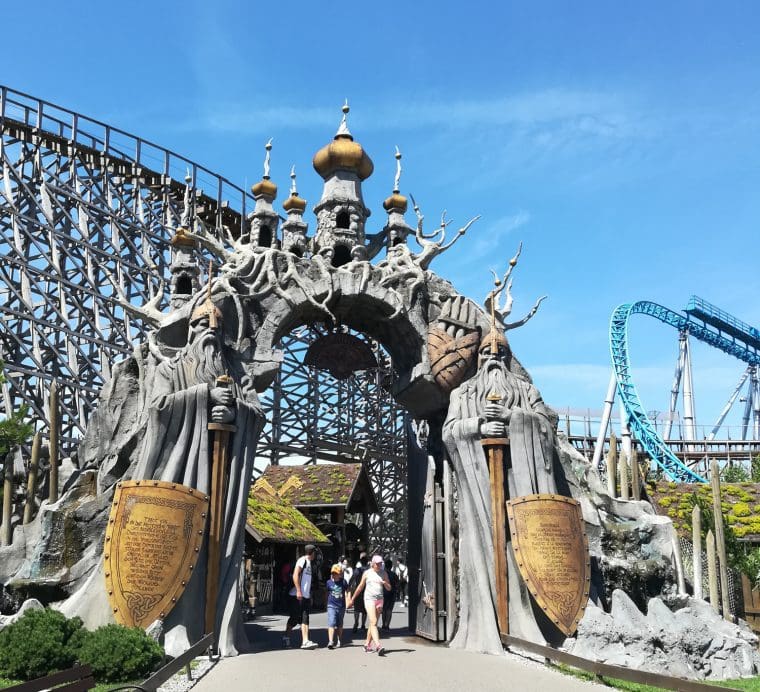
And Europa-Park is fantastic. It truly is a hidden gem. Almost no English people visit the park, so it is bilingual German/French, with 90% of visitors coming from the three nearby countries of Switzerland, Germany and France, but it’s well worth a visit. I hadn’t ridden a roller coaster in a decade, but an envious 16-year-old family friend had told me Europa-Park has some of the best in Europe, and they certainly felt spectacular (note: avoid the virtual reality headset on Pegasus if prone to motion sickness). The water rides suited the boiling heat, too; nothing cools you down like your car hitting a pool at speed, which happens on Atlantica SuperSplash.

The park is divided into 18 zones, each based on a European country. Each one tried to capture the essence of the place. ‘England’ has a replica Globe theatre with rock ‘n’ roll performances, an arcade, a double-decker-bus fairground ride and a popular English restaurant, and there’s an Irish zone, dedicated to small children. The Scandinavians and Greeks had the best roller coasters.
My highlight was the Voletarium, a tour of Europe from above. Your seat slides forward until you’re looking at a huge screen. The seats move with the projected views and you find yourself swooping through clouds, made all the more realistic by a gentle mist sprayed at your face. I don’t want to give spoilers, but you’ll soar with eagles and dive through detailed cityscapes. Don’t miss it!
The park has several shows and parades a day. The lack of English didn’t seem to matter at the ice show, an enjoyable pastiche of Charlie’s Angels. Dancers skated across Europe, defeating baddies while performing gymnastics in bikinis. An acrobat twirled around a pole suspended in mid air (without a safety harness, unlike the others), and the finale was on a London bus with real rain coming down in the arena.

The hotels at the Europa-Park keep to the theme of national identity. I stayed at Hotel Colesso, which had authentic-looking Roman decor, with frescos in the bedrooms and breakfast room, as well as a replica coliseum in the back.
Oddly, next door there is a New England-style hotel, with several restaurants specialising in the cuisine of the region. I enjoyed a five-course lobster-based extravaganza while seated amongst pretty, timed fountain displays (pictured).
Visiting the area is a straightforward, 80-minute journey from London Stanstead to Karlsrhue/Baden-Baden airport. You could almost do it as a day trip, but it’s certainly close enough for a weekend away.
Tempted? why not pin this post for later
Fact Box
For more information about Baden-Baden check their website
For more information about the Black Forest check the website
London Unattached travelled as a guest of Fly-Baden – part of the #FlyBaden summer series


A peaceful and scenic town, a very useful post for me
Great post Fiona! I was on a hunt for an article about traveling to Germany, and came across your post. I especially liked how you provide so much historical context and also give very practical advice.
Actually, I just put together an infographic about “10 Must Do’s in Black Forest”. Let me know if you’d like to check it out. If you have any ideas about Black Forest in particular, I’d like to know! -Leah
I’ve never heard of this city, but you certainly showed the gems of this place. The neoclassical building is the most interesting for me! <3
Baden-Baden is beautiful setting. The Trinkhalle, is a gorgeous building and to top it off leopards to lemurs (love lemurs). I love how the park is divided into 18 zones, based on a European country. It reminds me of Mini Europe in Brussels.
I had no idea that there was so much to do in Baden Baden. I’d only really heard of the baths there. I’d love to go to the park!
I’ve visited quite a bit of Germany but missed Baden-Baden so far. I am dying to visit though, and the baths are high on my list. As far as casinos go, I am not normally a fan, but I would love to retrace Dostoyevsky’s steps at Casino Baden-Baden 😀
I’ve been to Germany but never been to this city. It seems like the park alone is worth visiting it! And of course, the baths, too. Someday I’ll be back 🙂
What a fascinating area! I didn’t know Baden-Baden had “curative” baths. There are mineral hot springs here in Cali that people still swear by for healing excursions. Also, well done on winning at roulette! The Voletarium sounds like quite an experience, and the Europa-Park in general is now a “must see.” Thanks for sharing. Pinned!
I didn’t know there’s a Fabergé Museum in Germany. I thought there’s only one in St Petersburg. That alone would have appealed to me to visit Baden-Baden. Another attraction that’s piqued my curiosity is the curative spring water. I’d certainly like to try it out and see it for myself. Did you try it?
This looks like a great plan for a long weekend getaway from London with the flights from Stansted. I’ve been to a few places in Germany but never Baden Baden or Karlsruhe. You basically convinced me with the baths!
This looks like a really nice place to visit plus it was visited by Mark Twain, maybe I should do that too.
So lovely! Not only that there are “baths that heal”, and that the building of Trinkhalle looks so beautiful, but I like the fact that it was visited by Mark Twain and Dostoyevsky. 🙂 Sounds like a nice place. Didn’t think about it before, but I will now, nice guide, thanks. 🙂