Last Updated on March 2, 2025
Tips for a city break in Barcelona
Barcelona is a hugely popular destination for a short city break. Spain is the second most visited country on the planet and many of these visitors make their way to the sunny climes of this coastal Catalan city. Barcelona has a wealth of museums, restaurants, beaches, and nightlife. What’s more, it is relaxed, scenic and fun.

I recently enjoyed my fourth visit to Barcelona and decided to begin with a few museums I had not previously seen.
Table of Contents
MNAC and CaixaForum
My first stop was MNAC (Museu Nacional d’Art de Catalunya), the National Museum of Catalan Art which is housed in the Palau Nacional, a historical palace built to host the formal ceremonies for the 1929 International Exhibition. Situated on the slopes of Montjuïc, the museum building has a splendid view over Barcelona from its rooftop which is worth the visit in itself. I was particularly keen to see the superb collection of Romanesque art, rooms full of Medieval murals and panel paintings discovered in the early 20th century in Romanesque churches in the Pyrenees. The display halls are constructed in the shape of the churches from which the paintings were removed – there is a helpful film which explains how this was achieved – so visitors to the museum can experience how they were positioned in their context. I also enjoyed the two exhibition halls that contain a wealth of modern art showcasing Spanish artists including Miro, Picasso, Gaudi, Fortuny and Rusiñol.
Downhill from the museum, I found CaixaForum, a cultural centre which is housed in a former Modernist textile factory designed by renowned Catalan architect Josep Puig i Cadafalch. Here I enjoyed two excellent, temporary exhibitions which are part of this art institution’s rolling programme of contemporary art shows. For visitors interested in contemporary art it is always worth having a look to see what is on at CaixaForum during a visit to Barcelona.

Park Guëll and Sagrada Familia
Antoni Gaudí is a name synonymous with Barcelona, most renowned perhaps for the Sagrada Familia, a magnificent church the construction of which began in 1882 and continues today. Each time I have visited Barcelona the church has advanced higher into the sky and I was informed on this latest visit that 2026 is the anticipated year of completion. I had hoped to revisit this intriguing landmark of Barcelona, but I had not reckoned with the unavailability of tickets due to its popularity. Top tip: if you have a particular day on which you wish to visit the Sagrada Familia, book ahead as soon as you have your dates. I suggest the same for Gaudí’s remarkable Park Guëll which I was also hoping to revisit but was unable to secure a ticket during my short stay.

Casa Vicens and more Gaudí
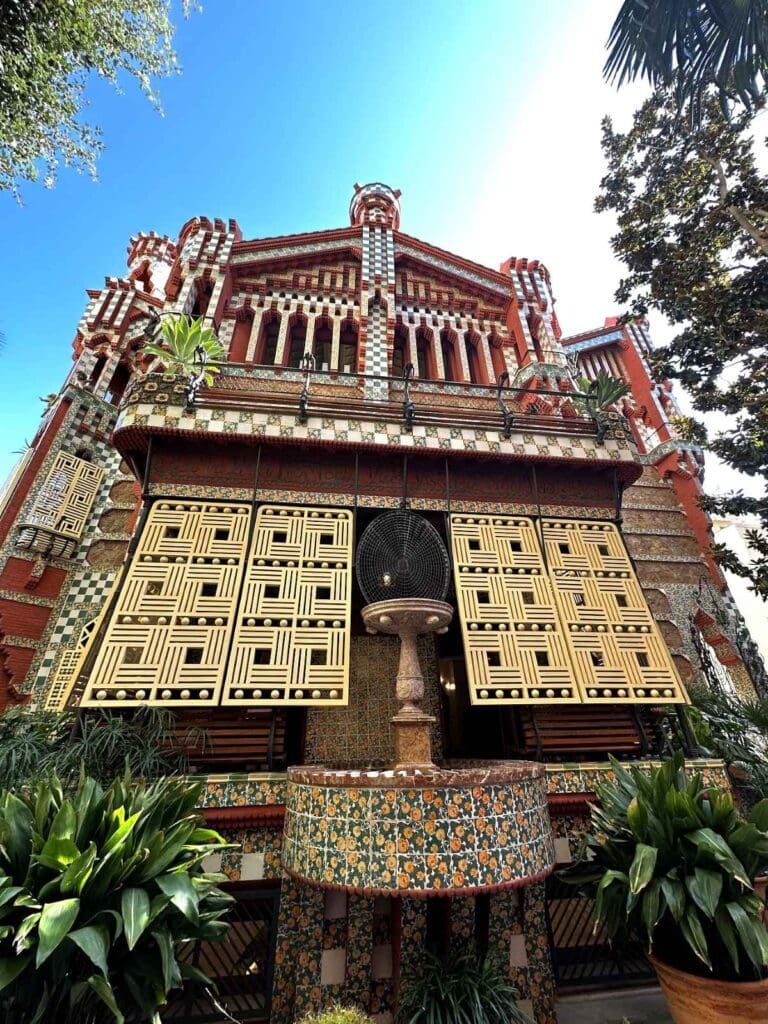
Fortunately, Barcelona is brimming with wonderful Gaudí properties to visit. I chose one I had not seen before and refreshed my memory by popping into a couple I last visited decades ago. Casa Vicens is the very first home that Gaudí designed and built soon after he graduated, a summer house for the Vicens family. It is a wonderful place to visit and to marvel at the talent that he revealed so early in his career. It gave me a chance to take a good look at the project where Modernisme (Catalan Modernism) was revealed in all its glory in Catalonia. I was delighted to find that there was no queue and I was able to enjoy looking at the rooms with relatively few others. Tiled turrets, carved wooden doors and extraordinary ironwork all make this a visit not to be missed. Each room is exquisitely decorated with tiles, organic forms and floral motifs and a series of tiny balconies with blinds to protect from the sun are charming. Resting briefly on a small terrace I could easily imagine the inhabitants taking tea or spending an afternoon reading and listening to the birds that proliferated in the gardens. Casa Vicens stands out as a stunning example of the Catalan interpretation of Art Nouveau and the emergence of architecture and interior design being thoroughly integrated through the use of decorative arts. It is, not surprisingly, one of six Gaudí buildings declared a UNESCO World Heritage site in 2005.

Two other sites which I enjoyed were La Pedrera-Casa Milà and Casa Batlló. As with all the Gaudí buildings, one begins to appreciate them from the outside. La Pedrera (meaning ‘quarry’) has a striking stone façade that seems to breathe and writhe over the street. During a visit to the latter which is the last private home designed by Gaudí – one ascends to one of the city’s most iconic rooftops with its forest of chimneys resembling a stone army from another planet. It is an exceptional and unforgettable sight. The rooftops of Gaudí buildings are always the cherry on the top for me, magical environments of twisting, sinuous turrets that are magnificently tiled. La Pedrera is very different, being more austere and an other-worldly experience. Casa Batlló is another extravagant display by Gaudí both outside and in. The interior and the rooftop are an undulating sea of colour, the latter framing the Barcelona skyline with its curved canopies and barnacled chimneys.

The Picasso Museum
The popularity of Barcelona means that visitors to the city on a short break are well advised to do some prior planning. Not only were there no tickets available for Park Guëll and the Sagrada Familia, but I also encountered disappointment at the Picasso Museum. Although I arrived at opening time, I cannot recall seeing such a long queue for a museum. It turned out that there was free entry as it was the first Sunday of the month. Presumably, most people in the long line knew this except for me. When I finally reached the front, I was offered a ticket for a mid-afternoon slot which I could not return for as I had a late lunch booking. Fortunately, I have visited all three of these popular sites on previous visits, but you might be frustrated if this happens to you. I know that many people prefer a spontaneous approach to travelling, but in large cities, it does save time to do some preparation and planning.

Planning your visit to Barcelona
There are so many outstanding museums to visit in Barcelona – not to mention a brilliant selection of restaurants and an enviable nightlife – that the city does require more than one visit. You could exhaust yourself cramming in museums from morning to night – I am often guilty of doing so – but Barcelona is also a city to enjoy by strolling around. There is much to enjoy on the streets, popping into a bar for a drink and a few tapas or sitting in a restaurant at lunchtime when the menú del día provides real value for money. Don’t miss browsing the Mercado de La Boqueria where you can buy fresh produce or grab a bar stool and tuck into a feast of local foods. Visit the Barri Gòtic with its winding alleys filled with independent boutiques, churches, and remnants of the Medieval Jewish quarter. For architecture enthusiasts, Barcelona is a remarkable city with each neighbourhood offering something unique. A visit to Montjuïc – one of the hills overlooking the city – is perfect for those who love sport (the Olympic stadium is there) as well as art – the Joan Miró Foundation is but one of the jewels in the Barcelona crown. Families may enjoy a visit to Tibidabo – another hill to the north of the city – where I recall a day out decades ago at an old-fashioned amusement park that the kids enjoyed. On the way, we visited the CosmoCaixa – Barcelona’s extraordinary science museum which makes a great day out.
Fact Box
Where to stay: my trip was hosted by Hotel Arts Barcelona, a five-star luxury hotel overlooking the Olympic Port and the beach.
Where to eat: Barcelona is brimming with outstanding fine-dining restaurants to small, atmospheric tapas bars so there is plenty to suit every budget. I was fortunate to be invited to review Enoteca Paco Pérez which has two Michelin stars and which I highly recommend.
Day trips: If you are in Barcelona for a few days you may want to include a day trip to Girona which is easily reached in 38 minutes on the fast train from Barcelona Sants station. It is a remarkable city with one of the best-preserved Medieval quarter in Europe, a host of fascinating museums and excellent restaurants.
Bear in mind that many museums are closed in Barcelona on Mondays so plan your itinerary accordingly. Many museums have late opening hours which is very handy for visitors.
MNAC, Palau Nacional, Parc de Montjuïc, closed Mondays, open Sun and Wed from 10am – 3pm and Tues, Thurs, Fri and Sat from 10am – 6pm
CaixaForum, Av. De Francesc Ferrer i Guàrdia, 6 -8, open daily from 10 am – 8pm
Casa Vicens Gaudí, Carrer de les Carolines, 20 -26, open daily from 9.30am – 4.30pm
La Pedrera-Casa Milà, Passage de Gràcia, 92, open daily from 9am – 11pm
Casa Batllo, Pg. de Gracia, 43, open daily from 9am – 8pm
Picasso Museum, C/ Montcada, 15-23, closed Mondays, open Tuesday – Sunday from 10am – 7pm
CosmoCaixa, Teodor Roviralta, 47-51, closed Mondays, open Tuesday – Sunday from 10am – 8pm
Tibidabo attraction park, pl. del Tibidabo, open weekends, 11am – 8pm
I was able to visit the Barcelona museums courtesy of Barcelona Turisme. You’ll find more information about Barcelona on their website. For more about Gaudi, check out our feature on Colonia Guell