
Last Updated on May 3, 2024
Exploring Newcastle’s Food Scene and Beyond
When you arrive in a City for the first time what do you do? Led by my stomach, I relish the idea of a food tour as a way to explore and in Newcastle, we had two such tours in different parts of the city! Whilst you might know of Newcastle for its beer, bridges or thriving nightlife, the city also has an excellent food scene as I discovered very quickly – after a weekend of trying various restaurants, cafes and bars around the town, I’m happy to report that there are plenty of options to try. Here are just a few places you shouldn’t miss. I’m sure there’s more and hope I’ll be back soon to find out more.

Table of Contents
Grey’s Monument and Grainger Town
The first landmark many visitors spot when they arrive in the centre of Newcastle is Grey’s monument. It looks a bit like Newcastle’s answer to Nelson’s Column. But, at the very top of the monument is a statue of Earl Grey. Built in 1835 in memory of the second Earl Grey who in his time as Prime Minister was the architect of the 1832 Reform Act. Although it was just the start of changes to bring a democratic government to the country, in its time it was a brave move that started the overhaul of the British parliamentary system. Earl Grey also gives his name to the famous bergamot infused tea which was reputedly specially blended for Lord Grey, to suit the water at Howick Hall, his family home Northumberland.

Nearby Grainger Market, the area around it and Grainger Street are all named after Richard Grainger, the architect who helped to rebuild most of the city centre between 1824 and 1835. And, that’s where I started my food fest, in the market where you’ll find fresh oysters, craft beers, Indian street food, tapas and more.

Stopping first at SnackWallah, it was hard to resist the trays of vegan Indian food inspired by the street food of Mumbai. Ravi the owner served us pani puri, delicious crispy shells of semolina, flour and salt (puri) made by deep-frying dough, then filled with what literally translates to ‘water’ – pani. Of course, it’s far more than water, a flavoured liquid full of the spices of India, there’s coriander, ginger, potato, cinnamon, cumin and black rock salt in a mixture that seems to explode in your mouth.

That was quickly followed by a visit to Lindsay Bros Fisheries where, along with Lindisfarne Oysters, you’ll find a wealth of fresh fish. I loved the freshly shucked oysters served with a dash of tabasco – plump, succulent and sweet rather than salty they were ultra-fresh and really delicious

On our whistlestop tour, we next went to Firebrick Brewery to enjoy a flight of locally brewed beers and ales. Launched in 2012, their beers come in all sorts of styles but there are some notable nods to Newcastle’s famous brown ale. The Firebrick ‘Toon Broon’ for example is a 4.6ABV Newcastle Brown Ale that has a traditional malty sweetness to it.

There’s a lot more to explore in Grainger Market. Blink and you could easily step back in time 50 or 60 years. But, back outside again, there’s more history to come.
Blackfriars.
Dominican friars arrived in Newcastle in 1239. The site where they first settled was donated to them by the first Mayor of Newcastle, Sir Peter Scot along with three anonymous sisters. What now lays claim to being the oldest dining room in the UK was the original monastery – now a thriving restaurant and bar.

With its origins dating back to 1239 and a long and turbulent history that included a spell as a hostel to accommodate King Henry III, Blackfriars confidently lays claim to being the oldest dining room in the UK! The friars who used to wear white tunics and black cloaks are said to have been the inspiration for Newcastle United’s black and white strip.

We stopped for a taster of their food – a beautifully fresh mackerel pate with toasted sourdough and pickled cucumber and learnt that in addition to lunch and dinner, the restaurant provides afternoon teas and regular local gin tasting events! Next time…
Dean Street and Kaltur Wine Bar and Restaurant
Built over a stream called the Lort Burn, Dean Street in the 17th century was described as a “vast nauseous hollow, equally unhealthy and inconvenient”. The street runs from the city centre down a steep hill to the quayside. Development by the architect David Stephenson in 1787 lead to the steep ‘dene’ becoming one of Newcastle’s principal streets despite being built over what was, at the time, essentially an open sewer taken waste from the flesh market out to sea. Today it’s lined with smart shops and restaurants including Kaltur Wine Bar and Restaurant where we stopped for a sharing board of Spanish meats and cheeses.

Excellent quality chorizo, Iberico ham, sobrasada and cheeses including a delicious manchego complemented by quince jelly provided a great snack, all washed down with a glass of house sangria.
St Nicholas Cathedral
A few minutes from Kaltur is the Cathedral Church of St Nicholas, a beautiful and historic building. The spire has served as a navigation point for ships on the River Tyne for over 500 years and it’s said that when the Scottish army threatened to blow up the church during the siege of Newcastle in 1644, the mayor Sir John Marley, put Scottish prisoners in the lantern tower!

It’s perhaps worth mentioning that Hadrian’s Wall, built by the Romans to protect the furthest extremes of their Empire in North West England from the Scots, passes through the centre of Newcastle. Next time I visit I’m planning to follow part of the 84-mile path out into the countryside.
The Castle and the French Quarter
Newcastle owes its name to William the Conqueror. In 1080, recognising the strategic importance of the city, he gave his son the order to build a ‘new castle’ on the site of an old Roman Fort. The castle became a major stronghold in the various wars between England and Scotland, last used during the English Civil War and the Seige of Newcastle. One of the oldest buildings in the city, it’s open to the public and has an excellent museum that is well worth a visit.

You might think that ‘The French Quarter‘ is a nod to our last French ruler but in fact, it’s simply a reflection of the founders’ passion for French food. Cédric (from the Loire valley) & Catherine Boc-Ho opened The French Quarter in 2017 to showcase the food and wine they love. A few minutes from the castle, we stopped there for café gourmand, my favourite French way of enjoying dessert – a trio of three puddings paired with three wines. Ile flottante, crème brulee and chocolate mousse were paired with a sweet Muscat de Rivesaltes, an Ugni Blanc fortified with Cognac and a rich Mas Amiel Maury Grenache.

Definitely another place to revisit, I’d love to try their full menu.
Eldon Square
If shopping rather than heritage and culture is on your agenda, you won’t starve in Newcastle. We spent an evening at Chaophraya, a Thai restaurant in the heart of the shopping centre serving excellent and very authentic freshly cooked food.

It seemed an unlikely location but turned out to be a wonderful feast of Thai dishes. In fact, Newcastle also has one of only five Chinatowns in England and if I had a little longer to explore I’d have headed to Stowell Street, not far from Eldon Square to see the arch and find out more. Next time!

Northumberland Street, Fenwicks and the City Baths
It’s hard to believe that from the opening of the bridge in 1928, Newcastle’s main shopping street, Northumberland Street, was part of the A1 between London and Edinburgh until the opening of the Tyne Tunnel in 1967. Now pedestrianised, it’s home to most major retail groups and significantly to the flagship branch of Fenwicks. In 1882, John James Fenwick bought 5 Northumberland Street. It had been a doctor’s house, but he converted it into one of Britain’s first department stores, Fenwicks, soon expanding along Northumberland Street. He was successful enough to open a second department store on New Bond Street just 9 years later.

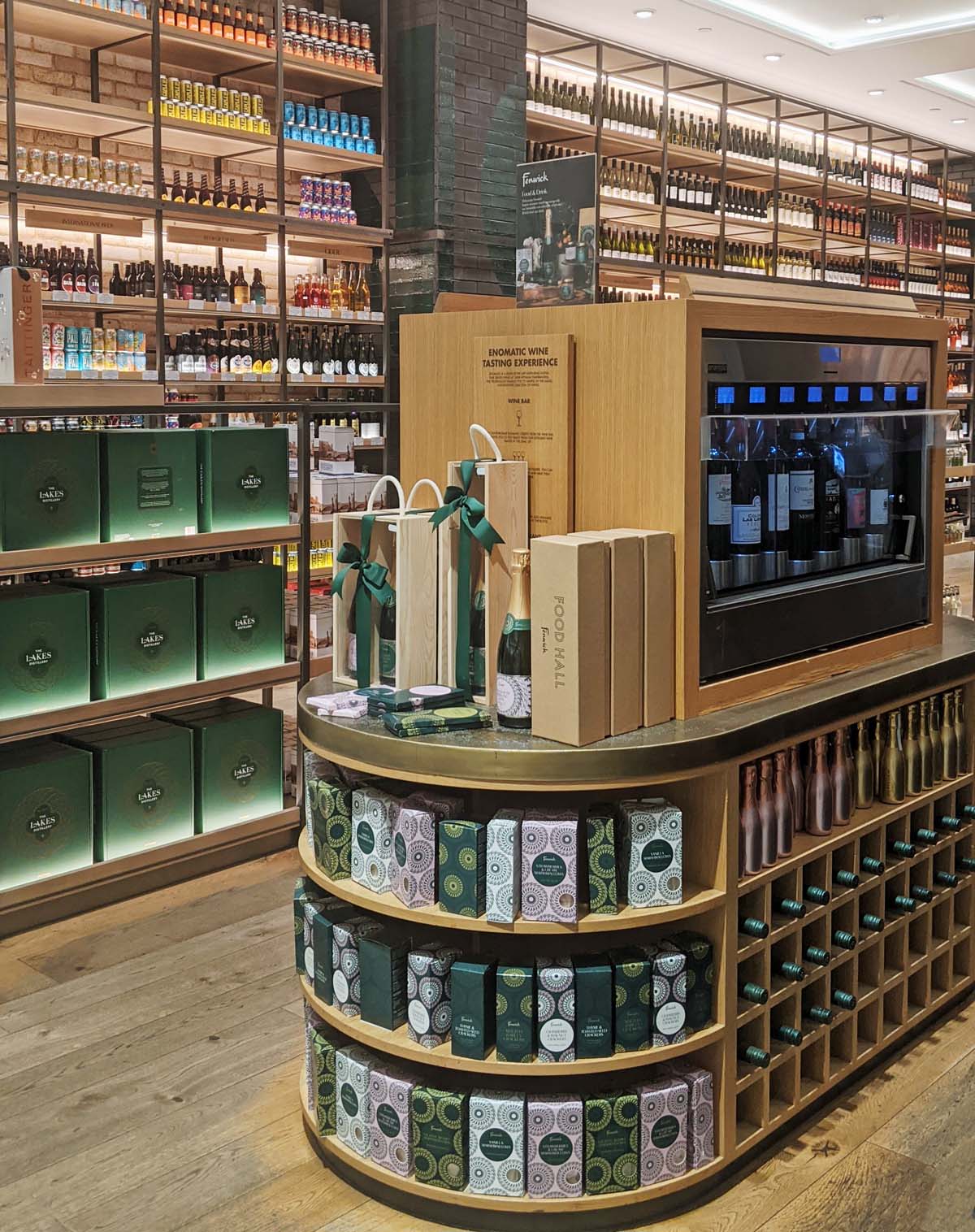
Fenwicks is still thriving today and their famous food hall is a must! We enjoyed dining at Fuego, a tapas restaurant at one end of the hall and drooled over some of the other restaurant outlets. Remembering the times when eating in a department store involved limp little gem and curling sandwiches, the offering from Fuego seemed a million miles away with excellent pizza, small plates of Padron pepper, Iberico ham and cheese

If all this feasting is too much, then make your way to the City Baths, newly refurbished and just a few minutes walk from Fenwicks. The history of the baths dates back to when famous Newcastle architect, John Dobson, built private baths in 1838 at a cost of £9,500. They were rebuilt in the 1920s and have recently reopened after a major refurbishment. You can enjoy a swim in the pool, relax in the steam rooms and Turkish baths or indulge in beauty treatments in their spa.
The Tyne Bridges
Of course, there are more bridges across the Tyne than the ones linking Newcastle to Gateshead. The four bridges that you’ll find within an easy walk of the city centre are a good start though. One side of the river is Newcastle, the other is Gateshead – it’s worth walking along the waterfront and taking in both the bridges and some of the famous landmarks you’ll see if you walk between Ousemouth and the City Centre.

The first bridge you’ll find is the Millenium Bridge, also known as the winking eye bridge. A pedestrian and cyclist tilt bridge, it opened to the public in 2001 and was designed by Wilkinson Eyre and structural engineering firm Giffords. A tilt bridge is an unusual construction the two hydraulic rams at each side tilt the bridge so that small boats can pass under!

On the Gateshead side is the Baltic Centre for Contemporary Arts, the UK’s largest contemporary art institution, housed in what was the Baltic Flour Mill. It was designed in the late 1930s and opened as a flour mill in 1950. After milling flour for Rank Hovis it closed in 1981.
A little further along, you’ll find The Sage, Gateshead, a music performance centre offering everything from classical concerts to rock and pop gigs. Designed by Foster and Partners, it is part of the Gateshead Quays development along with the Baltic Centre and the Gateshead Millenial Bridge.

Next, the Tyne Bridge, built-in 1925. It’s Grade II* listed and regarded as one of the signature buildings in the city. Not only did Mott, Hay and Anderson the engineering firm responsible for the design, go on to build the Forth Road Bridge, but their design is also regarded as being particularly significant in that one of the engineers, Sir Ralph Freeman, went on to work on the design of Sydney harbour,
The Hydraulic Grade II* Swing Bridge was opened for road traffic in June 1876 and for river traffic a month later. At the time it was constructed it was the largest swing bridge ever built. Another feat of engineering, it pivots on a central column to allow vessels on the river to pass through.

Next door, the Grade I listed High Level Bridge is a road and railway bridge that was designed by Robert Stephenson and built by the Hawks family to provide a rail link toward Scotland from the English railway network, together with a carriageway for road vehicles and pedestrians to generate additional revenue. It took 5,050 tons of iron to build it and is regarded as the most notable engineering work in the City.
There are three more bridges beyond the High Level bridge, all built in the 1900s.

We stopped to one side of the Tyne Bridge to feast a little more (what else would you expect) at Träkol By The River Brew Co. Describing themselves as an ‘independent container settlement which lives and breathes beneath the iconic Tyne Bridge’ you might wonder what kind of food is on offer. Träkol is their flagship restaurant offering seasonal food with a focus on preservation, dry ageing and cooking over fire. We loved our Market Fish Feast – a whole turbot roasted on the grill that was more than enough for two of us, with heritage potatoes and roasted greens on the side
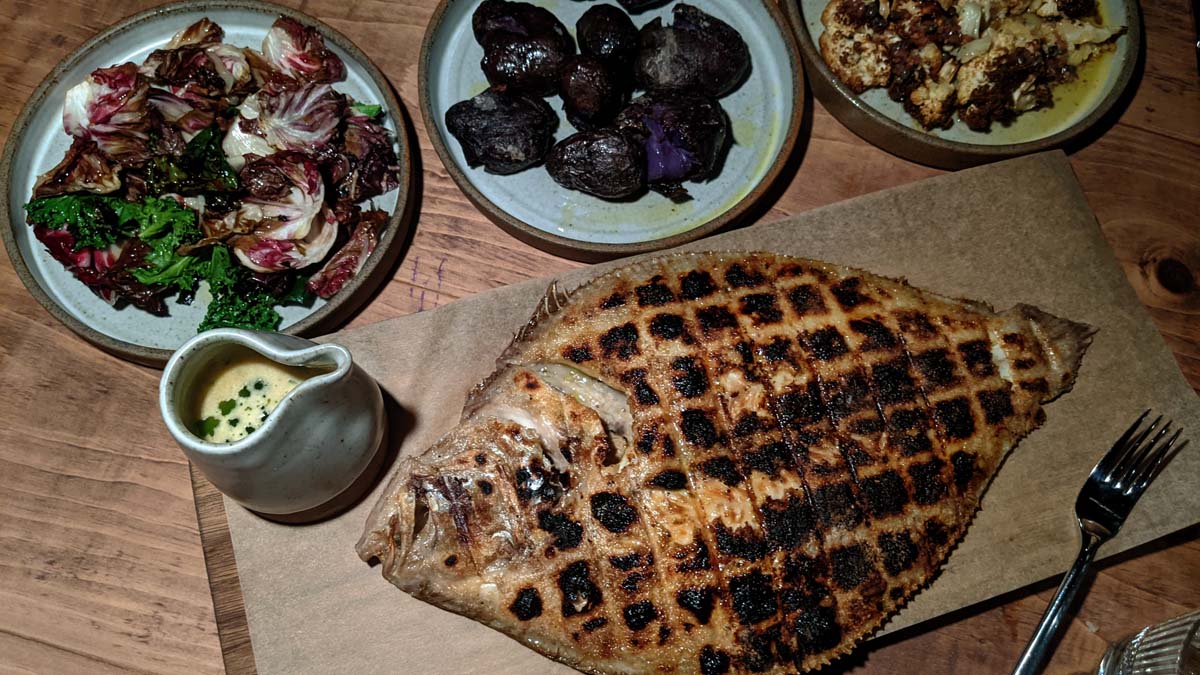
If your appetite doesn’t stretch to a full meal, there’s also a street food market, a microbrewery and a bagel shop. The kind of place you really need to know about
“Gan canny, and have a better time here in the Toon”
It’s lively, vibrant and the perfect place for a fun Saturday night out whether or not you are going on to a gig at The Sage
Ouseburn
Staying at Hotel du Vin in Ouseburn gave me the perfect opportunity to explore the food and drink scene in this emerging part of Newcastle.

After our tour of The Victoria Tunnel, we went on to try the beers and snacks at Brinkburn Street Brewery, a microbrewery with some great food designed to complement their own beers.

Then after our morning pints, we moved on to Kiln Cafe where we enjoyed a feast of mezze along with handmade sourdough flatbreads

At Cookhouse just around the corner, I was impressed by the range of pickles and fermented foods on show.
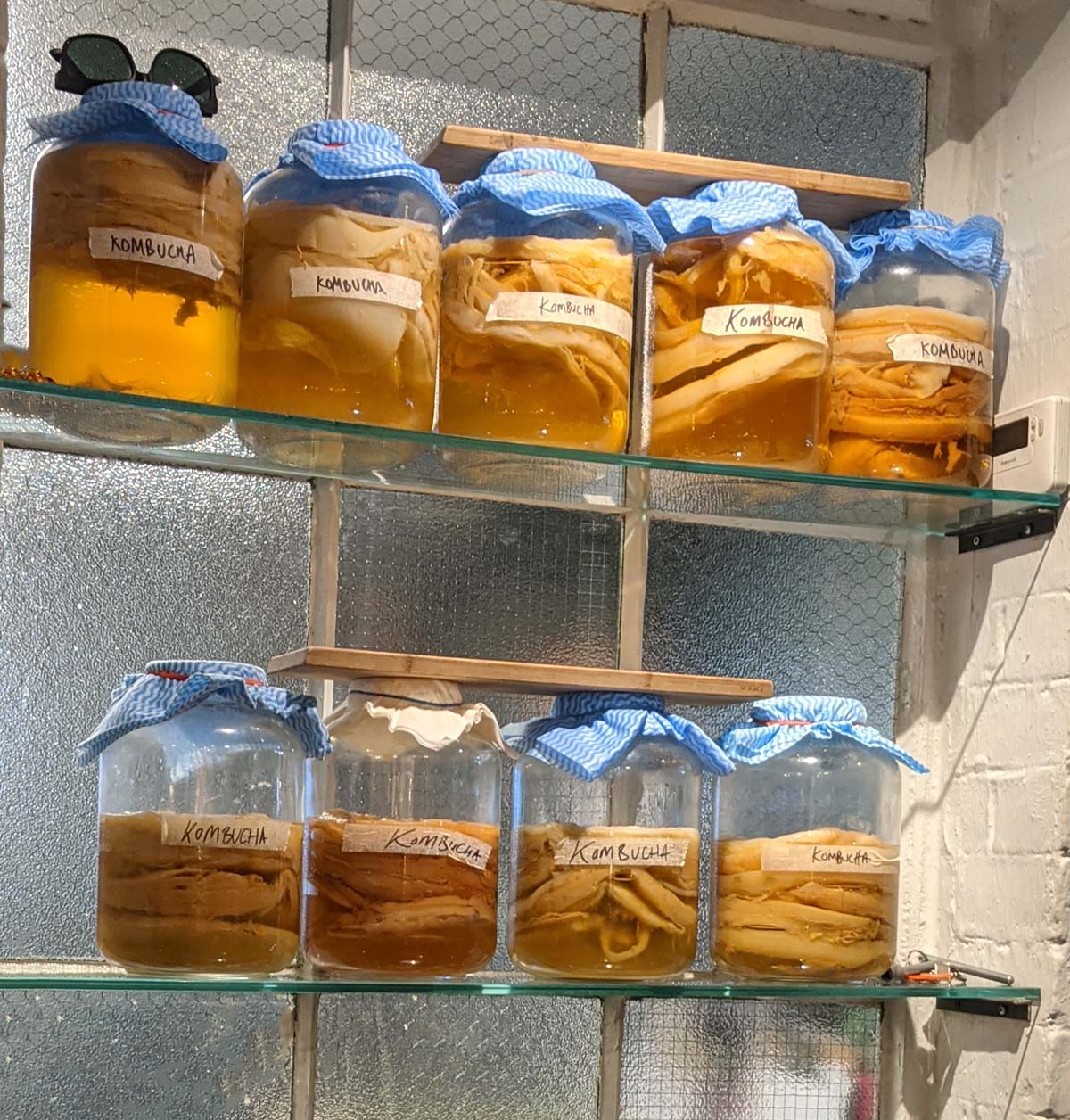
They had their own very delicious seasonal kombucha – the perfect thing to drink if you’ve been overindulging in food and wine! And, as one review does point out, it feels as if you are sitting in Anna Hedworth’s kitchen. Born of a true love of food, it’s the kind of place you’d really like to have on your own doorstep.
Finally, we stopped at Ernest for pudding – sticky toffee pudding, brownies and Eton mess were the order of the day. A lively, quirky independent coffee house and bar, I could have just sat here for the rest of the day…and enjoyed a few more brownies along the way.

It’s clear the food scene in this part of the city is perfect for grazing and more. Relaxed and informal, it’s a great place to wander around for an afternoon. It’s also an area full of independent pubs with a lively music scene and I loved the vibe at The Tyne, just one of the famous venues around here.

For more about Hotel du Vin Newcastle and about Ouseburn, do check my earlier feature.

We travelled by train with LNER from London’s Kings Cross to Newcastle. Our first-class carriage had comfy leather seats equipped with charging points for phones and laptops and we were offered complimentary food, drinks and WiFi. The journey takes about 3 hours
We were guests of the Newcastle Gateshead Initiative.
With many thanks to Triple-A Food Tours for their tours of the city and Ouseburn


I’ve never been to Newcastle, but it’s on my list!
What an AMAZING journey- would love to sample all too
Newcastle was a fabulous trip. I loved the industrial heritage and the cluster of hip eateries in Ouseburn, the historic city centre and the views along the Quayside walks were fascinating too. When it came to the food there was such a huge variety of excellent eateries. Newcastle’s definitely on the return to list!
It’s sensible coming by train because driving into Newcastle spoils all the pleasure possible. Great food, though and we love the theatres too.
We didn’t get a chance to do theatres or the Sage – but it’s now firmly on my list to go back for longer.
Well, this brought back many happy memories. Thoroughly loved our visit to Newcastle but I’ve not shifted the pounds I gained yet. Well worth it though! I’m longing to go back to revisit a few places and check out some more that we didn’t have time for this time.