

Last Updated on July 18, 2025
Take a trip into the country’s heartland.
Take a train from Stockholm’s central station and within an easy two and a half hours’ journey time, you’ll arrive in Sweden’s heartland, Dalarna (The Dales). Stretching from Avesta in the south to the Norwegian border, 350 kilometres north, this beautiful region offers the opportunity to discover the essence of Sweden and the source of much of the country’s global appeal.

Discover the Divine Dalarna, Sweden
Why Dalarna?
The area attracts Swedish tourists throughout the year, drawn by its stunning countryside, which offers endless opportunities to explore, relax, and experience a different way of life. It’s an area which can arguably be referred to as quintessentially Swedish. It is home to some of its most famous icons: the Dala Horse, the punishing Vasa ski-race, delightful midsummer celebrations, the ubiquitous red paint which is synonymous with much of Scandinavia, and artists Carl Larsson and Anders Zorn who with their well-connected circle, championed a national romanticism, fostering Sweden’s reputation for art, craft and design.


The countryside is vast. Don’t worry about over-tourism here. In winter, the area is open for a range of excellent sporting activities from skiing through to long-distance ice skating on Dalarna’s great lakes. It offers some of Sweden’s best cycling routes, accompanied by welcoming accommodation and miles of national parks to hike in. Here you have the right to walk, swim, sail or sleep wherever you may care (apart from someone’s garden or cultivated areas). Access for all is protected by law, and the countryside is yours to enjoy and explore!

Roaming in unknown territory can be daunting, and it’s also easy to miss local features, particularly here in a landscape formed from a meteorite’s impact 377 million years ago. Take time out to explore with local company, Green Owl Travel, experts in creating sustainably based “soft adventures” for the opportunity to get closer to nature and learn more about the area’s abundant flora, fauna, geological features and the traditions and superstitions of the people who once worked and lived in its forests.

Falu Red and Copper from Dalarna
Throughout Dalarna, you’ll see houses and outbuildings universally painted a rustic russet. The paint is known as Falu red, and it’s produced using iron ore from the Falun Copper Mine, which, along with the historic quarter of this very typical small Swedish city, has been a World Heritage Site since 2001.
Copper had been mined here since the Viking times, and at its peak in the 17th century, Falun’s copper supplied two-thirds of Europe’s requirements (it even features on the roof of Versailles). The working mine closed in 1992, and today you can experience some of the 30 kilometres of underground passages as part of an excellent guided tour. Spend time talking with guides and craftspeople in the living museum, explore the interactive Technology Museum, and enjoy a taste of Swedish home cooking at the popular museum restaurant. Sample a dish of the famous Falu Korv – a sausage brought to the region by the immigrant German miners.

Local museums provide the key to understanding a destination’s story, and Dalarna’s, housing some 3,000 items, provides an excellent introduction to the county. The copper mine clearly brought wealth to the area, but as an agricultural area, poverty was still rife. In the late 1700s, following a series of bad harvests, Sweden’s Enlightenment monarch, King Gustav III, removed the tax on paint to encourage local people to develop their arts and crafts for commercial gain and to avoid starvation.
Dalecarlian Painting and the Dala Horse
This led to the popularisation of the delightful Dalecarlian painting style, adorning beautiful wooden furniture and wall panels. You’ll find outstanding examples in the museum alongside splendid displays of traditional costumes from towns and villages across the county.

Possibly the most distinct of Swedish icons is the brightly painted Dala Horse. A three-metre-high red version was displayed at the 1939 World Fair in New York to attract visitors to the Swedish pavilion, and almost a century later, this somewhat primitive depiction of a farmer’s best friend retains its appeal. Dalarnas Museum features an eclectic display that illustrates the cultural pull of the Dala Horse. You’ll find cheap copies in the strangest of places, but for the real deal, head for the small town of Nusnäs.

Nils Olsson’s Workshop was established in 1928, and a guided tour brings you up close to the artist’s skillfully embellished wooden horses of varying sizes, featuring traditional painted patterns. Horses bought in the shop can be personalised, and you can even turn your hand to painting your own.
Swedes place a high value on handmade, functional, and decorative objects. At the nearby Nittsjö Keramik, you can witness the renaissance of a 200-year-old workshop where local artisans follow traditional methods to produce exquisite, contemporary pieces.

Swedish Design – Lilla Hyttnäss
To find the source of what we perceive today as “typically Swedish”, make a pilgrimage to Sundborn, a riverside village, and home to Lilla Hyttnäss, the beautiful family home of Carl and Karin Larsson. The couple settled here in 1888, but the house and their work continue to inform Swedish design.

The interior rooms, external gardens, and lakeside are instantly recognisable as the settings for Carl’s idyllic paintings of cherubic children playing in bucolic settings surrounded by flowers and greenery, as well as intimate family scenes.

Creating the home was a joint enterprise, but an artist herself, Karin’s design touch is seen everywhere: in the textiles and furniture, a nod to Sweden’s agricultural tradition, a hint of the era’s love affair with Japanism, but her work is totally distinct, personal and timeless; no Morris medievalism here here but bold, geometric patterns and vibrant colour. The house continues to inspire designers to this day. If you’re a fan of IKEA, keep an eye out for shapes and structures that may seem strangely familiar.

The Heritage of Dala Arts and Crafts
The Larssons were part of a large social circle of artists, intellectuals and reformists. In the late 1800s, artists came to Dalarna to paint a simpler, rustic way of life. They encouraged the Dala folk to practice their arts and crafts and wear their traditional clothing with pride.
One of the greatest proponents of the rural idyl was Anders Zorn, the most celebrated portraitist of his era. He made his fortune painting the rich and influential (including three American presidents), but perhaps it’s his depictions of Dalarna life, its celebrations and people, which have had the most impactful legacy. You’ll see fine examples of these at the impressive Zorn Museum at his home in Mora.

On their deaths Anders and Emma Zorn left their estate in Mora to the nation and a guided tour of their home provides a wonderful insight into the life of a rich artist at the beginning of the 1900s with innovation from America (a modern kitchen featuring Mora’s first refrigerator and telephone), style from England (including the arts and craft designers and Sheffield stainless steel), a bedroom fit for a prince and a good amount of Nordic heritage to boot.

Outdoor activities in Dalarna
Mora is an excellent centre for outdoor activities. Since 1922, the world’s largest skiing race by competitor numbers has seen cross-country skiers take on the challenge of the annual 90 km Vasaloppet from Sälen to Mora. This route, commemorating the return of Gustav Vasa in 1521 to oust the Danish “occupiers” and ultimately become Sweden’s first home-grown king, is known as the Vasaloppet Arena and offers well-developed hiking and cycling routes. Swedes really embrace summer, and in Dalarna, you have the chance to see why.

Midsummer Festivities in Dalarna
With sunlight until very late into the night and a more dependable dose of summer weather than in the UK, Swedes enjoy outdoor-based activities and a slower pace of living. Their summer season begins with Midsummer’s Eve, a national holiday held each year between June 19 and 25, and school is already out, so everyone is in a party mood. Flower crowns are created from the fields of wildflowers which hit their most perfect bloom at this time, a “maypole” is dressed (said to be another gift from the German miners of old), favourite food prepared (pickled herring, sweet new potatoes, sour cream and dill all washed down with a good chilled schnaps) and music and dancing ensue.

It’s the time of year when the town comes to the country, with pop-up pubs and restaurants aplenty. You’ll find a great example not far from Nusnäs, at Solgarskrogen, where chef and sommelier Jonathan and Genevieve Bjursenstedt create magic with a seasonal menu of their own and locally sourced, organic produce, cooked on an open fire or a Japanese hibachi grill, within the idyllic setting of their smallholding.
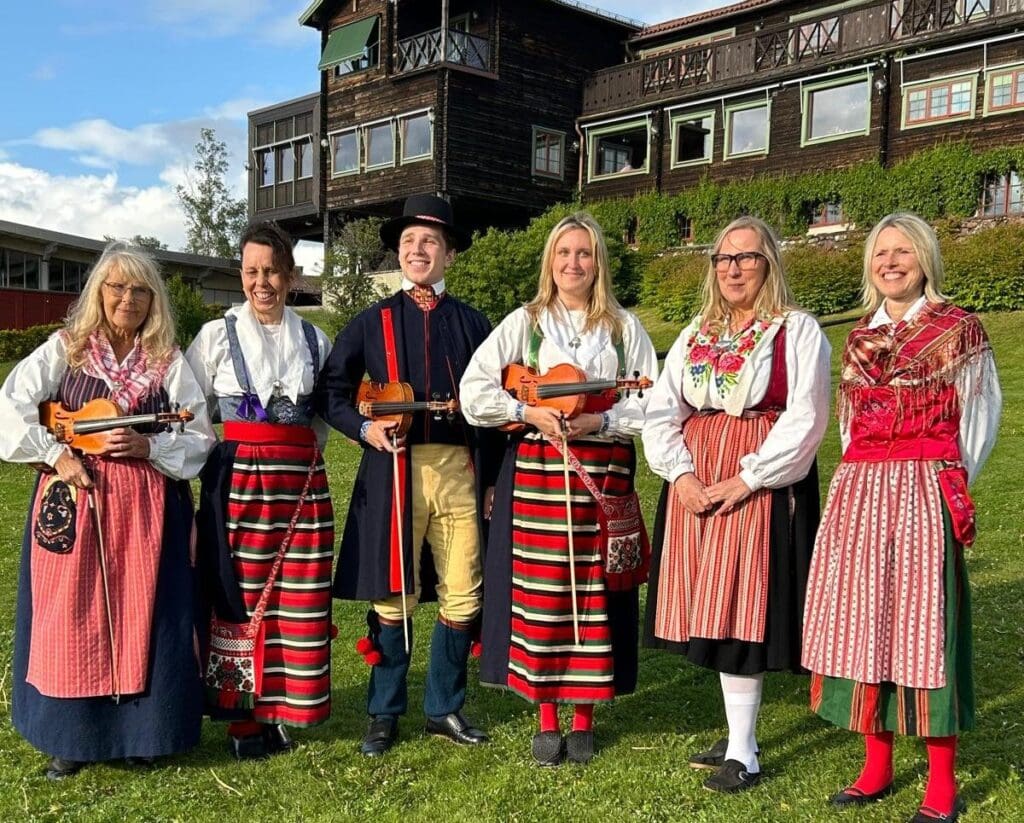
You’ll also find excellent hospitality at The Green Hotel, located in the village of Tällberg on the shores of magnificent Lake Siljan. With a railway line providing access into this picture-perfect village, you have a choice of several hotels, a lakeside camping site and country cottages. Offering breathtaking views and comfortable public areas filled with art and local crafts, The Green Hotel is a place to relax and immerse yourself in this delightful location.

While you’re here, try your hand at making Swedish-style cinnamon buns in the hotel’s traditional bake-house and then, just like the Swedes, twice a day, in the morning and in the afternoon, stop and sit for your compulsory “fika” or coffee break. Discover Dalarna, and you’ll discover a different way of life.

Helpful information about Dalarna, Sweden
You’ll find detailed descriptions of towns in the area, advice on places to stay and events throughout the year at www.visitdalarna.se
Visit Dalarna operate a call centre on +46 771-62 62 62, and you can email on info@visitdalarna.se
Carl Larsson’s House, Dalarna’s Museum, Falun’s Coppermine, The Zorn House and Gallery and Nils Olsson’s Workshop are amongst nine attractions forming Dalarna’s Cultural Route. Collect a stamp at all nine to receive a special edition of the Cultural Route’s Dala horse.
In Dalarna, check out:
The Quality Hotel Grand Falun – a comfortable, modern city centre hotel at Trotzgatan 9-11, Falun. Tel: +46 23-79 48 80 www.strawberryhotels.com
Banken Bar & Brasserie – a stylish restaurant popular with locals and tourists, offering excellent local ingredients and international flavours. It’s at Åsgatan 41, Falun. Tel: +46 23 71 19 11 www.bankenfalun.se
The Green Hotel, once a family home, has been welcoming visitors from around the world with warm hospitality since 1947. Ovabacksgattu 17, Tällberg. Tel: +46 247-500 00 www.greenhotel.se
Solgårdskrogen restaurant and pub are open only in the summer (June–August). For details, see www.solgardskrogen.se
Carl Larsson-gården, Carl Larssons väg 12, Sundborn. Tel: +46 23-600 53 www.carllarsson.se The house is open from May to September, 10:00-17:00, and access is by guided tour only. Book in advance via the website. The tour lasts 45 minutes. From October until April, there is one tour per day.
Dalarna Museum, Stigaregatan 2-4, Falun. www.dalarnasmuseum.se The museum is open Tuesday – Sunday, 1100 – 1700, and closed on some Swedish public holidays
Falun Coppermine (Falu Gruva), Gruvplatsen 1, Falun. Tel: +46 23-78 20 30 www.falugruva.se The site is open throughout the year, with opening hours adjusted to reflect the seasons and national holidays. Check the website for details.
Nils Olsson Dalahästar, Edåkersvägen 17, Nusnäs. Tel: +46 250-372 00. info@nilsolsson.se www.nilsolsson.se The workshop is open throughout the year, and opening times vary depending on the season. Check the website for details.
Nittsjö Ceramics, Nittsjö Keramikvägen 31, Rättvik. Tel: +46 248-17130 info@nittsjokeramik.se www.nittsjokeramik.se The shop is open daily. Due to seasonal operating hours, please check the website for updates.
Zorngården, Vasagatan 36, Mora. Tel +46 250-59 23 10. info@zorn.se www.zorn.se Open throughout the year, the house is accessible by guided tour only. Tickets for the house and museum can be purchased via the website.
Green Owl Travel organises guided excursions in the Lake Siljan area and multi-day package tours to discover more of Dalarna. www.greenowltravel.com info@greenowltravel.com. Tel: +46 736-16 11 10
For more information and inspiration on places to visit in Sweden, see April in Paris? No, for me it’s May in Stockholm and In Search of Sweden’s Vikings
Interior photographs of Carl and Karin Larsson’s house credited to Per Myrehed
Jenny was a guest of Visit Dalarna and Visit Sweden.


